
Binance vs Coinbase: Fees, Coins, Safety Comparison


Editorial Note: While we adhere to strict Editorial Integrity, this post may contain references to products from our partners. Here's an explanation for How We Make Money. None of the data and information on this webpage constitutes investment advice according to our Disclaimer.
Binance vs Coinbase in 2026: Binance is usually the better pick if you want lower fees, more coins/markets, and advanced tools; Coinbase is the safer-feeling choice if you prioritize a more regulated U.S.-friendly setup and a simpler interface.
When you want to get started with cryptocurrency trading, one of the first things you need to consider is which crypto exchange you'll use. When you do a simple internet search, you'll probably see that many sites and traders recommend Binance.
It's easy to see why when you consider that Binance is the leading cryptocurrency exchange in terms of trading volume. However, the American cryptocurrency exchange, Coinbase, is catching up with its competitors in many ways. As such it shares many of Binance’s features. So, which is better?
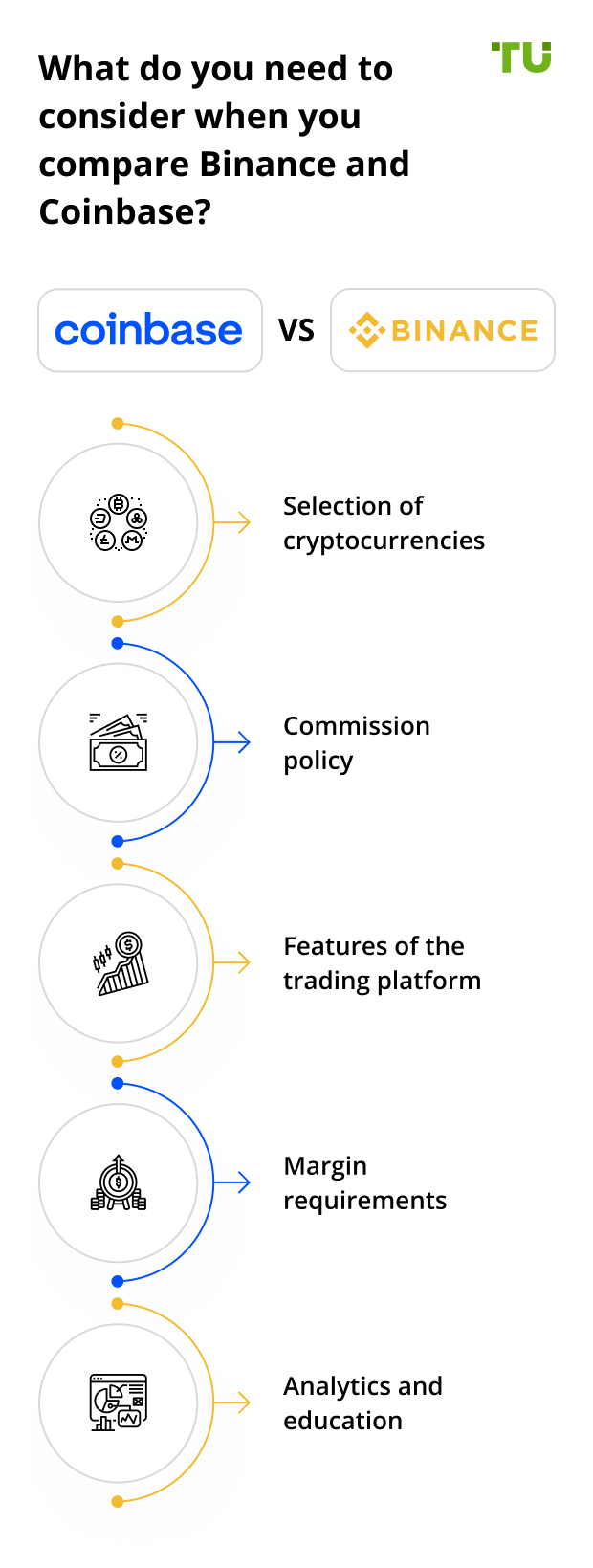
Fortunately, we're here to help. At Traders Union, our experts have compared these two crypto exchanges based on 11 key criteria. As a result, we've given each exchange an overall rating based on these parameters. This, in turn, helps traders to make the best choice for their specific needs.
With that in mind, let's take a look at how Binance and Coinbase compare.
Binance vs Coinbase: rating
To start off, let's look at their overall ratings based on the key criteria mentioned above. Based on this overall rating, you'll see that Binance is rated better by a small margin. However, it’s clear that they're quite evenly matched with Binance performing better in some instances, while Coinbase performs better in others.
| Feature | Binance | Coinbase |
|---|---|---|
Overall | 4.6 | 4.2 |
Regulation | 2.1 | 4.3 |
Fees | 4.7 | 3.5 |
Trading Assets | 5 | 4.4 |
Investment Instruments | 4.7 | 3.7 |
Platforms and Charting Tools | 4.9 | 3.6 |
Margin Rates | 4.8 | 3.5 |
Deposit and Withdrawal | 4.7 | 3.8 |
Research | 4.6 | 4.1 |
Education | 4.8 | 4.8 |
Support | 4.8 | 4.8 |
Promo | 4.2 | 4.8 |
Considering the above scores, let's now look at each of these crypto exchanges and key criteria in more detail.
Binance vs Coinbase: a brief introduction
Headquartered in Hong Kong, Binance is one of the largest cryptocurrency exchanges in the world. In fact, it holds the top spot when you consider indicators like daily turnover, the number of active users, liquidity, and web traffic. It also has its own native asset that you can trade in.
American exchange Coinbase is also popular, especially amongst novice traders. Like many other exchanges, it also allows you to trade in all the popular cryptocurrencies including Bitcoin, Ethereum, Litecoin, Ripple, Bitcoin Cash, and others. Although smaller than Binance, it still has over 43 million active traders in 100 countries.
As mentioned above, these crypto exchanges are quite similar, there are, however, some pros and cons that you'll need to consider with both.
| Binance | Coinbase | |
|---|---|---|
Overall Pros | Trading With Leverage up to 1:20 | 2 FA Authentication |
Low Trading and Non-Trading Fees | Low Minimum Deposit | |
3 Account Fiat Currencies + 50 Crypto | Passive Income With Staking | |
Derivatives, NFT, ETF Available | By studying courses you can get cryptocurrency | |
Debit/Credit Card Withdrawal Fee – 0% | ||
Indicators Available | ||
Passive Income With Staking and Mining Pool | ||
Strong Research | ||
Overall Cons | No Regulation | Max Leverage – 1:1 |
No Demo Account | 1 Account Fiat Currency + 6 Crypto | |
High Trading and Non-Trading Fees | ||
Indicators Not Available | ||
Derivatives, NFT, ETF Not Available |
Binance vs Coinbase: regulation
| Regulated By: | Binance | Coinbase |
|---|---|---|
SEC | No | No |
FINRA | No | No |
SIPC Protection | No | No |
Other Regulators | No |
As you can see from the table above, Binance is not regulated by any regulators. In contrast, Coinbase is licensed and regulated in 45 states in the US. Why is regulation important? It's simple, when you invest your hard-earned money into a platform you want to know that it's safe.
Being regulated means that there are certain safeguards in place to ensure that your money is protected. Keep in mind, though, that both of these are large crypto exchanges, and the likelihood of your money disappearing is very small. Yet, regulation gives you that extra peace of mind.
Binance vs Coinbase: trading conditions
| Trading Conditions | Binance | Coinbase |
|---|---|---|
Minimum Deposit | $1 | $25 |
Trading Platforms | Binance | Coinbase |
Leverage | 1:20 | 1:1 |
Number of Markets | 1,358 | 248 |
Number of Trading Accounts | 1 | 1 |
Base Account Currencies | USD, EUR, GBP + 50 Crypto | USD + 6 Crypto |
Binance has far more markets you can trade in, offers more base account currencies, and makes trading with higher leverage possible. Simply put, this gives you more options. Although, depending on your goals, needs, and requirements, this isn't necessarily a deal-breaker, it is something you should consider. This is more so over the long-term as you get more experience and want to trade with more assets.
Binance vs Coinbase: trading assets
| Asset Name | Binance | Coinbase |
|---|---|---|
Bitcoin (BTC) | Yes | Yes |
| Yes | Yes | |
| Yes | Yes | |
| Yes | Yes | |
| Yes | Yes | |
| Yes | Yes | |
| Yes | Yes | |
| Yes | Yes | |
| Yes | Yes | |
| Yes | Yes | |
| Yes | Yes | |
Derivatives | Yes | No |
Futures | Yes | No |
NFT | Yes | No |
ETF | Yes | No |
As mentioned above, having more options is beneficial when you want to trade with more instruments, especially when you get more experience. Coinbase, although it allows you to trade in all the major cryptocurrencies, doesn't offer you the opportunity to trade with derivatives, futures, NFTs, or ETFs.
Binance vs Coinbase: fees
A crucial part of choosing the right exchange is considering the fees you’ll pay. Typically, these fees include trading fees and non-trading fees and can have a substantial impact on the profit you're able to make.
With that in mind, let's look at how Binance and Coinbase compare.
Trading Fees
| Fee | Binance | Coinbase |
|---|---|---|
Max Maker | 0.1% | 0.5% |
Max Taker | 0.1% | 0.5% |
Min Maker | 0.012% | 0.04% |
Min Taker | 0.024% | 0% |
Debit/Credit Card Purchase Fee | 1% | 3.99% |
Trading cryptocurrencies is not free and you'll have to pay a fee for every trade you make. Depending on the specific trade and the circumstances, you'll either have to pay a maker or a taker fee. Generally, Binance is cheaper in respect of both maker and taker fees. Also, it's a lot cheaper than Coinbase when you buy cryptocurrencies with your debit or credit card.
Non-Trading Fees
| Binance | Coinbase | |
|---|---|---|
Account Fee | 0% | 0% |
Deposit Fee | 0% | 0% |
Bank Transfer Withdrawal Fee | 1.5 USD | 1.49% |
Debit/Credit Card Withdrawal Fee | 0% | 3.99% |
Inactivity Fee | 0% | 0% |
Non-trading fees are typically the fees you pay to have an account with an exchange and any fees for deposits and withdrawals. Here, Binance is also cheaper and charges no account, inactivity, deposit, or debit or credit card withdrawal fees.
In contrast, although Coinbase doesn't charge account, deposit, or inactivity fees, it does charge a debit or credit card withdrawal fee of 3.99% on the amount withdrawn. It also charges a bank transfer withdrawal fee of 1.49% which is higher than that of Binance.
Binance vs Coinbase: margin rates
| Feature | Binance | Coinbase |
|---|---|---|
Max for BTC (changing) | 0.05% | 2% |
Min for BTC | 0.04% | 2% |
Number of Levelsr | 10 | 1 |
Margin trading is when you buy cryptocurrencies or other instruments with borrowed money. Now, just like any other loan, you’ll have to pay interest on the amount you borrow. Here, you'll see that Binance is also a lot cheaper than Coinbase.
Binance vs Coinbase: passive income tools
| Investment Tools Name | Binance | Coinbase |
|---|---|---|
Staking | Yes | Yes |
Mining Pool | Yes | No |
Managed Accounts | No | No |
MAM/PAMM | No | No |
Other | No | No |
When trading cryptocurrencies you don't necessarily want to sit in front of your computer screen the entire day to spot opportunities, make trades, and earn a profit. That's why you need to look at whether the exchange you're considering offers passive income tools.
With these tools, you're able to invest money and earn a profit on it just like you would earn interest on a typical investment or bank account. When it comes to passive income tools, both Binance and Coinbase offer staking. This simply means that your cryptocurrency is used to secure and verify all transactions on the blockchain through a consensus mechanism called “Proof of Stake.” In turn, you receive a reward for this.
Binance does, however, offer a mining pool as an additional passive income tool while Coinbase doesn't.
Best trading platform: Binance or Coinbase
Another thing you should consider when choosing the right crypto exchange is the trading platform that it offers. You’ll specifically need to look at its security features, the platforms you can use it on, and the tools it includes. Keep in mind, though, that, depending on your needs goals, skills, and experience, you might not need all the tools that a platform offers.
To start off, here you can see that, although both platforms offer web trading and mobile apps, only Binance offers a desktop platform.
| Binance | Coinbase | |
|---|---|---|
Web | Yes | Yes |
Desktop | Yes | No |
Mobile (Android, iOS) | Yes | Yes |
Trading platform features
| Binance | Coinbase | |
|---|---|---|
SMS Based 2 FA | Yes | Yes |
App Based 2 FA | Yes | Yes |
Voice Call 2 FA | No | Yes |
Search Bar | Yes | Yes |
Filters | Yes | Yes |
When it comes to security and other features, you can see that both platforms are evenly matched with only Coinbase offering an additional security feature in the form of voice call two-factor authentication.
Technical analysis/charting tools
| Binance | Coinbase | |
|---|---|---|
Indicators | 19 | 0 |
Drawing Tools | 0 | 0 |
Historical Trades | Yes | Yes |
Live 2 Quotes | Yes | Yes |
Technical analysis plays a vital role in cryptocurrency trading and when you use it, you’ll be able to predict price movements, spot trends easier and find trading opportunities quicker. Here, Binance makes it easier by offering a variety of indicators that you can use.
Mobile trading
| Features | Binance | Coinbase |
|---|---|---|
iOS Version | Yes | Yes |
Android Version | Yes | Yes |
Apple Watch App | No | No |
Touch ID | No | No |
Face ID | No | No |
To make trading on the go easier, both platforms offer iOS and Android versions of their app which means you can trade wherever you are.
Types of orders
| Binance | Coinbase | |
|---|---|---|
Market | Yes | Yes |
Limit | Yes | Yes |
Stop Loss | Yes | Yes |
Stop Limit | Yes | No |
Trailing Stop | Yes | No |
In respect of the different types of orders, both platforms are evenly matched, with Binance offering both stop limit orders and trailing stop orders in addition to the market, limit, and stop loss orders that Coinbase offers. Although not strictly necessary to trade, these orders can help you manage your risk and increase your chances of making a profit.
For example, let's say you buy a specific cryptocurrency when it trades at $20, and you place a stop loss at $15. This means you won't lose more than $5 if it happens to go down in price. But it also means that it could increase at some stage during the day and then fall back to $15 which then limits the profit you could have made.
With a trailing stop, your stop loss will follow the price increase. So, if you're trailing stop is set at $5 and the price goes up to $30 before falling back, your stop loss will now be at $25 which means you'll still make a $5 profit.
Binance vs Coinbase: deposit and withdrawal
| Deposit and Withdrawal Method | Binance | Coinbase |
|---|---|---|
Bank Transfer | Yes | Yes |
Credit/Debit Card | Yes | Yes |
Electronic Wallets | Yes | Yes |
Crypto | Yes | Yes |
As you can see, when it comes to deposits and withdrawals both platforms offer you a variety of ways to deposit and withdraw your funds.
Binance vs Coinbase: research
| Research Type | Binance | Coinbase |
|---|---|---|
News Feed | Yes | Yes |
Fundamental Data | Yes | Yes |
Chart Analysis | Yes | No |
Trading Ideas | No | No |
E-Mail Reports | Yes | No |
Research is a crucial part of cryptocurrency trading. To be successful and spot opportunities when trading, you'll need to keep up to date with daily cryptocurrency news and the fundamental data relating to the specific cryptocurrency you want to trade.
Here, both platforms provide you with a news feed and fundamental data. However, Binance also gives you email reports and chart analysis to make things a bit easier.
Binance vs Coinbase: education
| Education Type | Binance | Coinbase |
|---|---|---|
Demo-account/Paper Trading | No | No |
Courses | Yes | Yes |
Articles | Yes | Yes |
Videos | Yes | Yes |
Webinars | Yes | No |
Books | No | No |
When you start trading there are a lot of things that you need to learn and master. So, it's crucial that you take a look at the educational tools that an exchange provides. Here, both Binance and Coinbase offer courses, articles, and videos. In addition, Binance also offers regular webinars that help you on your trading journey.
Binance US vs Coinbase: support
| Support Features | Binance | Coinbase |
|---|---|---|
Working Days | 24/7 | 24/7 |
| Yes | Yes | |
Phone | Yes | Yes |
Online chat | Yes | Yes |
Other | Telegram | No |
When it comes to support, both platforms are evenly matched, with Binance offering an additional support channel through Telegram. Despite this, both platforms offer comprehensive 24/7 support through phone, email, and chat.
Binance vs Coinbase: promo
| Promo | Binance | Coinbase |
|---|---|---|
Special Offers | No | Up to $35 for learning how specific cryptocurrencies work |
Referral Program | 40% of the partner's trading commissions | $10 when your friend completes a buy or sell of $100 |
Both Binance and Coinbase offer referral programs with varying rewards. However, when it comes to promotions, Coinbase offers a unique feature. It gives you the opportunity to learn about specific, qualifying cryptocurrencies and you’ll get paid in the specific cryptocurrency for learning about it.
Use a safer, more straightforward platform for holding and funding

The best exchange is the one that fits how you actually trade, not how you plan to trade. If you’re still building discipline or trade infrequently, a simpler, more regulated environment helps you avoid emotional and operational mistakes. If you trade actively, costs, execution speed, and risk-management tools matter far more over time than brand reputation.
My main advice is to think in terms of function: use a safer, more straightforward platform for holding and funding, and a more flexible one only when you truly need advanced tools. No matter which exchange you choose, treat it as a tool – not a bank – and prioritize reliability and control over maximum features.
Conclusion
Choosing between Binance and Coinbase ultimately depends on your priorities as a trader. If you value lower fees, more trading options, and advanced features, Binance stands out with its vast market access and cost-effective structure. On the other hand, Coinbase is the stronger choice for those who prefer robust regulation and a user-friendly environment, especially in the US. Remember, the best platform is the one that matches your trading habits and keeps your assets secure while empowering you to control your own success.
FAQs
How do the trading platforms and tools of Binance and Coinbase compare for advanced traders?
What are the major differences in supported assets and trading markets between Binance and Coinbase?
How do non-trading fees, such as withdrawal and inactivity fees, compare between Binance and Coinbase?
In what ways do Binance and Coinbase differ in research and analysis resources for traders?
Editors' Top Picks and Insights





Related Articles
Team that worked on the article
Johnathan M. is a U.S.-based writer and investor, a contributor to the Traders Union website.
Olga Shendetskaya has been a part of the Traders Union team as an author, editor and proofreader since 2017. Since 2020, Shendetskaya has been the assistant chief editor of the website of Traders Union, an international association of traders.
Mirjan Hipolito is a journalist and news editor at Traders Union. She is an expert crypto writer with five years of experience in the financial markets.
Cryptocurrency is a type of digital or virtual currency that relies on cryptography for security. Unlike traditional currencies issued by governments (fiat currencies), cryptocurrencies operate on decentralized networks, typically based on blockchain technology.
Bitcoin is a decentralized digital cryptocurrency that was created in 2009 by an anonymous individual or group using the pseudonym Satoshi Nakamoto. It operates on a technology called blockchain, which is a distributed ledger that records all transactions across a network of computers.
CFD is a contract between an investor/trader and seller that demonstrates that the trader will need to pay the price difference between the current value of the asset and its value at the time of contract to the seller.
Forex leverage is a tool enabling traders to control larger positions with a relatively small amount of capital, amplifying potential profits and losses based on the chosen leverage ratio.
Ethereum is a decentralized blockchain platform and cryptocurrency that was proposed by Vitalik Buterin in late 2013 and development began in early 2014. It was designed as a versatile platform for creating decentralized applications (DApps) and smart contracts.

-
 Afghanistan
-
 Albania
-
 Algeria
-
 Angola
-
 Argentina
-
 Armenia
-
 Australia
-
 Austria
-
 Azerbaijan
-
 Bahamas
-
 Bahrain
-
 Bangladesh
-
 Belarus
-
 Belgium
-
 Bolivia
-
 Botswana
-
 Brazil
-
 Brunei
-
 Bulgaria
-
 Cambodia
-
 Cameroon
-
 Canada
-
 Chile
Chile
-
 China
China
-
 Colombia
-
 Congo
Congo
-
 Costa Rica
-
 Cote d'Ivoire
-
 Croatia
-
 Cuba
Cuba
-
 Cyprus
-
 Czechia
-
 DR Congo
-
 Denmark
-
 Dominican Republic
-
 Ecuador
-
 Egypt
Egypt
-
 El Salvador
-
 Estonia
-
 Eswatini
-
 Ethiopia
-
 Finland
-
 France
-
 Georgia
-
 Germany
-
 Ghana
Ghana
-
 Greece
-
 Haiti
Haiti
-
 Hong Kong
-
 Hungary
-
 India
India
-
 Indonesia
-
 Iran, Islamic republic
-
 Iraq
Iraq
-
 Ireland
-
 Israel
-
 Italy
Italy
-
 Jamaica
-
 Japan
Japan
-
 Jordan
-
 Kazakhstan
-
 Kenya
Kenya
-
 Korea
Korea
-
 Kuwait
-
 Kyrgyzstan
-
 Laos
Laos
-
 Latvia
-
 Lebanon
-
 Lesotho
-
 Libya
Libya
-
 Lithuania
-
 Luxembourg
-
 Madagascar
-
 Malaysia
-
 Malta
Malta
-
 Mauritius
-
 Mexico
-
 Moldova
-
 Mongolia
-
 Montenegro
-
 Morocco
-
 Mozambique
-
 Myanmar
-
 Namibia
-
 Nepal
Nepal
-
 Netherlands
-
 New Zealand
-
 Nigeria
-
 North Macedonia
-
 Norway
-
 Oman
Oman
-
 Pakistan
-
 Palestine
-
 Panama
-
 Papua New Guinea
-
 Paraguay
-
 Peru
Peru
-
 Philippines
-
 Poland
-
 Portugal
-
 Puerto Rico
-
 Qatar
Qatar
-
 Reunion
-
 Romania
-
 Rwanda
-
 Saudi Arabia
-
 Serbia
-
 Singapore
-
 Slovakia
-
 Slovenia
-
 Somalia
-
 South Africa
-
 Spain
Spain
-
 Sri Lanka
-
 Sweden
-
 Switzerland
-
 Syria
Syria
-
 Taiwan
-
 Tajikistan
-
 Tanzania
-
 Thailand
-
 Trinidad and Tobago
-
 Tunisia
-
 Turkey
-
 UAE
UAE
-
 Uganda
-
 Ukraine
-
 United Kingdom
-
United States
-
 Uruguay
-
 Uzbekistan
-
 Venezuela
-
 Vietnam
-
 Yemen
Yemen
-
 Zambia
-
 Zimbabwe
- Forex
- Crypto












