
Crypto Ambassador Programs | All You Need To Know


Editorial Note: While we adhere to strict Editorial Integrity, this post may contain references to products from our partners. Here's an explanation for How We Make Money. None of the data and information on this webpage constitutes investment advice according to our Disclaimer.
A crypto ambassador program is a structured initiative where blockchain projects recruit active community members to promote their brand, grow their user base, and create content in exchange for rewards such as tokens, commissions, or exclusive perks. Crypto ambassadors can be content creators, community managers, or everyday users. Roles range from social media engagement to regional leadership. Earnings vary widely based on the program type and your level of contribution.
Crypto ambassador programs have become one of the most accessible entry points into the Web3 industry. What started as informal community volunteering has grown into a structured, competitive space where a crypto ambassador can take on defined responsibilities, report against performance targets, and earn solid rewards through a well-run crypto ambassador program.
Today, this model is used across the full spectrum of blockchain projects. A Layer 1 blockchain might recruit a cryptocurrency brand ambassador to build a regional community from scratch. A major exchange might run a crypto exchange ambassador initiative offering up to 50% commission on referred trading fees. A DeFi protocol might look for a crypto brand ambassador to produce educational content and guide new users through its ecosystem.
The variety is wide, but the core idea is the same across every ambassador role in the crypto space: the project gets authentic, community-driven growth, and the participant gets recognition, rewards, and real Web3 experience. Whether you want to become a crypto ambassador as a side activity or develop it into a serious income stream, understanding how these programs actually work is the right place to start. This article breaks it all down clearly.
Risk warning: Cryptocurrency markets are highly volatile, with sharp price swings and regulatory uncertainties. Research indicates that 75-90% of traders face losses. Only invest discretionary funds and consult an experienced financial advisor.
What is a crypto ambassador program?
A crypto ambassador program is a formal initiative launched by a blockchain project to recruit community members who will represent, promote, and grow the project in exchange for defined rewards. Unlike a one-off promotion, it comes with clear responsibilities, reporting requirements, and performance criteria.
Crypto ambassadors are essentially the public face of a project within their communities. Depending on the program, a participant might focus on creating educational content, driving referrals, managing a local community, or supporting new users getting started with the platform.
Most crypto ambassador programs follow a straightforward model:
applying through an official form or invitation;
completing assigned tasks such as content creation, community support, or event participation;
reporting results through a points system, activity logs, or regular updates;
receiving rewards in the form of tokens, stablecoins, NFTs, fee discounts, or exclusive platform access.
The more measurable and consistent your contributions, the higher your standing within the program and the better your access to top-tier rewards. What began as informal volunteer work has evolved into a competitive, structured role that now sits at the intersection of marketing, community management, and Web3 development.

Types of crypto ambassador programs
Not all crypto ambassador programs are built the same way. The structure depends on the project's goals, stage of development, and the kind of contributors it needs. Here is a clear breakdown of the four main formats you will encounter:
| Type | Who it suits | Typical tasks | Reward format |
|---|---|---|---|
| Open or mass programs | Beginners, casual participants | Social media engagement, reposting, basic community support | Points, tokens, NFTs, merchandise |
| Professional or curated programs | Experienced creators, analysts, marketers | High-quality content, KPI-driven reporting, event organization | Enhanced token rewards, stablecoins, allocations |
| Regional programs | Local community builders, multilingual contributors | Local community management, translations, offline events, regional outreach | Tokens, stipends, local brand support |
| Technical or educational programs | Developers, educators, product testers | Testnet participation, documentation, workshops, developer onboarding | Grants, early product access, long-term contracts |
Open programs are the easiest to join but also the most competitive, with individual contributions rarely standing out. Professional and technical ambassador programs offer significantly better rewards but expect measurable, consistent output. Regional programs are a strong option for anyone who wants to become a crypto ambassador in a lower-competition niche while building genuine local authority as a cryptocurrency brand ambassador.
Who can become a crypto ambassador?
One of the most common misconceptions is that you need a large social media following to qualify. Most crypto ambassador programs are far more interested in genuine engagement and consistent effort than follower counts. Here are the types of people who typically do well:
content creators who can write articles, make videos, or produce guides that help new users understand the project;
community managers and moderators comfortable running Discord or Telegram groups and supporting active discussions;
translators and localization specialists who can help a project reach non-English-speaking audiences;
developers and technical contributors able to test products, write documentation, or run educational workshops;
active traders and analysts who can explain tokenomics, market structure, or platform features to a broader audience;
beginners with genuine enthusiasm who are willing to learn, contribute consistently, and grow within the program over time.
The qualities that matter most across all formats are crypto knowledge, reliability, communication skills, and a willingness to put in documented, measurable effort. A large audience helps in some programs, but it is never the only path to becoming a successful crypto ambassador.
Examples of well-known crypto ambassador programs
Looking at real programs makes it easier to understand what a crypto ambassador role actually involves day to day. Here are three well-established examples across different program types:
Injective Ambassador Program (community and content focus)
The Injective Ambassador Program (Ninja Masters) runs on a tiered ranking system where completed tasks earn points and points drive progression through the ranks. Monthly INJ token rewards kick in once you reach the Knight tier, and the top contributors share a reward pool each month. Anyone can join through the official Injective Discord server, making this one of the more accessible crypto ambassador programs for beginners.

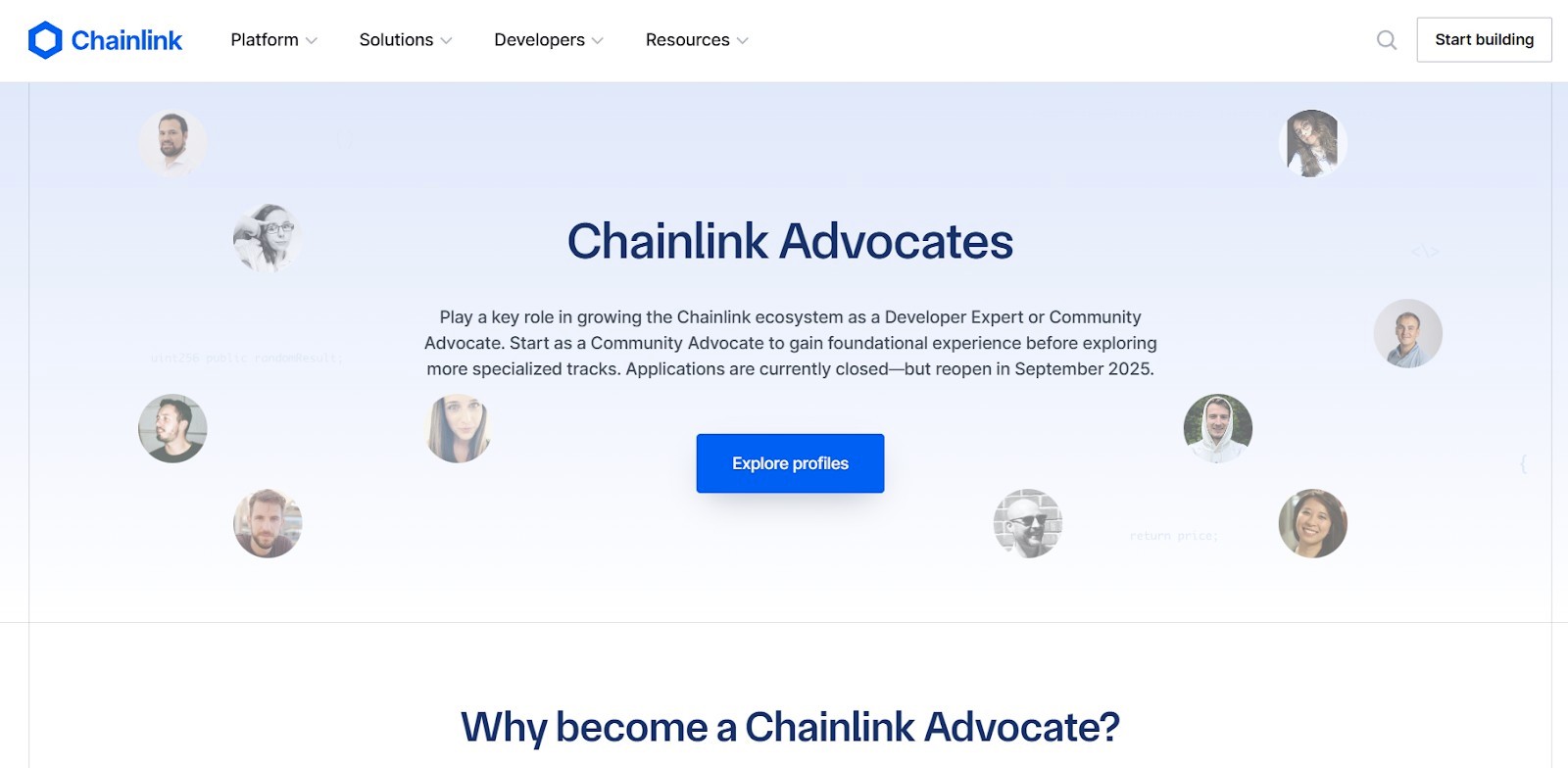
Chainlink Advocates (technical and educational focus)
Chainlink runs two tracks within its Advocates program: Community Advocates focused on ecosystem education, and Developer Experts focused on technical onboarding. The program operates on a wave-based application cycle, meaning intake opens periodically rather than on a rolling basis. Participants receive badges, grant support, and access to a global contributor network. This is a strong fit for anyone looking to grow as a crypto brand ambassador with a technical or educational edge.
Bybit Ambassador Program (exchange focus)
The Bybit ambassador initiative is a well-known crypto exchange ambassador program with a straightforward earning structure. Affiliates earn commission on referral trades, with top performers accessing additional sub-affiliate income. The program suits traders, analysts, and content creators and provides direct access to industry events and exclusive marketing support.
| Program | Type | Open to beginners | Key reward |
|---|---|---|---|
| Injective Ambassador Program | Community and content | Yes | Monthly INJ from Knight tier |
| Chainlink Advocates | Technical and educational | Selective | Badges, grants, travel support |
| Bybit Ambassadors | Exchange referral | Yes, audience helps | Commission on referrals |
How to become a crypto ambassador
The process of joining a crypto ambassador program is more structured than most people expect. Projects are not just looking for enthusiastic supporters. They want contributors who can deliver consistent, measurable results. Here is how the typical selection process works:
research programs that align with your skills and genuine interests, using sources like official project websites, Discord announcement channels, and aggregators like CoinLaunch which tracks active crypto ambassador programs across the industry;
prepare your application like you would a professional portfolio, outlining your skills, relevant experience, and what you can specifically contribute to the project;
submit through the official channel, whether that is an online form, an application portal, or a direct email;
complete a screening phase, which may include a review of your social profiles, content samples, or activity history within the project's community;
go through a trial or probation period where you complete test tasks and demonstrate reliability before receiving full crypto ambassador status;
get confirmed and assigned a defined role with clear responsibilities and reward terms.
Not every application leads to acceptance, and that is normal. Many crypto ambassador programs run limited intake cycles with specific skill requirements per wave. Applying to several programs at once, building a visible track record within communities, and improving the quality of your contributions over time all increase your chances significantly. Rejection from one program does not close the door on others.
How much can you earn from a crypto ambassador program?
Earnings from crypto ambassador programs vary widely and are never guaranteed. The range runs from zero for inactive participants to thousands of dollars per month for top performers in elite programs. The key variables are your role, the reward structure, and how consistently you deliver measurable results.
| Program type | Reward format | Realistic earning range |
|---|---|---|
| Open or mass programs | Points, tokens, NFTs | Minimal, often under $100/month |
| Professional community programs | Native tokens, stablecoins | $200 to $1,000/month for active contributors |
| Exchange referral programs | Commission on trading fees | Highly variable, scales with referral volume |
| Governance or elected roles | Stablecoins | Up to $10,000/month for top elected positions |
To give this more context, here are three concrete examples from verified programs currently active in 2026:
Polkadot Head Ambassadors. Elected through an on-chain governance process, these roles pay a fixed 10,000 USDT per month, making it one of the highest-paying structured ambassador roles in the space.
Alchemy Pay regional ambassadors. Participants receive a base of 200 USDT per month plus performance bonuses tied to merchant integrations and partnership conversions.
OKX and Bybit exchange programs. Both offer tiered commission structures where top crypto exchange ambassador performers earn up to 50% of trading fees generated by their referrals.
A few important factors affect the real value of your rewards regardless of the program:
whether rewards are paid in stablecoins or native tokens, since token-based rewards are subject to market volatility and may be worth far less by the time vesting conditions are met;
how clearly KPIs are defined, as programs with vague performance criteria often leave contributions undervalued or uncompensated;
the vesting and unlock schedule, which can delay access to earned rewards by weeks or months.
The most reliable income comes from programs that pay in stablecoins or commissions tied to real user activity. Token-based crypto ambassador program rewards can offer significant upside in a strong market but carry proportional risk when conditions shift.
Safety tips and risks to watch for
Crypto ambassador programs attract scammers just as much as they attract genuine projects. Fake recruitment posts, lookalike domains, and fraudulent programs that require upfront payments are all common in the space. Before joining any program, run through this checklist:
No entry fees or forced token purchases. Any program that asks you to deposit funds or buy tokens to participate is almost certainly a scam.
Verify all links carefully. Scammers frequently use domains that look nearly identical to official project websites. Always navigate to the program page directly from the project's verified social accounts.
Check for clear and realistic KPIs. Legitimate crypto ambassador programs define what is expected and what you will earn. Vague promises of "guaranteed income" or outsized rewards are a red flag.
Never share your private keys. No legitimate program will ever ask for wallet credentials or request that you sign transactions you do not fully understand.
Research the project independently. Look for a verifiable team, a published whitepaper, and an active community before committing time or effort.
Beyond scams, there are genuine risks even in legitimate programs worth understanding before you start:
Token-based rewards can lose value. Many programs pay in native tokens subject to vesting schedules. The token price at the time of unlocking may be significantly lower than when you earned the reward.
Program terms can change unilaterally. Projects can reduce rewards, change KPIs, or shut down a program entirely without notice or compensation.
Reputational risk is real. Associating your name with a project that later turns out to be a scam or fails publicly can damage your credibility within the broader Web3 community.
Time investment may not match returns. Open programs in particular can require significant effort for rewards that end up being minimal.
Going in with realistic expectations and a clear understanding of both the opportunity and the risks is what separates a productive ambassador experience from a frustrating one.
Alternatives: Crypto exchange affiliate programs
If the time commitment, token volatility, or uncertainty around crypto ambassador programs does not suit you, exchange affiliate programs offer a more straightforward earning model. You refer users, they trade, and you earn a percentage of their fees. Payouts are typically in stablecoins or major cryptocurrencies and are not tied to any vesting schedule.
| OKX | Coinbase | Crypto.com | Cryptohopper | |
|---|---|---|---|---|
|
Affiliate program |
Yes | Yes | Yes | Yes |
|
Spot Taker fee, % |
0.1 | 0.5 | 0.5 | 0 |
|
Spot Maker Fee, % |
0.08 | 0.5 | 0.25 | 0 |
|
Staking |
Yes | Yes | Yes | Yes |
|
Copy trading |
Yes | No | No | Yes |
|
Investor protection fund |
Yes | Yes | Yes | No |
|
Open an account |
Go to broker Your capital is at risk. |
Go to broker Your capital is at risk. |
Go to broker Your capital is at risk. |
Go to broker Your capital is at risk. |
Affiliate programs are not a replacement for the community-building and Web3 exposure that a well-run crypto ambassador program provides. But for anyone who wants predictable, performance-based income without the reporting requirements and program uncertainty, they are a practical and lower-risk alternative worth considering.
One focused program beats three scattered ones

I have seen many people approach crypto ambassador programs the wrong way. They join three or four programs at once, spread themselves thin, and end up with a track record that does not stand out anywhere. My advice is to pick one program that genuinely matches your skills and commit to it properly. Treat it the way you would treat a part-time job. Document everything, meet your KPIs consistently, and build a visible presence within that specific community. That discipline is what gets you noticed, moved up the tiers, and eventually into the roles that pay meaningfully.
The other thing most people overlook is the reward structure. Before accepting a crypto ambassador role, I always look at three things: whether rewards are in stablecoins or native tokens, what the vesting schedule looks like, and whether the KPIs are defined clearly enough that your contributions will actually be recognized. A program with vague terms and token-only payouts can cost you months of real effort for very little in return. Clarity upfront saves a lot of frustration later.
Conclusion
Crypto ambassador programs provide one of the most accessible entry points into the dynamic world of Web3, rewarding dedicated community members with tangible incentives like tokens, commissions, and recognition. Whether through content creation in the Injective Ambassador Program or technical contributions in the Chainlink Advocates initiative, the key to success lies in consistent, measurable effort and choosing the right program that fits your skills and interests. While the opportunities can be significant, ambassadors must be vigilant about program legitimacy and the real value of token-based rewards. Ultimately, focusing your efforts on a single well-chosen program and treating it with professionalism is what transforms ambassador roles from a casual side gig into a meaningful path within the crypto industry.
FAQs
How are contributions measured and rewarded in crypto ambassador programs?
What types of tasks can a crypto ambassador expect to handle?
What are the main risks involved in joining a crypto ambassador program?
How do regional ambassador programs differ from open or professional programs?
Editors' Top Picks and Insights






Related Articles
Team that worked on the article
Aleksandra Chaikina has been a contributor to Traders Union since 2021. With over 15 years of experience in copywriting and more than 5 years focused on financial content, she specializes in producing detailed guides, analytics, and comparative reviews across various sectors, including cryptocurrencies, Forex, investment strategies, and financial technologies.
Dan Blystone began his trading career in 1998 as an arbitrage clerk on the floor of the Chicago Mercantile Exchange (CME). He later traded bond and Eurex futures at proprietary firms such as Altea Trading, gaining valuable experience in high-frequency trading and risk management.
Chinmay Soni is a financial analyst with more than 5 years of experience in working with stocks, Forex, derivatives, and other assets. As a founder of a boutique research firm and an active researcher, he covers various industries and fields, providing insights backed by statistical data.
Index in trading is the measure of the performance of a group of stocks, which can include the assets and securities in it.
Bitcoin is a decentralized digital cryptocurrency that was created in 2009 by an anonymous individual or group using the pseudonym Satoshi Nakamoto. It operates on a technology called blockchain, which is a distributed ledger that records all transactions across a network of computers.
An investor is an individual, who invests money in an asset with the expectation that its value would appreciate in the future. The asset can be anything, including a bond, debenture, mutual fund, equity, gold, silver, exchange-traded funds (ETFs), and real-estate property.
Cryptocurrency is a type of digital or virtual currency that relies on cryptography for security. Unlike traditional currencies issued by governments (fiat currencies), cryptocurrencies operate on decentralized networks, typically based on blockchain technology.
CFD is a contract between an investor/trader and seller that demonstrates that the trader will need to pay the price difference between the current value of the asset and its value at the time of contract to the seller.

-
 Afghanistan
-
 Albania
-
 Algeria
-
 Angola
-
 Argentina
-
 Armenia
-
 Australia
-
 Austria
-
 Azerbaijan
-
 Bahamas
-
 Bahrain
-
 Bangladesh
-
 Belarus
-
 Belgium
-
 Bolivia
-
 Botswana
-
 Brazil
-
 Brunei
-
 Bulgaria
-
 Cambodia
-
 Cameroon
-
 Canada
-
 Chile
Chile
-
 China
China
-
 Colombia
-
 Congo
Congo
-
 Costa Rica
-
 Cote d'Ivoire
-
 Croatia
-
 Cuba
Cuba
-
 Cyprus
-
 Czechia
-
 DR Congo
-
 Denmark
-
 Dominican Republic
-
 Ecuador
-
 Egypt
Egypt
-
 El Salvador
-
 Estonia
-
 Eswatini
-
 Ethiopia
-
 Finland
-
 France
-
 Georgia
-
 Germany
-
 Ghana
Ghana
-
 Greece
-
 Haiti
Haiti
-
 Hong Kong
-
 Hungary
-
 India
India
-
 Indonesia
-
 Iran, Islamic republic
-
 Iraq
Iraq
-
 Ireland
-
 Israel
-
 Italy
Italy
-
 Jamaica
-
 Japan
Japan
-
 Jordan
-
 Kazakhstan
-
 Kenya
Kenya
-
 Korea
Korea
-
 Kuwait
-
 Kyrgyzstan
-
 Laos
Laos
-
 Latvia
-
 Lebanon
-
 Lesotho
-
 Libya
Libya
-
 Lithuania
-
 Luxembourg
-
 Madagascar
-
 Malaysia
-
 Malta
Malta
-
 Mauritius
-
 Mexico
-
 Moldova
-
 Mongolia
-
 Montenegro
-
 Morocco
-
 Mozambique
-
 Myanmar
-
 Namibia
-
 Nepal
Nepal
-
 Netherlands
-
 New Zealand
-
 Nigeria
-
 North Macedonia
-
 Norway
-
 Oman
Oman
-
 Pakistan
-
 Palestine
-
 Panama
-
 Papua New Guinea
-
 Paraguay
-
 Peru
Peru
-
 Philippines
-
 Poland
-
 Portugal
-
 Puerto Rico
-
 Qatar
Qatar
-
 Reunion
-
 Romania
-
 Rwanda
-
 Saudi Arabia
-
 Serbia
-
 Singapore
-
 Slovakia
-
 Slovenia
-
 Somalia
-
 South Africa
-
 Spain
Spain
-
 Sri Lanka
-
 Sweden
-
 Switzerland
-
 Syria
Syria
-
 Taiwan
-
 Tajikistan
-
 Tanzania
-
 Thailand
-
 Trinidad and Tobago
-
 Tunisia
-
 Turkey
-
 UAE
UAE
-
 Uganda
-
 Ukraine
-
 United Kingdom
-
United States
-
 Uruguay
-
 Uzbekistan
-
 Venezuela
-
 Vietnam
-
 Yemen
Yemen
-
 Zambia
-
 Zimbabwe
- Forex
- Crypto










- What is a crypto ambassador program?
- Types of crypto ambassador programs
- Who can become a crypto ambassador?
- Examples of well-known crypto ambassador programs
- How to become a crypto ambassador
- How much can you earn from a crypto ambassador program?
- Safety tips and risks to watch for
- Alternatives: Crypto exchange affiliate programs
- Expert opinion
- Conclusion
- FAQs


