
DeFi Wallet Scams: New Threats, Data-Driven Defense


Editorial Note: While we adhere to strict Editorial Integrity, this post may contain references to products from our partners. Here's an explanation for How We Make Money. None of the data and information on this webpage constitutes investment advice according to our Disclaimer.
Scammers target DeFi wallets with phishing links, fake dApps, approval-drain contracts, address poisoning, and even romance tricks. Protect yourself by using official apps and URLs only, simulating transactions, and rejecting unlimited token approvals. Revoke old permissions regularly (Etherscan/Revoke.cash), whitelist trusted addresses, and send a small test before large transfers. Turn on wallet alerts, keep seed phrases offline, and never act on DMs offering “airdrops,” “mining,” or “support.” If you slip, revoke access immediately.
The rise of decentralized finance (DeFi) has brought accessibility and power to individual traders, but also paved the way for highly targeted frauds. The tactics now used in DeFi wallet scams are not only technical, but also psychological, social, and financial. Users at every level, from newcomers to DeFi veterans, are exposed to tailored attacks that evolve faster than standard protections can keep up.
As capital moves freely across chains and through wallets, scammers are increasingly focused on behavioral manipulation, exploiting every moment of human error. The scale of crypto DeFi wallet scams is no longer anecdotal, it's systemic.
Risk warning: Cryptocurrency markets are highly volatile, with sharp price swings and regulatory uncertainties. Research indicates that 75-90% of traders face losses. Only invest discretionary funds and consult an experienced financial advisor.
The scale of the problem
In 2026, global crypto-related scams reached an all-time high. According to data by Chainalysis and Certik, over $12.3 billion was lost to scams and fraud, up from $9.1 billion in 2024. DeFi-specific exploits made up more than 60% of total losses. This reflects both the growing adoption of non-custodial wallets and the increasing sophistication of scam strategies.
As per Reuters, AI-generated scam scripts, voice cloning, and impersonation now dominate fraud reports filed across Europe and Southeast Asia.
Anatomy of a scam
Most frauds targeting DeFi wallets follow a structured lifecycle. In 2026, over 64% of scams involving DeFi users followed this specific pattern: lure, manipulate, drain, disappear. Here’s how each phase works with real methods and estimated damage.
Lure & Trust building
Scammers begin by earning the user’s trust, usually by impersonating official brands, wallet support teams, or investment projects. In one notable campaign, users were targeted for DeFi wallet scams on Facebook, where scammers ran cloned versions of official pages, promoting “airdrops” or urgent wallet recovery notices.
Similarly, DeFi wallet scams on Telegram groups became a top distribution channel for phishing links. Victims were often invited to fake admin groups or DM'd by bots posing as technical support.
In more socially engineered setups, such as DeFi wallet romance scams, attackers posed as potential romantic partners who introduced “joint crypto investments” after weeks of casual conversation. These scams resulted in losses averaging $36,000 per case, based on Chainalysis incident reports.
Access manipulation
Once contact is established, the attacker directs the victim to perform wallet actions that grant control:
Clicking phishing links leading to fake dApps or wallet dashboards.
Approving malicious smart contracts that request unlimited token permissions.
Signing transactions that appear standard but embed harmful contract logic.
In one instance posted on Reddit about DeFi Wallet Scams, a victim unknowingly approved a contract that drained all tokens after a delayed trigger, disguised within a “gasless swap” function.
Address poisoning also surged in 2026, with attackers inserting lookalike addresses into transaction history, causing users to copy-paste the wrong recipient. These subtle manipulations led to over $320 million in wallet-level theft.
Drain & Launder
Once access is granted, funds are either instantly drained or moved slowly to avoid triggering wallet alerts.
In several reports, victims interacted with forged swap routes via DEX aggregators. These routes included hidden contract steps that rerouted output tokens to attacker-controlled wallets, all while appearing legitimate.
Aftermath
Once funds are gone, recovery becomes nearly impossible. Most victims realize the theft hours or even days later. In 2026, the average delay between compromise and detection was 16.8 hours, by which point tokens were already swapped, bridged, and laundered.
While some victims report their crypto losses in DeFi wallet scam threads across forums and community platforms, recovery success remains extremely low. Most wallets and protocols disclaim liability for user-side exploits, and law enforcement response is fragmented and often ineffective.
Only 2.3% of DeFi scam victims recovered part of their funds in 2026, according to Reuters.
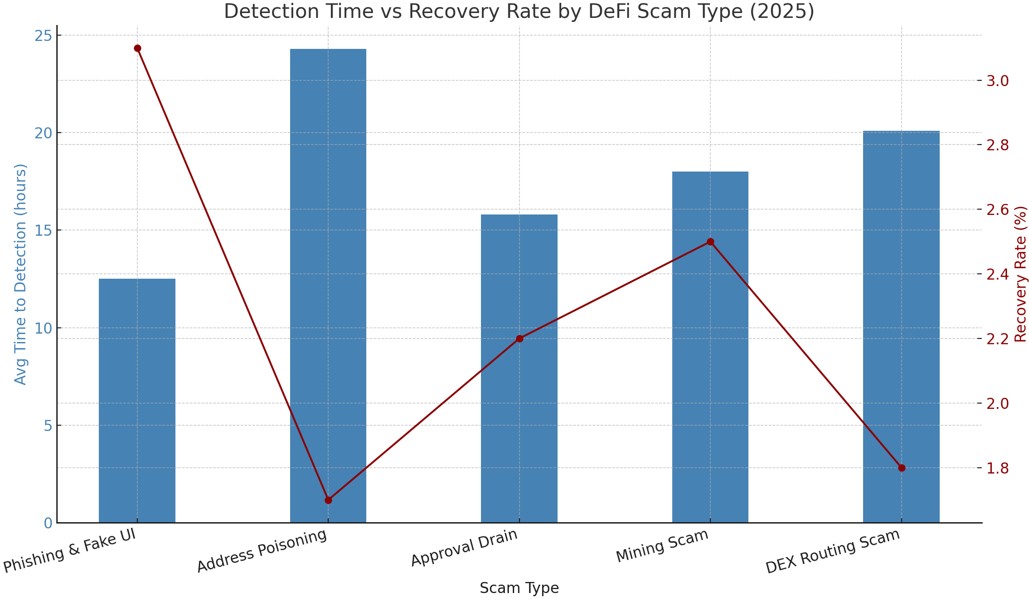
Key insights
Phishing & Fake UI scams are detected relatively quickly (~12.5 hours), but recovery remains low (3.1%).
Address poisoning is the slowest to detect (~24.3 hours) and also the hardest to recover from (1.7%).
Approval drain and DEX routing scams fall in the middle but still show poor recovery odds.
Targeting behavior, not just technology
While some attacks focus on contract vulnerabilities or front-end exploits, a significant number of DeFi wallet scams in 2026 relied entirely on user psychology and behavioral manipulation.
Romance-based fraud has exploded in DeFi. As per Chainabuse, cases of DeFi wallet romance scams increased by 77% year-over-year, with average losses reaching $54,600 per victim. One widely reported U.S. case involved a user who sent $68,000 over three months to a scammer posing as a crypto trader seeking “joint investments.” This aligns with the broader “pig butchering” scam model, where emotional trust is weaponized to extract crypto.
Community forums also play a growing role in scam response. According to ScamSniffer, over 8,300 posts tagged as DeFi wallet scams on Reddit were documented in 2026 across subreddits like r/CryptoCurrency and r/ethdev. These posts led to the identification of more than 120 phishing domains and dozens of fake staking platforms, often reported directly by victims.
As per Reuters, human-driven scams have outpaced technical exploits in volume, highlighting that while contracts can be audited, users remain the most vulnerable entry point.
Misuse of known brands
Scammers are also leveraging brand trust. In multiple reports, fraudsters used cloned interfaces of 1inch to launch fake token sales or connect wallets to malicious contracts. Victims reported losses via what is now frequently labeled as a 1-inch crypto DeFi wallet scam.
In a separate campaign, fraudsters targeted users through a Trust Wallet DeFi mining scam, promoting fake “staking rewards” via social media ads. Users who connected their wallets unknowingly approved contracts that allowed token extraction over several weeks.
Defensive best practices
Revoke token allowances regularly using trusted explorers like Etherscan or apps like Revoke.cash.
Enable address whitelisting and warning systems on wallets that support such features.
Avoid interactions initiated through unverified links, no matter how professional the interface appears.
Use wallet monitoring tools that provide push alerts for new approvals, swaps, or unusual token movements.
Slow-burn attacks: a hidden threat
According to a study on arXiv, over $103 million was stolen via slow-drain liquidity pool contracts in 2026 alone. These contracts were designed to extract value gradually, often going unnoticed for weeks.
This strategy differs from traditional flash exploits, making it much harder to detect and avoid without proper contract inspection or behavioral monitoring tools.
How scams work in 2026
Below is a data-backed comparison of the most frequent and damaging DeFi scam types in 2026. All statistics are drawn from verified industry research.
| Scam Type | How It Works | 2026 Losses (USD M) | Avg. Detection Time (hrs) | Recovery Rate (%) | Detailed Impact Summary |
|---|---|---|---|---|---|
| Smart Contract Exploits | Exploits contract flaws like reentrancy or logic bugs. | 1,900 | 14.2 | 1.5 | Large-scale protocol drains are often tied to unaudited contracts; complex logic allows attackers to move millions within minutes. |
| Phishing & Fake UI | User interacts with cloned sites or fake wallet interfaces. | 850 | 12.5 | 3.1 | Widely used scams exploiting front-end mimicry; targets include both desktop and mobile users through fake support or giveaways. |
| Approval Drain Scams | Victim approves malicious contract permissions. | 710 | 15.8 | 2.2 | High-volume scam type in 2026; attackers use polished interfaces to gain unlimited token permissions. |
| Address Poisoning | Fake address inserted into history; user accidentally sends funds to attacker. | 320 | 24.3 | 1.7 | One of the stealthiest scams; losses often go undetected for days. |
| Liquidity Mining Frauds | Fake staking dashboards simulate earnings; approval grants access to funds. | 460 | 18.0 | 2.5 | Fake mining dashboards simulate yield; tokens are drained after approval. |
| Romance-Based Scams | Scammer builds online relationship, then solicits crypto for “joint investment.” | 650 | 20.7 | 2.0 | Emotional long-cons through dating apps or social chats. |
This table shows that smart contract exploits remain the most damaging category, but user-driven phishing and approval abuse are also critical vulnerabilities.
Community impact and response
The role of Reddit, Twitter, and Discord cannot be overstated. Real-time scam tracking has helped identify and flag dangerous contracts early. It has also happened that a thread led to the deactivation of a major phishing site within 24 hours due to mass reporting by users.
However, community response is no substitute for infrastructure-level defenses. Wallets and dApps must implement contract simulation, transaction simulation, and contract risk scoring features natively.
Exchange exposure to DeFi scams
When evaluating the safety of trading environments, it is important to consider not only market features like liquidity and fees, but also how exchanges and brokers handle scam-related risks. A good factor to judge the same is the regulation of the exchange. Below we have highlighted the top exchanges that are adequately regulated. You can compare them and choose the best one for yourself.
| Crypto | Foundation year | Min. Deposit, $ | Coins Supported | Spot Taker fee, % | Spot Maker Fee, % | Alerts | Copy trading | Tier-1 regulation | TU overall score | Open an account | |
|---|---|---|---|---|---|---|---|---|---|---|---|
| Yes | 2012 | 10 | 400+ | 0.5 | 0.5 | Yes | No | Yes | 8.5 | Go to broker Your capital is at risk. |
|
| Yes | 2011 | 10 | 399 | 0.3 | 0.2 | No | Yes | Yes | 8.08 | Go to broker Your capital is at risk.
|
|
| Yes | 2016 | 1 | 400+ | 0.5 | 0.25 | Yes | No | Yes | 7.76 | Go to broker Your capital is at risk. |
|
| Yes | 2011 | 10 | 400+ | 0.4 | 0.25 | Yes | Yes | Yes | 7.68 | Go to broker Your capital is at risk. |
|
| Yes | 2018 | No | 100 | 0.07 | 0.04 | Yes | No | Yes | 6.57 | Go to broker Your capital is at risk.
|
Protect capital first

While DeFi continues to expand as a cornerstone of the crypto economy, traders must balance opportunity with risk. The rise of DeFi wallet scams shows that even seasoned users can be targeted through phishing, fake approvals, or social manipulation. High-yield promises in mining dashboards or forged DEX routes may look profitable in the short term, but they are often traps designed to drain tokens over time. If you encounter offers tied to “exclusive staking” or suspicious dashboards like those linked to Trust Wallet DeFi mining scam cases, treat them as red flags and walk away.
For long-term trading strategies, keep exposure in secure wallets, regularly revoke approvals, and avoid interacting with contracts that lack transparency or independent audits. While short-term gains may tempt you, survival in DeFi comes from discipline, not speculation. The market rewards those who protect capital first. Smart traders are now double-checking approvals, monitoring wallet history for address poisoning, and learning from reports. These practices don’t just reduce risk, but also keep you in the game long enough to capture real opportunities in protocols with proven utility.
Conclusion
In summary, the DeFi landscape of 2026 has seen increasingly sophisticated wallet scams, emphasizing the urgent need for heightened vigilance among users. Whether through deceptive phishing campaigns or elaborate fake dApp interfaces, attackers exploit every vulnerability, as shown by the widespread approval drain fraud that resulted in millions lost across multiple wallets. The central takeaway is that personal security cannot be delegated; users must rigorously verify every interaction and tool before granting permissions. As DeFi continues to evolve, the most resilient investors will be those who match innovation with informed caution, remembering always that in this ecosystem, trust is verified—not given.
FAQs
What are the most common entry points for DeFi wallet scams in 2026?
How can users minimize loss after falling victim to a DeFi wallet scam?
What distinguishes approval-drain scams from other DeFi wallet attack methods?
Which defensive wallet settings and habits most effectively reduce DeFi scam risks?
Editors' Top Picks and Insights






Related Articles
Team that worked on the article
Andrey Mastykin is an experienced author, editor, and content strategist who has been with Traders Union since 2020. As an editor, he is meticulous about fact-checking and ensuring the accuracy of all information published on the Traders Union platform.
Dan Blystone began his trading career in 1998 as an arbitrage clerk on the floor of the Chicago Mercantile Exchange (CME). He later traded bond and Eurex futures at proprietary firms such as Altea Trading, gaining valuable experience in high-frequency trading and risk management.
Chinmay Soni is a financial analyst with more than 5 years of experience in working with stocks, Forex, derivatives, and other assets. As a founder of a boutique research firm and an active researcher, he covers various industries and fields, providing insights backed by statistical data.
CFD is a contract between an investor/trader and seller that demonstrates that the trader will need to pay the price difference between the current value of the asset and its value at the time of contract to the seller.
Index in trading is the measure of the performance of a group of stocks, which can include the assets and securities in it.
Copy trading is an investing tactic where traders replicate the trading strategies of more experienced traders, automatically mirroring their trades in their own accounts to potentially achieve similar results.
Yield refers to the earnings or income derived from an investment. It mirrors the returns generated by owning assets such as stocks, bonds, or other financial instruments.
Xetra is a German Stock Exchange trading system that the Frankfurt Stock Exchange operates. Deutsche Börse is the parent company of the Frankfurt Stock Exchange.

-
 Afghanistan
-
 Albania
-
 Algeria
-
 Angola
-
 Argentina
-
 Armenia
-
 Australia
-
 Austria
-
 Azerbaijan
-
 Bahamas
-
 Bahrain
-
 Bangladesh
-
 Belarus
-
 Belgium
-
 Bolivia
-
 Botswana
-
 Brazil
-
 Brunei
-
 Bulgaria
-
 Cambodia
-
 Cameroon
-
 Canada
-
 Chile
Chile
-
 China
China
-
 Colombia
-
 Congo
Congo
-
 Costa Rica
-
 Cote d'Ivoire
-
 Croatia
-
 Cuba
Cuba
-
 Cyprus
-
 Czechia
-
 DR Congo
-
 Denmark
-
 Dominican Republic
-
 Ecuador
-
 Egypt
Egypt
-
 El Salvador
-
 Estonia
-
 Eswatini
-
 Ethiopia
-
 Finland
-
 France
-
 Georgia
-
 Germany
-
 Ghana
Ghana
-
 Greece
-
 Haiti
Haiti
-
 Hong Kong
-
 Hungary
-
 India
India
-
 Indonesia
-
 Iran, Islamic republic
-
 Iraq
Iraq
-
 Ireland
-
 Israel
-
 Italy
Italy
-
 Jamaica
-
 Japan
Japan
-
 Jordan
-
 Kazakhstan
-
 Kenya
Kenya
-
 Korea
Korea
-
 Kuwait
-
 Kyrgyzstan
-
 Laos
Laos
-
 Latvia
-
 Lebanon
-
 Lesotho
-
 Libya
Libya
-
 Lithuania
-
 Luxembourg
-
 Madagascar
-
 Malaysia
-
 Malta
Malta
-
 Mauritius
-
 Mexico
-
 Moldova
-
 Mongolia
-
 Montenegro
-
 Morocco
-
 Mozambique
-
 Myanmar
-
 Namibia
-
 Nepal
Nepal
-
 Netherlands
-
 New Zealand
-
 Nigeria
-
 North Macedonia
-
 Norway
-
 Oman
Oman
-
 Pakistan
-
 Palestine
-
 Panama
-
 Papua New Guinea
-
 Paraguay
-
 Peru
Peru
-
 Philippines
-
 Poland
-
 Portugal
-
 Puerto Rico
-
 Qatar
Qatar
-
 Reunion
-
 Romania
-
 Rwanda
-
 Saudi Arabia
-
 Serbia
-
 Singapore
-
 Slovakia
-
 Slovenia
-
 Somalia
-
 South Africa
-
 Spain
Spain
-
 Sri Lanka
-
 Sweden
-
 Switzerland
-
 Syria
Syria
-
 Taiwan
-
 Tajikistan
-
 Tanzania
-
 Thailand
-
 Trinidad and Tobago
-
 Tunisia
-
 Turkey
-
 UAE
UAE
-
 Uganda
-
 Ukraine
-
 United Kingdom
-
United States
-
 Uruguay
-
 Uzbekistan
-
 Venezuela
-
 Vietnam
-
 Yemen
Yemen
-
 Zambia
-
 Zimbabwe
- Forex
- Crypto












