
Best Defensive ETFs To Buy Before The Market Turbulence



Editorial Note: While we adhere to strict Editorial Integrity, this post may contain references to products from our partners. Here's an explanation for How We Make Money. None of the data and information on this webpage constitutes investment advice according to our Disclaimer.
According to experts, the top 9 defensive ETFs for bear markets are:
In this article, the experts will delve into the world of defensive ETFs, covering everything from what they are and how to choose the best ones to building a strong investment portfolio. They will also explore the top 9 defensive ETFs, and learn about the criteria that investors should consider before buying defensive stocks. Finally, they will discuss on how to construct a solid defensive investment portfolio and also consider sectors that thrive during market turbulence.
What are defensive ETFs?
Defensive Exchange-traded funds (ETFs) are financial instruments intended to reduce risk and offer stability in unpredictable or bear driven market environment. They do this by making investments in assets that generally do well during volatility and decline in the overall market. During a stock market crisis or recession, defensive equities often perform consistently and sometimes even better in recession or a market crash.
This is because they work in industries like food and drink, utilities, and healthcare services, where there is a steady demand for goods. These items are considered to have "inelasticity of demand," which indicates that a change in price won't have a substantial effect on demand because they typically don't see a big shift in demand throughout the year.
As a result, defensive stocks are sometimes viewed as a kind of "safe haven asset" that investors may purchase and keep to reduce portfolio risk. This means that, in times of crisis when other sectors are underperforming, defensive stocks remain strong and may help to balance out the risk on your open positions in economically delicate areas.
Defensive ETFs come in various types each with its unique strategy. It primarily refers to sectors such as Consumer Staples, Healthcare, Utilities, Telecommunication Services, Gold and Precious Metals, Low-Volatility, Dividend, and High-Quality Bond ETFs. These sectors are considered more stable and stronger, offering protection during market dips.
Top defensive ETFs and funds to consider
| Name | Stock Ticker | Net Assets | NAV | Yield | Beta (5Y Monthly) | Expense Ratio (net) |
|---|---|---|---|---|---|---|
| Vanguard Total Stock Market Index Fund (VTI) | VTI | $1.27T | $216.06 | 1.62% | 1.02 | 0.03% |
| iShares Edge MSCI Min Vol USA ETF (USMV) | USMV | $26.8B | $73.81 | 1.86% | 0.76 | 0.15% |
| FidelityMSCI Utilities Index ETF (FUTY) | FUTY | $1.33B | $39.30 | 3.54% | 0.68 | 0.08% |
| SPDR S&P Kensho Future Security ETF (FITE) | FITE | $31.58M | $47.59 | 0.14% | 0.92 | 0.45% |
| ARK Space Exploration & Innovation ETF (ARKX) | ARKX | $238.6M | $13.44 | NA | NA | 0.70% |
| Invesco Russell 1000 Equal Weight ETF (EQAL) | EQAL | $598.85M | $39.27 | 2.04% | 1.04 | 0.20% |
| iShares 1-3 Year Treasury Bond ETF (SHY) | SHY | $27.04B | $81.09 | 2.72% | 0.24 | 0.15% |
| SPDR S&P 500 Aerospace & Defense ETF (XAR) | XAR | $1.6B | $120.46 | 0.43% | 1.16 | 0.35% |
| ColumnValUtilities Select Sector SPDR ETF (XLU)ue1 | XLU | $13.29B | $61.25 | 3.55% | 0.65 | 0.10% |
Vanguard Total Stock Market Index Fund (VTI)
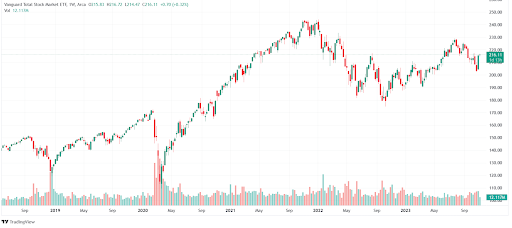 Vanguard Total Stock Market Index Fund (VTI)
Investing in the Vanguard Total Stock Market Index Fund (VTI) can be a strategic move, particularly in the context of the growing Artificial Intelligence (AI) sector. VTI offers diversification surrounding a wide range of industries, including tech giants like Apple, Microsoft, and Adobe which play vital roles in AI development. This diversification can help enhance future growth looking at future trend and prospects
Furthermore, VTI has a low expense ratio of 0.03%, ensuring that a significant portion of your investment is put to work, rather than being consumed by fees. The fund has a history of delivering consistent returns, with a scorching 143.5% total return on capital over the past several years.
The AI market is projected to surge to a substantial $2.7 trillion by 2032, as per Grand View Research. VTI provides an opportunity to participate in the AI revolution while maintaining a balanced and diversified portfolio. Its low costs and historical performance make it an appealing choice for investors seeking long-term growth potential in the evolving technology landscape. Here is the list of top 10 holdings of this ETF.
| Name | Symbol | % Assets |
|---|---|---|
| AppleInc | AAPL | 6.07% |
| Microsoft Corp | MSFT | 5.60% |
| Amazon.com Inc | AMZN | 2.82% |
| NVIDIA Corp | NVDA | 2.44% |
| AlphabetInc Class A | GOOGL | 1.85% |
| TeslaInc | TSLA | 1.61% |
| Meta Platforms Inc Class A | META | 1.59% |
| AlphabetInc Class C | GOOG | 1.55% |
| Berkshire HathawayInc Class B | BRK-B | 1.49% |
| Exxon Mobil Corp | XOM | 1.12% |
iShares Edge MSCI Min Vol USAETF (USMV)
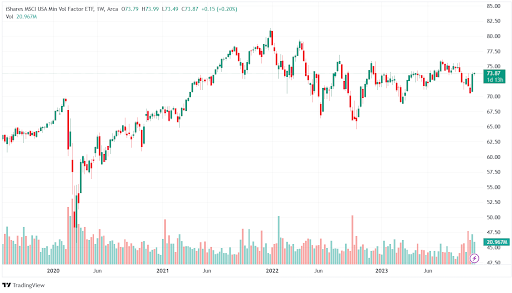 iSharesEdge MSCI Min Vol USA ETF (USMV)
The iShares EdgeMSCI Min Vol USAETF (USMV) offers convincing reasons for investors to consider it for their portfolios. This ETF is designed to track the MSCI USA Minimum Volatility (USD) Index, focusing on minimizing volatility while providing exposure to the U.S. equities market.
USMV's current price of $74.37 and recent 12-month target of $82 given by certain analysts indicate potential upside. The bid and ask prices reflect market demand, facilitating efficient trading for investors.
One key advantage is risk-consciousness. Todd Rosenbluth of CFRA highlights USMV as a risk-conscious ETF, making it attractive for Risk Averse Investors seeking stability in uncertain markets.
USMV's strategy selects stocks with lower volatility characteristics from the MSCI USA Index, reducing the impact of market turbulence. Its rules-based approach optimizes the balance between expected returns and volatility.
With a low expense ratio of 0.15%, USMV offers cost-effective exposure to stable U.S. equities. Year-to-date, it has delivered a total return of 1.75%, making it an appealing choice for investors looking to minimize risk while participating in the U.S. stock market's potential growth. Here is a list of top 10 holdings of this ETF.
| Name | Symbol | % Assets |
|---|---|---|
| Microsoft Corp | MSFT | 3.52% |
| AppleInc | AAPL | 3.47% |
| Amazon.com Inc | AMZN | 2.56% |
| FacebookInc A | FB | 1.63% |
| Alphabet Inc A | GOOGL | 1.61% |
| Alphabet Inc C | GOOG | 1.57% |
| Procter & Gamble Co | PG | 1.54% |
| VisaInc Class A | V | 1.53% |
| Johnson & Johnson | JNJ | 1.51% |
| UnitedHealth GroupInc | UNH | 1.50% |
The Fidelity MSCI Utilities IndexETF (FUTY)
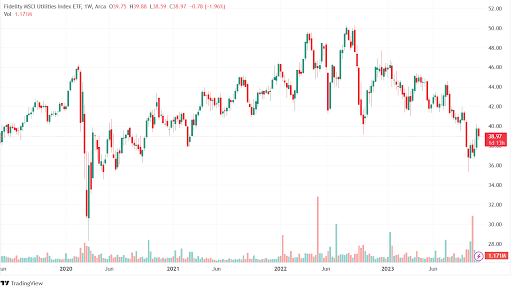 The FidelityMSCI Utilities Index ETF (FUTY)
The Fidelity MSCI Utilities Index ETF (FUTY) is a smart choice for anyone interested in the Utilities sector. FUTY has almost 99.70% of its investments in this area. It's also an affordable way to invest in this industry, with a low expense ratio of just 0.08%. This means you won't lose much of your investment to fees.
The concentrated approach of this ETF allows investors to target companies in the Utilities sector. Some of its major holdings are well-established names like Nextera Energy, Southern Co., and Duke Energy, which can provide stability and pay dividends to investors. In fact, it offers a competitive dividend yield (3.54% over the past year).
While its recent performance has been negative, it's a medium-risk investment with a beta of 0.56. It also has a diversified portfolio of around 70 holdings, which helps spread the risk. Additionally, FUTY is very transparent, revealing its holdings daily FUTY is therefore a cost-effective way to invest in Utilities, making it a valuable addition for those seeking stability and income in their investments.
| Name | Symbol | % Assets |
|---|---|---|
| NextEra Energy, Inc. | NEE | 13.36% |
| The Southern Company | SO | 8.43% |
| Duke Energy Corporation | DUK | 7.64% |
| Sempra | SRE | 5.00% |
| American Electric Power Company, Inc. | AEP | 4.50% |
| Exelon Corporation | EXC | 4.46% |
| Constellation Energy Corporation | CEG | 4.15% |
| PG&E Corporation | PCG | 3.86% |
| Dominion Energy, Inc. | D | 3.79% |
SPDR S&P Kensho Future Security ETF (FITE)
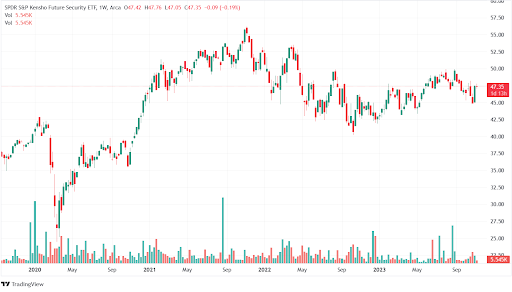
The SPDR S&P Kensho Future Security ETF (FITE) is an investment fund that's focused on companies involved in shaping the future of security. It manages $33.19 million in assets having an expense ratio of 0.45%.
What makes FITE interesting is its specialized approach. It invests in businesses involved in areas like cyber security, advanced border security, military technologies such as drones, space technology, and more. These sectors are expected to grow due to increasing security needs.
The fund is well-diversified across 61 different holdings, with the top 10 making up over half of its investments. This balance offers a mix of stability and growth potential. Furthermore, the companies FITE invests in are predicted to have a solid 3–5-year earnings growth rate of 14.74%.
In a nutshell, if you're planning to invest in the future of security, FITE provides a cost-effective and diversified way to do so, potentially offering you opportunities for growth in this evolving sector. Here are top 10 holdings of this ETF
| Name | Symbol | % Assets |
|---|---|---|
| Qualys Inc | QLYS | 10.30% |
| SentinelOne Inc Class A | S | 10.20% |
| CrowdStrike Holdings Inc Cla | CRWD | 10.10% |
| Varonis Systems Inc | VRNS | 9.70% |
| Parsons Corp | PSN | 9.70% |
| Palo Alto Networks Inc | PANW | 9.70% |
| Textron Inc | TXT | 10.00% |
| Kratos Defense… | KTOS | 10.00% |
| Zscaler Inc | ZS | 9.50% |
ARK Space Exploration & Innovation ETF (ARKX)
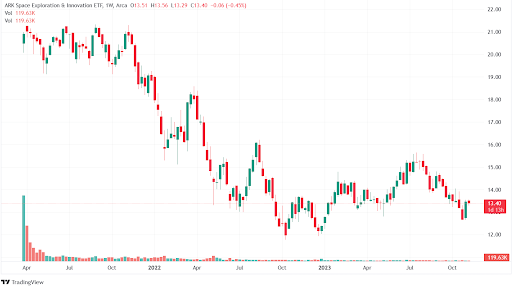 ARK Space Exploration & Innovation ETF (ARKX)
The ARK Space Exploration & Innovation ETF (ARKX) is an investment fund that focuses on the space exploration and innovation industry. It was created in March 2021 and has made a decent amount of money, with over $245 million in assets.
The ETF includes various companies, both from the United States and abroad, that are at the forefront of space exploration and innovation. Its portfolio is moderately diversified, with its top 10 holdings, including companies like AeroVironment, Kratos Defense & Security Solutions, and Trimble Inc., making up a significant portion of its assets.
While the past year's performance was moderate, with a 2.14% return, it has done better this year with an 11.14% return. So, if you're interested in being part of the growing space industry and believe in its future potential, this ETF can be a great choice for long-term growth. Here are top 10 holdings of this ETF.
| Name | Symbol | % Assets |
|---|---|---|
| AeroVironment Inc | AVAV | 8.78% |
| Kratos Defense & Security Solutions Inc | KTOS | 8.58% |
| Trimble Inc | TRMB | 8.42% |
| Iridium Communications Inc | IRDM | 7.20% |
| L3Harris Technologies Inc | LHX | 5.01% |
| The 3D Printing ETF | PRNT | 4.52% |
| Komatsu Ltd (6301.T) | 6301.T | 4.27% |
| Archer Aviation Inc Class A | ACHR | 4.09% |
| UiPathInc Class A | PATH | 4.03% |
| Teradyne Inc | TER | 3.64% |
Invesco Russell 1000 Equal Weight ETF (EQAL)
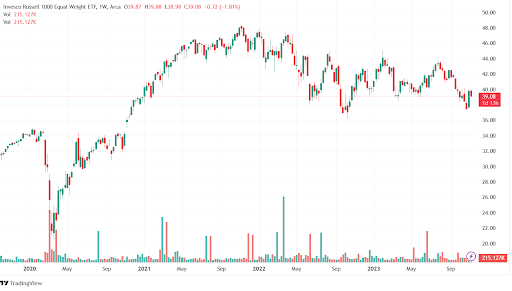 Invesco Russell 1000 Equal Weight ETF (EQAL)
The Invesco Russell 1000 Equal Weight ETF (EQAL) provides an advanced way to invest in the US stock market. What makes it different is that it doesn't follow the traditional method of investing based on a company's size. Instead, EQAL gives every company in the S&P 1000 index an equal footing. This approach means smaller companies have just as much influence on the fund's performance as larger ones. Over time, this strategy could potentially lead to better returns for investors.
One more reason to consider EQAL is its low expense ratio of 0.20%, making it a cost-effective choice. By investing in EQAL, you can also enjoy diversification benefits. It helps reduce the risk that comes from having too much of your money in one stock or sector.
The Invesco Russell 1000 Equal Weight ETF (EQAL) primarily allocates around 12.20% to the Information Technology sector. Its top three holdings include Frontier Communications Parent Inc (FYBR), Charter Communications Inc (CHTR), and Liberty Broadband Corp (LBRDK). The top 10 holdings make up approximately 5.13% of its total assets under management.
The ETF offers a 12-month trailing dividend yield of 1.98%, showcasing its income potential. It is proudly sponsored by Invesco and has impressively accumulated assets exceeding $612.30 million, solidifying its position as one of the prominent ETFs striving to replicate the Large Cap Blend sector of the US equity market. Top 10 holdings of this ETF are listed below
| Name | Symbol | % Assets |
|---|---|---|
| Frontier Communications Parent Inc | FYBR | 0.69% |
| AT&TInc | T | 0.54% |
| Arista Networks Inc | ANET | 0.54% |
| T-Mobile US Inc | TMUS | 0.54% |
| Verizon Communications Inc | VZ | 0.53% |
| Motorola Solutions Inc | MSI | 0.53% |
| Roku Inc | ROKU | 0.51% |
| Charter Communications Inc | CHTR | 0.50% |
| Liberty Broadband Corp | LBRDK | 0.48% |
| Comcast Corp | CMCSA | 0.48% |
iShares 1-3 Year Treasury Bond ETF (SHY)
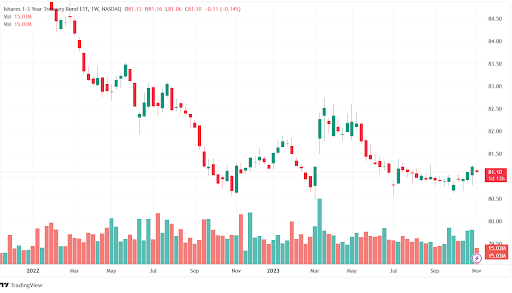 iShares 1-3 Year Treasury Bond ETF (SHY)
The iShares 1-3 Year Treasury Bond ETF (SHY) is an excellent investment option for those who prefer lower risk and have a short-term investment horizon. This ETF focuses on U.S. Treasury bonds with maturities ranging from one to three years, which are known for their stability and reliability.
SHY has a net asset value (NAV) of $81.04, making it a solid choice for those who value stability in their investments. What's even more appealing is its relatively low expense ratio of 0.15%. Another key highlight is that SHY has delivered a year-to-date (YTD) return of 2.37% as of November 6, 2023, which is a respectable performance for a low-risk investment.
In addition to its low cost, SHY is designed to minimize both interest rate risk and credit risk. Morningstar, a respected investment analysis firm, has recognized SHY as a Bronze Medalist, signifying its appeal and reliability as an investment.
| Name | % Assets |
|---|---|
| United States Treasury Notes 0.875% | 1.50% |
| United States Treasury Notes 1.375% | 1.50% |
| United States Treasury Notes 1.125% | 1.50% |
| United States Treasury Notes 1.625% | 1.50% |
| United States Treasury Notes 1.25% | 1.50% |
| United States Treasury Notes 1.5% | 1.50% |
| United States Treasury Notes 1.375% | 1.50% |
| United States Treasury Notes 1.125% | 1.50% |
| United States Treasury Notes 1.25% | 1.50% |
| United States Treasury Notes 1.625% | 1.50% |
SPDR S&P 500 Aerospace & Defense ETF (XAR)
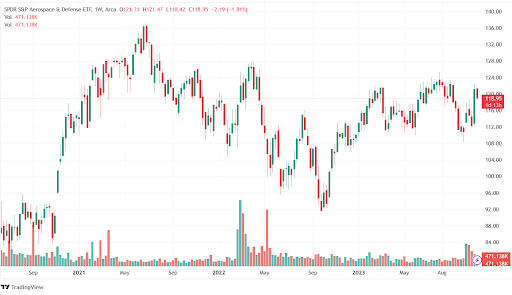 SPDR S&P 500 Aerospace & Defense ETF (XAR)
The SPDR S&P 500 Aerospace & Defence ETF (XAR) is a smart investment option for those interested in the Aerospace & Defence industry. It currently manages a substantial $1,676.54 million in assets, indicating strong investor interest.
What makes XAR appealing is its well-rounded approach, including companies of various sizes, from large to small caps. By following a modified equal-weighted index, it ensures that one’s investment isn't too concentrated in one company, providing balanced industry exposure. Additionally, with a competitive gross expense ratio of only 0.35%, the costs are kept low.
XAR holds positions in 32 companies, with a weighted average market capitalization of $28,680.47 million. Its top 5 holdings, such as Lockheed Martin Corp, Raytheon Technologies Corp, Boeing Co, General Dynamics Corp, and Northrop Grumman Corp, give you exposure to industry leaders.
Furthermore, it's worth noting that XAR offers an estimated 3–5-year EPS growth rate of 9.44%, suggesting the potential for future profitability. With its diversification, low expenses, and strong industry presence, XAR is a wise choice for investors looking to benefit from the growth and stability of the Aerospace & defence sector. The top 10 holdings of this ETF are listed below
| Name | Symbol | % Assets |
|---|---|---|
| Spirit AeroSystems Holdings Inc Class A | SPR | 4.97% |
| Northrop Grumman Corp | NOC | 4.65% |
| General Dynamics Corp | GD | 4.61% |
| Lockheed Martin Corp | LMT | 4.48% |
| L3Harris Technologies Inc | LHX | 4.45% |
| Huntington Ingalls Industries Inc | HII | 4.34% |
| BWX Technologies Inc | BWXT | 4.29% |
| Textron Inc | TXT | 4.19% |
| Curtiss-Wright Corp | CW | 4.15% |
| Woodward Inc | WWD | 4.07% |
Utilities Select Sector SPDR ETF (XLU)
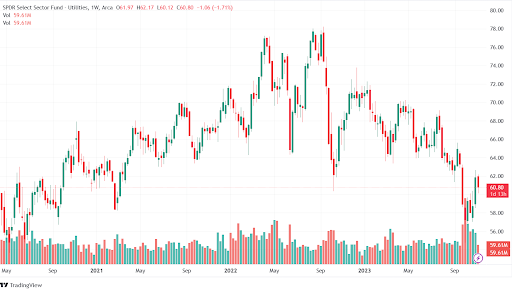 Utilities Select Sector SPDR ETF (XLU)
The Utilities Select Sector SPDR ETF (XLU) is sponsored by State Street Global Advisors and is the largest ETF in the Utilities sector, boasting over $14.13 billion in assets under management. As a passively managed fund, XLU offers cost-effective exposure to a diverse range of utility industries.
Financially, XLU demonstrates its strength with a low annual operating expense ratio of 0.10%, positioning it as one of the most cost-efficient options in the space. The 12-month trailing dividend yield of 3.46% adds an income-generating dimension, making it an attractive choice for investors seeking stable returns. With its Zacks ETF Rank of 3 (Hold) and precise exposure to crucial utility sectors, XLU emerges as a reliable and well-rounded investment for those looking to balance their portfolio with the stability and income potential offered by the Utilities sector. The top 10 holdings of the ETF are
| Name | Symbol | % Assets |
|---|---|---|
| NextEra Energy, Inc. | NEE | 13.36% |
| The Southern Company | SO | 8.43% |
| Duke Energy Corporation | DUK | 7.64% |
| Sempra | SRE | 5.00% |
| American Electric Power Company, Inc. | AEP | 4.50% |
| Exelon Corporation | EXC | 4.46% |
| Constellation Energy Corporation | CEG | 4.15% |
| PG&E Corporation | PCG | 3.86% |
| Dominion Energy, Inc. | D | 3.79% |
| Xcel Energy Inc (XEL) - | XEL | 3.71% |
Best Stock brokers
Choosing the right ETF is only part of the equation – investors also need a broker that provides convenient access to stock and ETF markets, transparent fees, and reliable execution. Below is a comparison of stock brokers that can be considered for buying defensive ETFs and building a more resilient portfolio.
| eToro USA | eOption | Revolut | Interactive Brokers | Fidelity | |
|---|---|---|---|---|---|
|
Foundation year |
2007 | 2007 | 2015 | 1978 | 1946 |
|
Account min. |
50 | No | No | No | No |
|
Interest rate |
3,75 | 8.95% | 0%-4% | 4.83% | 4.97% |
|
Basic stock/ETF fee |
No | $0 | 0.12%-0.25% | 0-0,0035% | No |
|
Min. stock/ETF fee |
No | $0 | £1.00/€1.00 | $1,00 | No |
|
TU overall score |
8.8 | 7.93 | 8.6 | 8.53 | 8.34 |
|
Open an account |
Go to broker Your capital is at risk. |
Study review | Study review | Study review | Study review |
Is it a good time to buy defensive ETFs?
Let us understand this through Ray Dalio’s approach to his permanent portfolio, which is created to do well in different economic environments. When you hold permanent parts of your portfolio in assets like defensive ETFs, you maintain a balance regardless of market conditions. Bonds, gold, and other stable investments will also be a part of your holding. Due to this, you get stability and can mitigate losses during a market downturn. It’s like having a safety net for your portfolio. However, it might not help you to maximize returns during strong bull markets.
Therefore, it is practically recommended to set aside some of your portfolio (20-30%) to defensive ETFs for long-term stability. Investors should keep an eye on it and make sure that balance in your portfolio is well maintained. So, it is recommended that when you predict market conditions to be vulnerable in future, necessary adjustments should be made to your portfolio. To protect your money from potential downturns, simply increase the share of defensive ETFs in your portfolio. This approach requires active monitoring of economic indicators and market trends. Moreover, the ultimate choice between these approaches and portfolio management will always depend on your risk tolerance, investment horizon, and market outlook.
Criteria for selecting defensive ETFs
Experts have discussed below criteria to look out for while selecting Defensive ETFs for your Portfolio.
Cost ratio: Start your research by scrutinizing the expense ratio—the annual fee from an ETF firm to manage the fund. Choose low-cost ETFs for long-term returns.
Cash flow: Evaluate the ETF's investments by looking at trading volumes and bid-ask spreads. Higher trading volumes and narrower spreads make the trade more efficient, resulting in better prices at the time of trading.
Diversification: A diversified ETF is critical to effective risk management. Find out the amount of investment and its distribution across sectors and assets. Broad portfolios reduce the risk and maintain a balanced portfolio.
Records: Realizing that historical performance does not predict future results, consider how the ETF has been through various market conditions. From this analysis, one can always explore the possibility of resilience and return to profitability.
Risks: Consider the level of associated risk inherent in the ETF. Choose low-risk funds that will act as a hedge against market fluctuations, contributing to the overall stability of your portfolio.
Low Beta: Factor in the beta, a measure of volatility relative to the market. Defensive ETFs with lower beta values are typically less volatile, providing a cushion during market downturns.
Dividend Yield: Explore ETFs concentrating on dividend-paying stocks to secure a consistent income stream and mitigate potential losses during market downturns.
Blue-Chip Stocks: Consider ETFs investing in blue-chip stocks meaning established companies with consistent earnings. Such investments contribute to portfolio stability and foster long-term growth.
Assets Under Management (AUM): A higher AUM signifies a larger market capitalization and often correlates with increased liquidity. Consider the interplay between market capitalization and Net Asset Value (NAV) for insights into potential discounts or premiums.
Trading Activity: Evaluate daily trading volume; higher volumes usually indicate greater liquidity and tighter bid-ask spreads. This is crucial for efficient entry and exit from the ETF.
Market Conditions: Assess the ETF's performance in different market conditions, particularly during economic downturn. A defensive ETF should display resilience and relative stability in turbulent markets.
How to build a defensive investment portfolio
Experts have discussed below key elements of how to build a defensive investment portfolio
Portfolio Rebalancing: Regularly review and adjust your portfolio to maintain the desired asset allocation. Sell well-performing assets and reinvest in underperforming ones. Stay vigilant to changing market conditions and make adjustments accordingly.
Invest in Stable Sectors: Prioritize investments in stable sectors such as consumer staples, utilities, and essential services. These sectors demonstrate resilience in the face of economic turbulence due to sustained demand for their products and services.
Strategic Selection of Stocks: Invest in stable companies, particularly those in industries like healthcare, utilities, and consumer staples. These sectors tend to be less risky, providing a solid foundation for your investment portfolio.
Diversification Across Sectors: Ensure your investments are spread across different sectors and industries. This diversification acts as a risk management strategy, mitigating the impact of potential losses in any one sector.
Mitigating Inflation with Essential Investments: Combat the effects of rising living costs by strategically investing in companies that produce essential goods and services. This approach serves as a hedge against inflation, preserving the value of your portfolio.
Global Portfolio Diversification: Expand your investment horizon by diversifying geographically. Investing in companies from various countries helps mitigate the risks associated with economic and political fluctuations in any single region.
Asset Class Allocation: Construct a well-rounded portfolio by incorporating different asset classes, such as stocks, bonds, and cash. This diversified approach provides a balanced defence against market volatility and economic uncertainties.
What are typical defensive sectors?
To understand the various defensive sectors and the source of their stability, refer to the following table
| ETF Category | Description | Stability Factor |
|---|---|---|
| Consumer StaplesETFs | Invests in companies producing essential items like food, household products, and personal care items | Stable investment due to consistent demand for everyday essentials during crisis periods |
| Healthcare ETFs | Focuses on healthcare industry, including pharmaceuticals, healthcare providers, and medical equipment | Defensive sector with consistent demand for medical services and medicines regardless of market conditions |
| Utilities ETFs | Includes companies providing vital services like gas, electricity, and water | Less affected by market ups and downs as people depend on these services in their day-to-day life |
| Telecommunication Services | Invests in companies offering various communication services like mobile, fiber-optic, and wireless networks | Stable demand for communication services, providing a more stable investment option |
| Gold and Precious Metals | Tracks the performance of gold and precious metals | Considered a prominent investment option during crises, acting as a hedge against economic chaos |
| Low-Volatility ETFs | Invests in stocks with a history of stable prices | Aims to reduce risk and provide stability, particularly beneficial when markets are unpredictable |
| Dividend ETFs | Focuses on companies that regularly pay dividends | Offers a steady income stream, comforting during bear markets when capital preservation is crucial |
| High-Quality Bond ETFs | Particularly focuses on high-quality and investment-grade bonds | Acts as a safe haven during market turbulence, providing stability in a portfolio |
Do defensive ETFs really protect you during bear market?
Defensive ETFs are designed to protect investors when the market takes a hit, but their effectiveness depends on the specific portfolio. Two types of these ETFs, low-volatility and smart-beta, aim to reduce risk by investing in historically stable stocks and using rules-based strategies. This helps minimize fluctuations and may even lead to higher returns compared to traditional ETFs.
On the flip side, there are inverse and leveraged ETFs that take a different approach. Inverse ETFs work to give you the opposite performance of a specific index on a daily basis, acting as a hedge during market declines. Then there are leveraged ETFs, which use derivatives to amplify index returns, potentially doubling daily gains or losses. However, it's important to note that these options come with added complexity and higher risk.
Despite their features, no ETF can guarantee absolute protection. It's crucial for investors to carefully consider their individual objectives, risk tolerance, and time horizon when choosing ETFs. The key is aligning your ETF choices with the specific needs of your portfolio.
Always pay attention to is correlation

Defensive ETFs work best when they are treated as a portfolio stabilizer rather than a standalone solution. I would not use them as a way to “hide” from the market completely. Instead, I see them as a tool for improving portfolio behavior during stressful periods, especially when volatility starts affecting decision-making.
One point I always pay attention to is correlation. Two ETFs may look defensive on paper, but if they react similarly under pressure, they may not provide the diversification you expect. That is why I prefer combining instruments with different drivers – for example, pairing equity-based defensive exposure with short-duration bonds or other lower-sensitivity assets.
I also think investors should be realistic about expectations. A defensive allocation is not meant to win every rally or outperform aggressive sectors in a bull run. Its value becomes more visible over a full market cycle, when lower drawdowns and steadier compounding can make a meaningful difference to long-term results.
Conclusion
In times of market uncertainty, adding defensive ETFs to your portfolio is a practical strategy for achieving stability and minimizing risk. The article makes it clear that while no ETF can provide absolute protection, thoughtfully selected defensive options—such as the Vanguard Total Stock Market Index Fund (VTI) or iShares Edge MSCI Min Vol USA ETF (USMV)—can act as a buffer during downturns without sacrificing long-term growth potential. The key takeaway is that defensive ETFs should be a core component of a diversified investment approach, helping investors weather turbulence and maintain discipline even when markets are volatile. Ultimately, true resilience comes not from trying to avoid all risks, but from building a well-balanced portfolio that lets you withstand them and continue compounding over time.
FAQs
How can defensive ETFs help balance risk in a diversified investment portfolio?
What role do expense ratios play when selecting the best defensive ETFs for bear markets?
Are high dividend yields important when evaluating defensive ETFs during market downturns?
How do defensive ETFs in different sectors perform relative to each other during bear markets?
Editors' Top Picks and Insights

Hunting crypto owners: Why criminals have gone offline

BitMEX is shutting down: Why Trump could not save the exchange

Do governments need crypto workers?

Brent nears $100: Why oil prices are rising

Gram Wallet launch: Can Telegram bring crypto to the masses?

AI without limits: How dangerous are neural networks?
Related Articles
Team that worked on the article
Parshwa is a content expert and finance professional possessing deep knowledge of stock and options trading, technical and fundamental analysis, and equity research. As a Chartered Accountant Finalist, Parshwa also has expertise in Forex, crypto trading, and personal taxation.
Dr. BJ Johnson is a PhD in English Language and an editor with over 15 years of experience. He earned his degree in English Language in the U.S and the UK.
Mirjan Hipolito is a journalist and news editor at Traders Union. She is an expert crypto writer with five years of experience in the financial markets.
Index in trading is the measure of the performance of a group of stocks, which can include the assets and securities in it.
Economic indicators — a tool of fundamental analysis that allows to assess the state of an economic entity or the economy as a whole, as well as to make a forecast. These include: GDP, discount rates, inflation data, unemployment statistics, industrial production data, consumer price indices, etc.
Cryptocurrency is a type of digital or virtual currency that relies on cryptography for security. Unlike traditional currencies issued by governments (fiat currencies), cryptocurrencies operate on decentralized networks, typically based on blockchain technology.
Forex leverage is a tool enabling traders to control larger positions with a relatively small amount of capital, amplifying potential profits and losses based on the chosen leverage ratio.
Options trading is a financial derivative strategy that involves the buying and selling of options contracts, which give traders the right (but not the obligation) to buy or sell an underlying asset at a specified price, known as the strike price, before or on a predetermined expiration date. There are two main types of options: call options, which allow the holder to buy the underlying asset, and put options, which allow the holder to sell the underlying asset.

-
 Afghanistan
-
 Albania
-
 Algeria
-
 Angola
-
 Argentina
-
 Armenia
-
 Australia
-
 Austria
-
 Azerbaijan
-
 Bahamas
-
 Bahrain
-
 Bangladesh
-
 Belarus
-
 Belgium
-
 Bolivia
-
 Botswana
-
 Brazil
-
 Brunei
-
 Bulgaria
-
 Cambodia
-
 Cameroon
-
 Canada
-
 Chile
Chile
-
 China
China
-
 Colombia
-
 Congo
Congo
-
 Costa Rica
-
 Cote d'Ivoire
-
 Croatia
-
 Cuba
Cuba
-
 Cyprus
-
 Czechia
-
 DR Congo
-
 Denmark
-
 Dominican Republic
-
 Ecuador
-
 Egypt
Egypt
-
 El Salvador
-
 Estonia
-
 Eswatini
-
 Ethiopia
-
 Finland
-
 France
-
 Georgia
-
 Germany
-
 Ghana
Ghana
-
 Greece
-
 Haiti
Haiti
-
 Hong Kong
-
 Hungary
-
 India
India
-
 Indonesia
-
 Iran, Islamic republic
-
 Iraq
Iraq
-
 Ireland
-
 Israel
-
 Italy
Italy
-
 Jamaica
-
 Japan
Japan
-
 Jordan
-
 Kazakhstan
-
 Kenya
Kenya
-
 Korea
Korea
-
 Kuwait
-
 Kyrgyzstan
-
 Laos
Laos
-
 Latvia
-
 Lebanon
-
 Lesotho
-
 Libya
Libya
-
 Lithuania
-
 Luxembourg
-
 Madagascar
-
 Malaysia
-
 Malta
Malta
-
 Mauritius
-
 Mexico
-
 Moldova
-
 Mongolia
-
 Montenegro
-
 Morocco
-
 Mozambique
-
 Myanmar
-
 Namibia
-
 Nepal
Nepal
-
 Netherlands
-
 New Zealand
-
 Nigeria
-
 North Macedonia
-
 Norway
-
 Oman
Oman
-
 Pakistan
-
 Palestine
-
 Panama
-
 Papua New Guinea
-
 Paraguay
-
 Peru
Peru
-
 Philippines
-
 Poland
-
 Portugal
-
 Puerto Rico
-
 Qatar
Qatar
-
 Reunion
-
 Romania
-
 Rwanda
-
 Saudi Arabia
-
 Serbia
-
 Singapore
-
 Slovakia
-
 Slovenia
-
 Somalia
-
 South Africa
-
 Spain
Spain
-
 Sri Lanka
-
 Sweden
-
 Switzerland
-
 Syria
Syria
-
 Taiwan
-
 Tajikistan
-
 Tanzania
-
 Thailand
-
 Trinidad and Tobago
-
 Tunisia
-
 Turkey
-
 UAE
UAE
-
 Uganda
-
 Ukraine
-
 United Kingdom
-
United States
-
 Uruguay
-
 Uzbekistan
-
 Venezuela
-
 Vietnam
-
 Yemen
Yemen
-
 Zambia
-
 Zimbabwe
- Forex
- Crypto












