
Why Gold Outperformed Bitcoin In 2025: Is BTC Still Digital Gold?


Editorial Note: While we adhere to strict Editorial Integrity, this post may contain references to products from our partners. Here's an explanation for How We Make Money. None of the data and information on this webpage constitutes investment advice according to our Disclaimer.
Gold outperformed bitcoin in 2025 as investors prioritized stability during economic and geopolitical uncertainty. Rising global debt, currency risks, leveraged crypto sell-offs, and shifting institutional flows pushed capital toward gold, while Bitcoin traded more like a risk asset than a safe haven. Despite this underperformance, BTC’s long-term correlation with global money supply suggests it may still regain its “digital gold” role over time.
At the start of 2025 there were some bold predictions that bitcoin (BTC) would end the year at $150,000 or even $250,000. Instead it was gold’s time to shine, starting the year at about $2,600/oz and ending it at $4,300/oz, a 65% gain over the year.
Bitcoin ended the year 5% down. Silver did even better, squeezing out the short sellers to notch up gains of 158% in 2025.What has happened to bitcoin’s vaunted status as a refuge in times of crisis?
Why bitcoin underperformed in late 2025
Several factors weighed on BTC in the final quarter of 2025:
Flight to familiar safety. Investors gravitated to gold as a more established and reliable store of value during times of economic instability. U.S. President Donald Trump’s tariff wars, unpredictable foreign policy and rising geopolitical tensions fire-hosed money from traditional assets into something more tangible and familiar. The $38 trillion U.S. debt mountain and its unsustainable interest burden, and a deliberate policy of weakening the USD to restore U.S. export competitiveness, account for much of gold’s renewed vitality.
Sell-offs driven by leverage and liquidity issues. October 2025 was marked by a sharp sell-off in crypto assets following Trump’s tariff threats against China, wiping out more than $1 trillion in crypto market value in weeks. One of the hazards of modern crypto investing is leveraged trading, resulting in mass liquidation of long positions of the kind witnessed in October 2025. Gold, meanwhile, continued its steady climb without the fanfare seen in the bitcoin market.
Regulatory setbacks and integration into mainstream finance. There were some regulatory advances in the crypto sector which smoothed the way for its integration into mainstream finance as seen in the number of banks now installing rapid, low-cost stablecoin plumbing into their traditional systems. The mainstreaming of crypto had its downsides, such as fickle institutional flows into ETFs that are prone to flight at the first signs of price weakness.
The AI boom. The AI craze diverted funds to AI stocks, diluting BTC’s claim to be the new digital gold. As some have noted, gold's "atomic certainty" as a physical asset provided anti-fragility in a time of systemic risk, while bitcoin's ephemeral (digital) character made it less appealing in a year where risk and certainty were paramount.
Speaking on the Moneyweb Crypto podcast, Carel de Jager, founder and CEO of crypto analytics firm Silver Sixpence, pointed to several factors behind bitcoin’s weaker performance versus gold in late 2025. These included concerns over a potential removal of Strategy – the largest corporate holder of BTC – from the MSCI index (a move that was later reversed), market rumors about a major holder being forced to liquidate, and disappointment that the proposed U.S. Strategic Bitcoin Reserve materialized as a loosely defined stockpile rather than a clear source of sustained buying demand.
De Jager describes the decision to keep Strategy – which holds roughly 670,000 BTC – within the MSCI index as a strongly positive signal for bitcoin. He notes that MSCI indices are widely tracked by passive investors such as pension funds, endowments, and index-tracking portfolios that allocate capital automatically rather than selectively. Because Strategy remains part of these indices, any inflows into MSCI-linked funds translate into purchases of Strategy shares, which in turn supports ongoing demand for bitcoin.
Bitcoin has at times behaved like a tech stock, but this at times breaks ranks and moves to a different tune. Over the longer term, BTC shows a surprisingly strong correlation to global M2 money supply, ranging around 0.82. A 1% increase in US M2 is associated with a 2.65% rise in the BTC price over the long term. That works both ways: contractions in M2 growth correlate with BTC price drops.
The chart below shows the long-term correlation between M2 money supply growth from 21 central banks and BTC. Bitcoin price movements lag global M2 by about 10–12 weeks.
BTC vs M2 global money supply

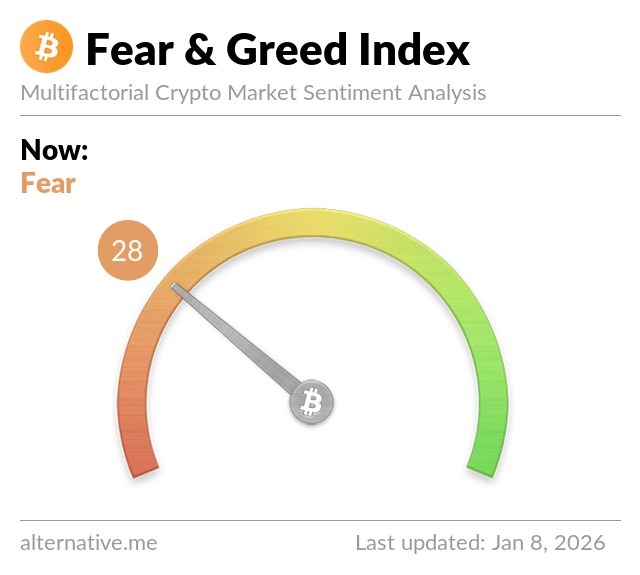
There’s a good argument that gold is overbought and we should expect some profit taking in the coming weeks or months. Bitcoin is oversold (it is now in the “Fear” zone on the Fear and Greed index, and studies have shown that this is a good time to increase positions.
The Fear and Greed index measures crypto market sentiment on a 0-100 scale based on six key metrics: volatility, market momentum/volume, social media sentiment, Bitcoin dominance, Google trends data and surveys.
Bitcoin News
Bitcoin consolidates while ETF inflows and oversold RSI support stability

Charles Schwab opens Bitcoin and Ethereum trading to all U.S. retail clients

BTC/USD holds above 82,000 as sticky U.S. inflation and ETF outflows test key support

Jimmy Song: Trump has failed to meet Bitcoiners' expectations

Bitcoin price prediction: $82,552 resistance in focus? BTC trades flat

Can renewed US demand support Bitcoin?
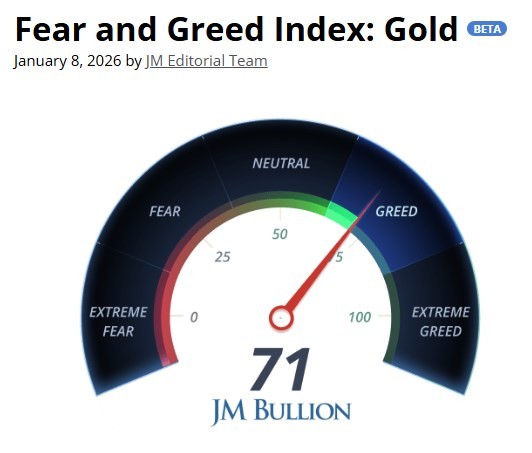
Gold, on the other hand, is now solidly in “Greed” territory:
But for the purposes of the Goldpedia study, people hold gold as a hedge against inflation and currency devaluation. They are far less likely to speculate on risk assets such as tech stocks and bitcoin.
A recent survey by Goldpedia among 100 financially savvy investors – true, not exactly a broad sample – found most would prefer to sell tech stocks first in a crisis, followed by crypto, then gold. Very few would sell their silver.
Gold News and Precious Metal & Commodity Market Updates

ECR Minerals advances Maddens mine development as processing plant starts operations in Queensland

Pakistan gold prices decline as global bullion rates ease

Pakistan gold prices rise with global market gains

RBI sets premature redemption price for Sovereign Gold Bond 2020-21 Series VII at ₹14,614

Gold trades flat after weaker US dollar supports gold demand

Indian ETF restrictions coincide as gold price consolidates near support
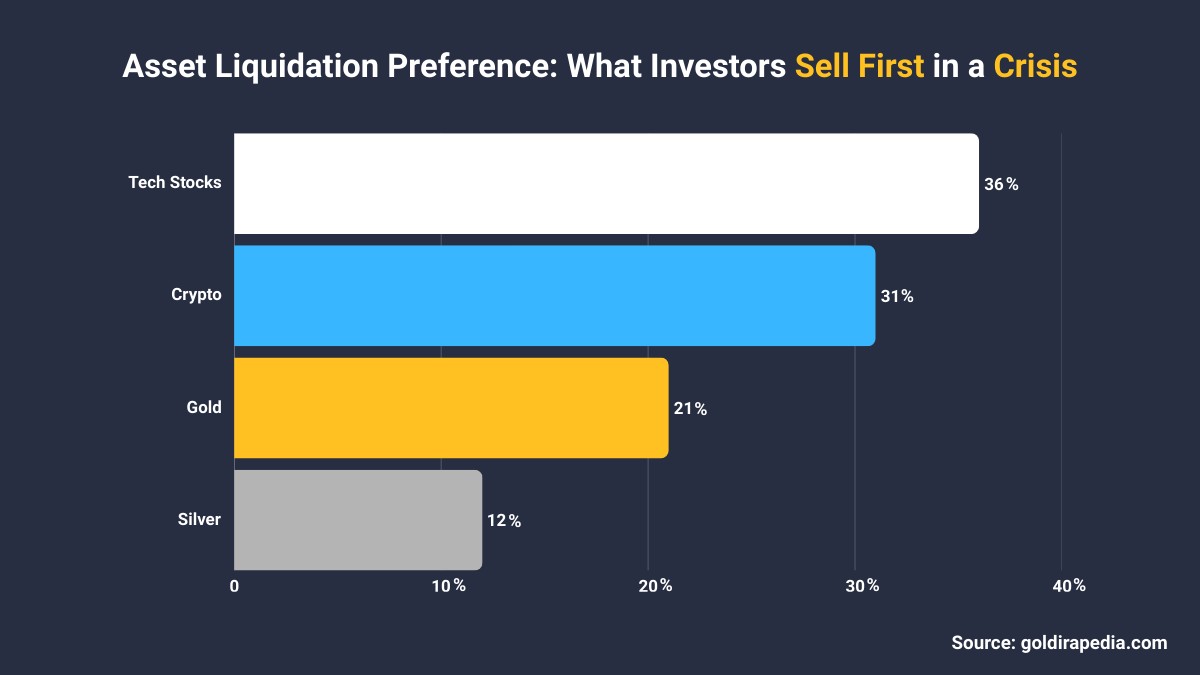
However, South African payments and crypto company 80eight observes that the same survey taken a year from now would likely produce an entirely different result. Sentiment changes and what this tells us is that investors are chasing the trend. So long as gold and silver are in the ascendant, investors are unlikely to switch horses.
To create a diversified portfolio of alternative assets – such as gold, silver, bitcoin and tech stocks – it is vital to choose reliable brokers. We have studied the conditions of top brokers and suggest that you familiarise yourself with the comparative table:
| Trading.com USA | Plus500 | OANDA | FOREX.com | IG Markets | |
|---|---|---|---|---|---|
|
Min. deposit, $ |
50 | 100 | No | 100 | 1 |
|
Tradable assets |
69 | 2800 | 129 | 5500 | 20000 |
|
Gold |
No | Yes | Yes | Yes | Yes |
|
Silver |
No | Yes | Yes | Yes | Yes |
|
Crypto |
No | Yes | Yes | Yes | Yes |
|
Stocks |
No | Yes | Yes | Yes | Yes |
|
TU overall score |
6.88 | 6.67 | 6.63 | 6.47 | 6.38 |
|
Open an account |
Go to broker Your capital is at risk. |
Go to broker 81% of retail CFD accounts lose money. |
Go to broker Your capital is at risk. |
Study review | Study review |
Gold’s rally may continue, while BTC recovery depends on global money supply growth
Gold’s rally may continue, while BTC recovery depends on global money supply growth

We don’t think the gold bull run is over yet. What’s less certain is whether bitcoin’s drawdown has touched bottom, with recent evidence showing large-scale profit-taking into price strength. The overall point remains solid, however, that BTC and gold are both increasingly perceived as a hedge against monetary profligacy, so we should expect bitcoin to hew more closely to M2 monetary expansion as global central banks have no option but to turn on the printing machines as budgetary squeezes force them to.
Conclusion
Gold’s dominance over Bitcoin in 2026 serves as a potent reminder that, even in an era of digital optimism, traditional safe havens still command deep trust during periods of uncertainty. While Bitcoin’s narrative as 'digital gold' has appeal, its sharp losses in the face of global financial stress highlight lingering volatility and perception challenges. For example, institutional investors flocked to gold-backed ETFs, while crypto funds saw notable outflows. Ultimately, this year proves that, until Bitcoin earns resilience through tougher storms, gold’s centuries-old shine remains more than just sentimental—it's strategic.
FAQs
How does economic and geopolitical uncertainty impact the performance of gold and Bitcoin?
What is the role of global money supply (M2) in influencing Bitcoin’s long-term price behavior?
How do investor liquidation preferences shift during financial crises between gold, Bitcoin, and other assets?
Why might the current trends favoring gold over Bitcoin not persist indefinitely?
Editors' Top Picks and Insights





Related Articles
Team that worked on the article
Ciaran Ryan is a veteran financial journalist based in South Africa, where he covers cryptocurrency, mining, stock markets, and governance for Moneyweb. He also hosts the weekly Moneyweb Crypto Podcast.
Dan Blystone began his trading career in 1998 as an arbitrage clerk on the floor of the Chicago Mercantile Exchange (CME). He later traded bond and Eurex futures at proprietary firms such as Altea Trading, gaining valuable experience in high-frequency trading and risk management.
Chinmay Soni is a financial analyst with more than 5 years of experience in working with stocks, Forex, derivatives, and other assets. As a founder of a boutique research firm and an active researcher, he covers various industries and fields, providing insights backed by statistical data.
Index in trading is the measure of the performance of a group of stocks, which can include the assets and securities in it.
A long position in Forex, represents a positive outlook on the future value of a currency pair. When a trader assumes a long position, they are essentially placing a bet that the base currency in the pair will appreciate in value compared to the quote currency.
The fear and greed index is a tool that measures the sentiment of the crypto market based on various indicators. It assigns a value between 0 and 100, where 0 represents extreme fear while 100 represents extreme greed. The index can help investors avoid emotional overreactions and make rational decisions.
Ethereum is a decentralized blockchain platform and cryptocurrency that was proposed by Vitalik Buterin in late 2013 and development began in early 2014. It was designed as a versatile platform for creating decentralized applications (DApps) and smart contracts.
Risk management is a risk management model that involves controlling potential losses while maximizing profits. The main risk management tools are stop loss, take profit, calculation of position volume taking into account leverage and pip value.

-
 Afghanistan
-
 Albania
-
 Algeria
-
 Angola
-
 Argentina
-
 Armenia
-
 Australia
-
 Austria
-
 Azerbaijan
-
 Bahamas
-
 Bahrain
-
 Bangladesh
-
 Belarus
-
 Belgium
-
 Bolivia
-
 Botswana
-
 Brazil
-
 Brunei
-
 Bulgaria
-
 Cambodia
-
 Cameroon
-
 Canada
-
 Chile
Chile
-
 China
China
-
 Colombia
-
 Congo
Congo
-
 Costa Rica
-
 Cote d'Ivoire
-
 Croatia
-
 Cuba
Cuba
-
 Cyprus
-
 Czechia
-
 DR Congo
-
 Denmark
-
 Dominican Republic
-
 Ecuador
-
 Egypt
Egypt
-
 El Salvador
-
 Estonia
-
 Eswatini
-
 Ethiopia
-
 Finland
-
 France
-
 Georgia
-
 Germany
-
 Ghana
Ghana
-
 Greece
-
 Haiti
Haiti
-
 Hong Kong
-
 Hungary
-
 India
India
-
 Indonesia
-
 Iran, Islamic republic
-
 Iraq
Iraq
-
 Ireland
-
 Israel
-
 Italy
Italy
-
 Jamaica
-
 Japan
Japan
-
 Jordan
-
 Kazakhstan
-
 Kenya
Kenya
-
 Korea
Korea
-
 Kuwait
-
 Kyrgyzstan
-
 Laos
Laos
-
 Latvia
-
 Lebanon
-
 Lesotho
-
 Libya
Libya
-
 Lithuania
-
 Luxembourg
-
 Madagascar
-
 Malaysia
-
 Malta
Malta
-
 Mauritius
-
 Mexico
-
 Moldova
-
 Mongolia
-
 Montenegro
-
 Morocco
-
 Mozambique
-
 Myanmar
-
 Namibia
-
 Nepal
Nepal
-
 Netherlands
-
 New Zealand
-
 Nigeria
-
 North Macedonia
-
 Norway
-
 Oman
Oman
-
 Pakistan
-
 Palestine
-
 Panama
-
 Papua New Guinea
-
 Paraguay
-
 Peru
Peru
-
 Philippines
-
 Poland
-
 Portugal
-
 Puerto Rico
-
 Qatar
Qatar
-
 Reunion
-
 Romania
-
 Rwanda
-
 Saudi Arabia
-
 Serbia
-
 Singapore
-
 Slovakia
-
 Slovenia
-
 Somalia
-
 South Africa
-
 Spain
Spain
-
 Sri Lanka
-
 Sweden
-
 Switzerland
-
 Syria
Syria
-
 Taiwan
-
 Tajikistan
-
 Tanzania
-
 Thailand
-
 Trinidad and Tobago
-
 Tunisia
-
 Turkey
-
 UAE
UAE
-
 Uganda
-
 Ukraine
-
 United Kingdom
-
United States
-
 Uruguay
-
 Uzbekistan
-
 Venezuela
-
 Vietnam
-
 Yemen
Yemen
-
 Zambia
-
 Zimbabwe
- Forex
- Crypto












