
Bitcoin vs Gold As Safe Haven Assets


Editorial Note: While we adhere to strict Editorial Integrity, this post may contain references to products from our partners. Here's an explanation for How We Make Money. None of the data and information on this webpage constitutes investment advice according to our Disclaimer.
Bitcoin and gold both serve as safe haven assets, but they protect wealth in different ways. Gold offers long-standing stability during market stress, while Bitcoin provides decentralized, high-growth potential when trust in financial systems fades. The smarter choice depends on your risk appetite and timing.
The argument about whether Bitcoin or gold is the better safe haven is not just about how they behave when things fall apart. It is really about what people count on. Gold has been trusted for centuries. It is rare, physical, and proven to hold up in rough times. Bitcoin runs on tech and a global network that never stops. When panic hits some grab what they can hold others trust what cannot be printed. If you are only comparing the numbers you are missing what gives each one real weight. The tough choice is between what worked for years and what is being shaped for tomorrow.
Risk warning: All investments carry risk, including potential capital loss. Economic fluctuations and market changes affect returns, and 40-50% of investors underperform benchmarks. Diversification helps but does not eliminate risks. Invest wisely and consult professional financial advisors.
Understanding safe haven assets
When financial markets face periods of turmoil, investors often shift their focus toward stability. This shift leads them to safe haven assets, which are instruments that tend to hold their value or appreciate during times of heightened risk. These assets are not designed to generate high returns but to preserve capital when traditional investments such as stocks or corporate bonds come under pressure.
Safe havens play a critical role in portfolio management, particularly during economic downturns or geopolitical instability.
Defining safe haven assets
Safe haven assets are financial instruments that offer relative protection during market downturns. They are known for maintaining value when riskier asset classes experience sharp declines. This stability makes them valuable tools for risk management and long-term capital preservation.
Unlike cyclical investments, safe haven assets are typically less influenced by the business cycle and more valued for their resilience.
What makes an asset a safe haven
For an asset to qualify as a reliable safe haven, it usually exhibits several defining traits:
Tends to hold or gain value during recessions, crises, or market crashes.
Has a historical record of stability in periods of financial stress.
Shows little correlation with equities, high-yield debt, or speculative sectors.
Offers deep liquidity and accessibility across global markets.

Safe haven assets help reduce overall portfolio losses during major downturns. They offer peace of mind and financial stability in periods of high volatility. Also they act as a hedge when uncertainty is high.
Historical context of gold as a safe haven

Gold has been the go-to safe haven for centuries, long before modern financial markets even existed. It is not tied to any single currency or government, making it useful during geopolitical or economic crises. Gold has physical value, which gives it an edge when people lose faith in paper assets. It is easily traded and globally recognized, making it a trusted store of value.
Historical examples
During the 2008 financial crisis, gold prices surged as stocks collapsed.
In times of war or inflation, investors often turn to gold to protect their wealth.
Even during the COVID-19 pandemic, gold reached new highs while global markets struggled.
Gold continues to serve as a reliable hedge against inflation, currency depreciation, and systemic risk. While other safe havens depend on political or economic stability, gold holds its ground independently. Many investors keep gold in their portfolios to prepare for worst-case scenarios
Bitcoin's appeal during economic uncertainty
Since its launch in the aftermath of the 2008 financial crisis, Bitcoin has attracted attention as a form of digital gold. Investors often turn to it during periods of macro instability or mistrust in traditional systems.
Bitcoin offers something traditional systems do not:
Limited supply. With a fixed cap of 21 million coins, bitcoin’s scarcity appeals to investors who are concerned about fiat currency devaluation, especially in environments with loose monetary policy.
Decentralized network. Bitcoin is not controlled by any government or central bank. It operates on a global peer-to-peer system, which draws interest from those seeking alternatives to traditional financial authorities.
Global portability. Bitcoin can be transferred across borders quickly, offering financial flexibility in countries facing currency controls, banking restrictions, or limited access to stable monetary systems.
Potential inflation hedge. When inflation rises and purchasing power declines, bitcoin is seen by some as a store of value. While not as consistent as gold, its finite nature gives it a similar appeal in inflationary periods.
Where Bitcoin has played a role during tough times
Argentina and Turkey. During periods of sharp currency depreciation, people in both countries turned to bitcoin as a way to preserve value and avoid local financial instability.
Ukraine (2022). Amid war-related banking disruptions and capital restrictions, bitcoin was used to move funds and make international payments when traditional systems failed.
Global interest (2024–2025). As inflation pressures and geopolitical risks intensified, institutional and retail demand for bitcoin increased. Despite price swings, its role as an alternative asset gained renewed attention.
Bitcoin does not promise stable prices, but it does offer freedom from systems that people sometimes stop trusting. In a world where banks can freeze accounts and currencies can lose value overnight, Bitcoin offers a way to opt out. For many, it is not just about growth, it is about protection.
Comparative analysis of Bitcoin and gold
Volatility and price stability
Gold is widely recognized for its price stability. Historically, it has maintained a relatively steady trajectory, often acting as a buffer during financial crises. In 2025, gold reached new highs above $3,500 per ounce, supported by central bank demand and global inflation concerns. Its average annualized volatility remains in the range of 10 to 15 percent.
Bitcoin, by contrast, is known for extreme price movements. In the first half of 2025, bitcoin briefly crossed $123,000 before retracing sharply to below $115,000. Its historical annual volatility has hovered around 50 to 70 percent, and even short-term moves of 10 to 20 percent in a single day are not uncommon.

Gold is better suited for those who want protection without big price swings. Bitcoin may offer high returns, but its price can drop fast, which is not ideal during a crisis. Volatility makes Bitcoin attractive to some but risky for others.
Liquidity and market accessibility
Both assets are relatively easy to buy and sell, but with different entry points and audiences.
Gold is available through a wide range of channels, including:
Bullion dealers, banks, and retail platforms for physical purchases.
Institutional ETFs and futures markets for indirect exposure.
| Gold | XAU/USD spread, pips | XAU/USD commission, $ | Min. deposit, $ | Regulation | TU overall score | Open an account | |
|---|---|---|---|---|---|---|---|
| Yes | 45 | 3 | 100 | CySEC, FCA, ASIC, FMA, FSCA, FSA Seychelles, EFSA, MAS, DFSA, SCB | 7.7 | Go to broker 81% of retail CFD accounts lose money. |
|
| Yes | 30 | 3 | No | FSC (BVI), ASIC, IIROC, FCA, CFTC, NFA | 6.63 | Go to broker Your capital is at risk. |
|
| Yes | 35 | 2.5 | 100 | CIMA, FCA, FSA (Japan), NFA, IIROC, ASIC, CFTC | 6.47 | Study review | |
| Yes | 30 | No | 1 | FCA, BaFin, ASIC, MAS, CySec, FINMA, BMA, CFTC, NFA | 6.38 | Study review | |
| Yes | 15 | 2 | No | SEC, FINRA, SIPC, FCA, NSE, BSE, SEBI, SEHK, HKFE, IIROC, ASIC, CFTC, NFA | 6.37 | Study review |
Central banks, which hold gold as part of their foreign reserves.
Global gold trading volumes exceed $150 billion daily, covering over-the-counter, futures, and ETF transactions. Physical gold remains especially popular in countries like India and China, where it is culturally tied to wealth storage. However, large-scale holdings often involve: secure vaulting and transportation, insurance costs.
Bitcoin is traded around the clock on global digital exchanges, with average daily volumes between $35 and $40 billion across spot and derivatives markets. It is accessible to a wide range of investors through:
Crypto exchanges, which allow round-the-clock trading in multiple denominations.
| BTC | Foundation year | Min. Deposit, $ | Coins Supported | Spot Taker fee, % | Spot Maker Fee, % | Alerts | Copy trading | Tier-1 regulation | TU overall score | Open an account | |
|---|---|---|---|---|---|---|---|---|---|---|---|
| Yes | 2017 | 10 | 600+ | 0.1 | 0.08 | Yes | Yes | No | 8.48 | Go to broker Your capital is at risk. |
|
| Yes | 2012 | 10 | 400+ | 0.5 | 0.5 | Yes | No | Yes | 7.84 | Go to broker Your capital is at risk. |
|
| Yes | 2016 | 1 | 400+ | 0.5 | 0.25 | Yes | No | Yes | 7.8 | Go to broker Your capital is at risk. |
|
| Yes | 2018 | No | 1000 | 0 | 0 | Yes | Yes | No | 7.76 | Go to broker Your capital is at risk. |
|
| Yes | 2011 | 10 | 399 | 0.3 | 0.2 | No | Yes | Yes | 7.6 | Go to broker Your capital is at risk.
|
Fractional purchasing, where users can invest any amount regardless of price.
Mobile and desktop wallets, making it easy to store and transfer.
Bitcoin requires no physical handling or storage, but users must consider: cybersecurity risks, especially for self-custodied wallets, custody solutions for large holders, including institutional-grade platforms, regulatory frameworks, which vary by region and can affect accessibility.
Performance during economic crises
When the economy hits a rough patch, safe haven assets like gold and Bitcoin come under the spotlight. But their actual performance during crises tells two very different stories. Gold has a long history of holding up when markets fall. Bitcoin, being much newer, has shown mixed behavior, – sometimes acting like a hedge, other times moving with risky assets. Comparing how each asset performs in crisis periods helps investors decide how to use them in their portfolios.
Gold's track record in past downturns
Gold has earned its reputation over decades of financial turbulence:
2008 financial crisis. As global markets collapsed, gold prices rose. Investors fled stocks and poured money into gold, pushing its value up over 20 percent between 2008 and 2009.
Dot-com bubble (2000–2002). While tech stocks crashed, gold held steady and eventually climbed, offering a safe place for worried investors.
COVID-19 pandemic (2020). After an initial dip, gold rallied and reached record highs above $2,000 as fears about the economy and inflation grew.
It is seen as a store of value when currencies weaken or inflation rises. Central banks hold large amounts of gold, reinforcing its role as a global reserve asset. It does not rely on earnings, governments, or credit markets.
Bitcoin's behavior in recent market turmoils
Bitcoin’s performance in crises is still evolving. As a newer asset, it is tested every time markets get shaky:
March 2020 COVID crash. Bitcoin fell more than 40 percent in a matter of days, dropping alongside stocks. But it quickly recovered and later surged past all-time highs by the end of the year.
2022 inflation and interest rate hikes. Bitcoin dropped sharply as central banks raised rates. Investors treated it more like a tech stock than a safe haven, with prices falling nearly 65 percent from peak levels.
2023 banking turbulence. During regional bank collapses in the US, Bitcoin briefly acted like a hedge. It rose as confidence in the traditional banking system dipped, drawing comparisons to gold.
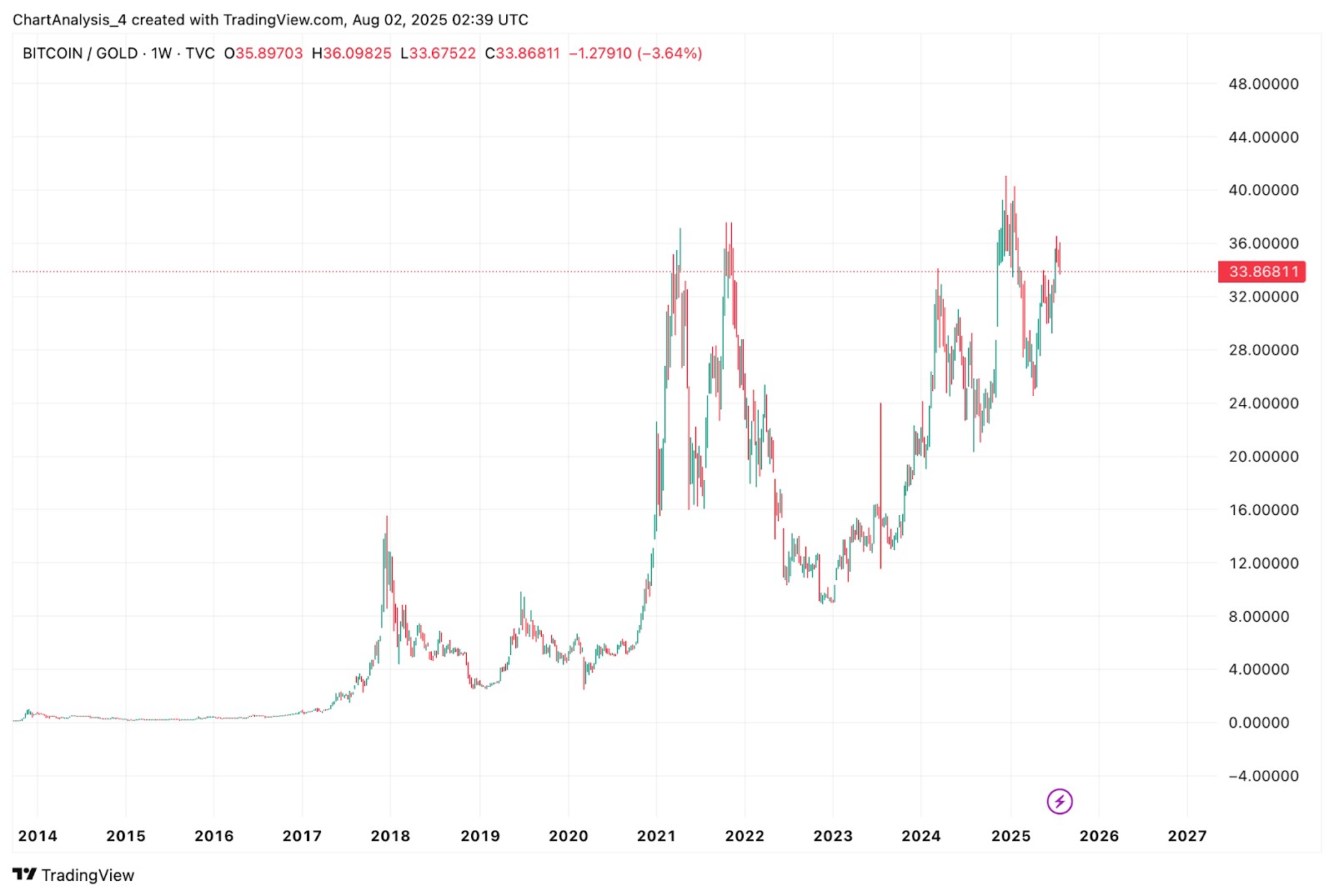
The Bitcoin-to-gold ratio chart shows how dramatically Bitcoin has outpaced gold in certain cycles, particularly since late 2023, although it remains far more volatile.
Early 2025 geopolitical and economic stress. In June 2025, as tensions rose between the U.S. and Iran, Bitcoin gained about 1 percent while equities and the dollar declined. This divergence reignited debate over its potential as a safe haven. However, analysts remained cautious, citing its speculative nature.
Bitcoin is still considered risky by many institutional investors. Its volatility makes it more suitable for long-term holding than short-term protection. Investor behavior and regulation are still shaping how Bitcoin performs under pressure. Against this backdrop of contrasting volatility and crisis behavior, gold outshone bitcoin in 2025, reinforcing its role as a preferred safe haven at a time when investors prioritized stability over high-risk, high-reward assets.
Future outlook for Bitcoin and gold as safe havens
The future is uncertain, but both gold and Bitcoin are likely to remain important. Gold is the old guard, trusted across centuries. Bitcoin is the newcomer, fast-moving and still proving itself. Depending on how the world changes, each one could play a different role in helping people protect their money.
Potential scenarios and market trends
Gold and Bitcoin are on different paths, but both could remain valuable depending on what happens next.
Gold might grow if:
Central banks keep buying it, which they have been doing in large amounts.
Inflation picks up or major currencies lose value.
Global conflicts or economic fears drive investors to seek safety.
Bitcoin could gain ground if:
More companies and governments are starting to use it.
Clear rules make it safer for big investors to join in.
People in struggling economies turn to it when their local money fails.
Diversification strategies involving both assets
Many smart investors choose not to rely solely on either gold or Bitcoin – they hold both. These assets complement each other: gold brings long-term stability and acts as a hedge during periods of inflation or currency devaluation, while Bitcoin offers higher growth potential, especially when confidence in traditional systems weakens.
Combining the two allows for a more balanced risk profile by diversifying exposure across both traditional and digital value stores. This dual approach helps strengthen a portfolio against a variety of market shocks. For those starting out, it’s wise to begin with conservative allocations that match your risk tolerance, reassess regularly, and always stay clear about your purpose – whether it's seeking safety, growth, or financial independence.
Crisis reveals the truth

If you are just getting into safe haven investing and trying to compare Bitcoin and gold the first thing to understand is that they respond to fear in very different ways. Gold tends to rise when the world slows down. Bitcoin tends to fall first during chaos then bounce back once liquidity returns. This has to do with how each asset sits in the system. Gold is a final destination. Bitcoin is still a tradeable asset in a system that gets drained during panic. If you buy Bitcoin thinking it will behave like gold during a crash you might sell at the worst moment. Understanding where each fits into the panic cycle is key.
Another point most beginners miss is how liquidity can trap you. Gold is slow to move but its market rarely vanishes. Bitcoin trades fast but during major stress it can freeze up if big players step back. Your ability to exit matters more than your entry. If you are using either asset for safety, know who is on the other side of your trade. With gold it is usually a long term investor or central bank. With Bitcoin it might be a fund facing margin calls. That difference is not small. In a crunch what matters most is not just holding the right asset. It is knowing whether you can actually move it when it counts.
Conclusion
The debate between Bitcoin and gold is not just about old versus new. It is about belief speed and how each holds up when the system creaks. Gold has earned its place by being slow, silent and hard to break. Bitcoin is still proving itself under pressure. If you want safety, understand that both offer protection in different ways. The smarter question is not which one wins but which one fits your risk, your timing and your ability to act when the world stops making sense.
FAQs
What are the tax implications of investing in Bitcoin versus gold?
Both Bitcoin and gold are typically taxed as capital assets, meaning gains are subject to capital gains tax. However, in some countries, gold may also incur additional taxes or be treated as a collectible with higher tax rates.
How does the supply mechanism of Bitcoin differ from gold's scarcity?
Bitcoin has a fixed maximum supply of 21 million coins, enforced by its code and halving schedule. Gold supply, on the other hand, depends on ongoing mining efforts and discoveries, making it potentially expandable but less predictable.
How do transaction times and fees compare between Bitcoin and gold?
Bitcoin transactions can be completed in minutes to an hour depending on network congestion, with fees varying by demand. Gold transactions, especially physical transfers, take much longer and often involve higher logistical and handling costs.
What are the environmental considerations of Bitcoin mining versus gold extraction?
Bitcoin mining consumes large amounts of electricity, often from fossil fuels, raising concerns about carbon emissions. Gold mining is energy- and water-intensive as well, and it also causes significant land disruption and toxic waste issues.
Editors' Top Picks and Insights





Related Articles
Team that worked on the article
Anton Kharitonov is an active trader and analyst. He employs both short- and long-term trading strategies, primarily based on fundamental factors, supported by technical indicators and intermarket analysis.
Andreas Kristo Saragih is a seasoned equity research analyst with over a decade of experience across both buy-side and sell-side roles, focused on the Indonesian capital market. He has extensive sector coverage, including banking, consumer goods, retail, real estate, healthcare, transportation, poultry, cement, pharmaceuticals, construction, and infrastructure.
Chinmay Soni is a financial analyst with more than 5 years of experience in working with stocks, Forex, derivatives, and other assets. As a founder of a boutique research firm and an active researcher, he covers various industries and fields, providing insights backed by statistical data.
Risk management is a risk management model that involves controlling potential losses while maximizing profits. The main risk management tools are stop loss, take profit, calculation of position volume taking into account leverage and pip value.
Volatility refers to the degree of variation or fluctuation in the price or value of a financial asset, such as stocks, bonds, or cryptocurrencies, over a period of time. Higher volatility indicates that an asset's price is experiencing more significant and rapid price swings, while lower volatility suggests relatively stable and gradual price movements.
Cryptocurrency is a type of digital or virtual currency that relies on cryptography for security. Unlike traditional currencies issued by governments (fiat currencies), cryptocurrencies operate on decentralized networks, typically based on blockchain technology.
Xetra is a German Stock Exchange trading system that the Frankfurt Stock Exchange operates. Deutsche Börse is the parent company of the Frankfurt Stock Exchange.
An investor is an individual, who invests money in an asset with the expectation that its value would appreciate in the future. The asset can be anything, including a bond, debenture, mutual fund, equity, gold, silver, exchange-traded funds (ETFs), and real-estate property.

-
 Afghanistan
-
 Albania
-
 Algeria
-
 Angola
-
 Argentina
-
 Armenia
-
 Australia
-
 Austria
-
 Azerbaijan
-
 Bahamas
-
 Bahrain
-
 Bangladesh
-
 Belarus
-
 Belgium
-
 Bolivia
-
 Botswana
-
 Brazil
-
 Brunei
-
 Bulgaria
-
 Cambodia
-
 Cameroon
-
 Canada
-
 Chile
Chile
-
 China
China
-
 Colombia
-
 Congo
Congo
-
 Costa Rica
-
 Cote d'Ivoire
-
 Croatia
-
 Cuba
Cuba
-
 Cyprus
-
 Czechia
-
 DR Congo
-
 Denmark
-
 Dominican Republic
-
 Ecuador
-
 Egypt
Egypt
-
 El Salvador
-
 Estonia
-
 Eswatini
-
 Ethiopia
-
 Finland
-
 France
-
 Georgia
-
 Germany
-
 Ghana
Ghana
-
 Greece
-
 Haiti
Haiti
-
 Hong Kong
-
 Hungary
-
 India
India
-
 Indonesia
-
 Iran, Islamic republic
-
 Iraq
Iraq
-
 Ireland
-
 Israel
-
 Italy
Italy
-
 Jamaica
-
 Japan
Japan
-
 Jordan
-
 Kazakhstan
-
 Kenya
Kenya
-
 Korea
Korea
-
 Kuwait
-
 Kyrgyzstan
-
 Laos
Laos
-
 Latvia
-
 Lebanon
-
 Lesotho
-
 Libya
Libya
-
 Lithuania
-
 Luxembourg
-
 Madagascar
-
 Malaysia
-
 Malta
Malta
-
 Mauritius
-
 Mexico
-
 Moldova
-
 Mongolia
-
 Montenegro
-
 Morocco
-
 Mozambique
-
 Myanmar
-
 Namibia
-
 Nepal
Nepal
-
 Netherlands
-
 New Zealand
-
 Nigeria
-
 North Macedonia
-
 Norway
-
 Oman
Oman
-
 Pakistan
-
 Palestine
-
 Panama
-
 Papua New Guinea
-
 Paraguay
-
 Peru
Peru
-
 Philippines
-
 Poland
-
 Portugal
-
 Puerto Rico
-
 Qatar
Qatar
-
 Reunion
-
 Romania
-
 Rwanda
-
 Saudi Arabia
-
 Serbia
-
 Singapore
-
 Slovakia
-
 Slovenia
-
 Somalia
-
 South Africa
-
 Spain
Spain
-
 Sri Lanka
-
 Sweden
-
 Switzerland
-
 Syria
Syria
-
 Taiwan
-
 Tajikistan
-
 Tanzania
-
 Thailand
-
 Trinidad and Tobago
-
 Tunisia
-
 Turkey
-
 UAE
UAE
-
 Uganda
-
 Ukraine
-
 United Kingdom
-
United States
-
 Uruguay
-
 Uzbekistan
-
 Venezuela
-
 Vietnam
-
 Yemen
Yemen
-
 Zambia
-
 Zimbabwe
- Forex
- Crypto












