
Bitcoin: Digital Gold or a Speculative Asset? | TU Research


Editorial Note: While we adhere to strict Editorial Integrity, this post may contain references to products from our partners. Here's an explanation for How We Make Money. None of the data and information on this webpage constitutes investment advice according to our Disclaimer.
TU proprietary research suggests that Bitcoin is still perceived primarily as a speculative asset rather than a true “digital gold” by most retail investors. In a survey of 1,386 respondents, only 27% said they primarily use Bitcoin as long-term protection against inflation, while 49% described it mainly as a high-growth speculative investment. During hypothetical financial crises, respondents still preferred traditional safe-haven assets such as gold (38%) and US dollars (34%) over Bitcoin (18%). The study also found strong differences across age and income groups, with younger investors significantly more likely to trust Bitcoin as a long-term store of value.
Over the past several years, Bitcoin has increasingly been described by institutional investors, hedge funds, and asset managers as “digital gold.” Major financial institutions including BlackRock, JP Morgan, ARK Invest, and Goldman Sachs have repeatedly argued that Bitcoin may serve as a hedge against inflation, currency debasement, and macroeconomic instability.
At the same time, critics continue to view Bitcoin primarily as a speculative and highly volatile asset driven by market sentiment rather than by fundamental safe-haven characteristics.
The study focuses on five key questions:
Findings
Based on TU research, several important patterns emerge regarding Bitcoin’s role as a potential store of value:
Bitcoin remains primarily a speculative asset for most retail investors. Only 27% of respondents described BTC mainly as long-term capital protection, while 49% viewed it primarily as a high-risk growth asset.
Traditional safe havens still dominate during uncertainty. In hypothetical crisis scenarios, gold and cash were preferred significantly more often than Bitcoin.
Younger investors show much stronger trust in Bitcoin. Investors aged 18–34 were nearly twice as likely to consider BTC a long-term store of value compared to older respondents.
Income level affects Bitcoin perception. Higher-income respondents demonstrated greater willingness to allocate part of their savings to BTC during inflationary periods.
Volatility remains the biggest barrier to Bitcoin’s safe-haven status. More than 70% of respondents identified large price swings as the main reason they do not fully trust BTC as “digital gold.”
Institutional narratives influence retail behavior. Social media, ETF approvals, and institutional adoption significantly increased investor confidence in Bitcoin’s legitimacy.

Risk warning: Cryptocurrency markets are highly volatile, with sharp price swings and regulatory uncertainties. Research indicates that 75-90% of traders face losses. Only invest discretionary funds and consult an experienced financial advisor.
Institutional validation
Institutional research increasingly supports the narrative that Bitcoin may evolve into a macro hedge and alternative store of value.
ARK Invest research repeatedly describes Bitcoin as a “monetary network” capable of protecting purchasing power in environments of aggressive monetary expansion and currency debasement.
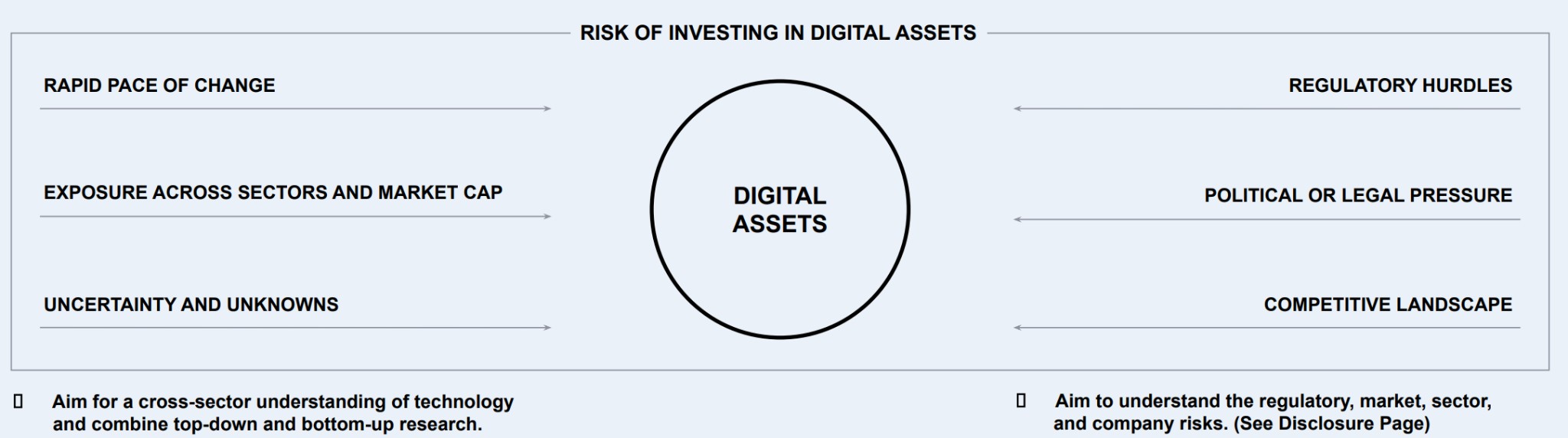
Goldman Sachs has acknowledged growing institutional demand for Bitcoin exposure, particularly after the launch of spot Bitcoin ETFs in the United States.
BlackRock described Bitcoin as a “unique diversifier” and highlighted its limited supply structure as one of the reasons some investors compare it to gold.
JP Morgan research remains more cautious, emphasizing that Bitcoin still behaves more like a risk asset than a defensive asset during many market stress periods.
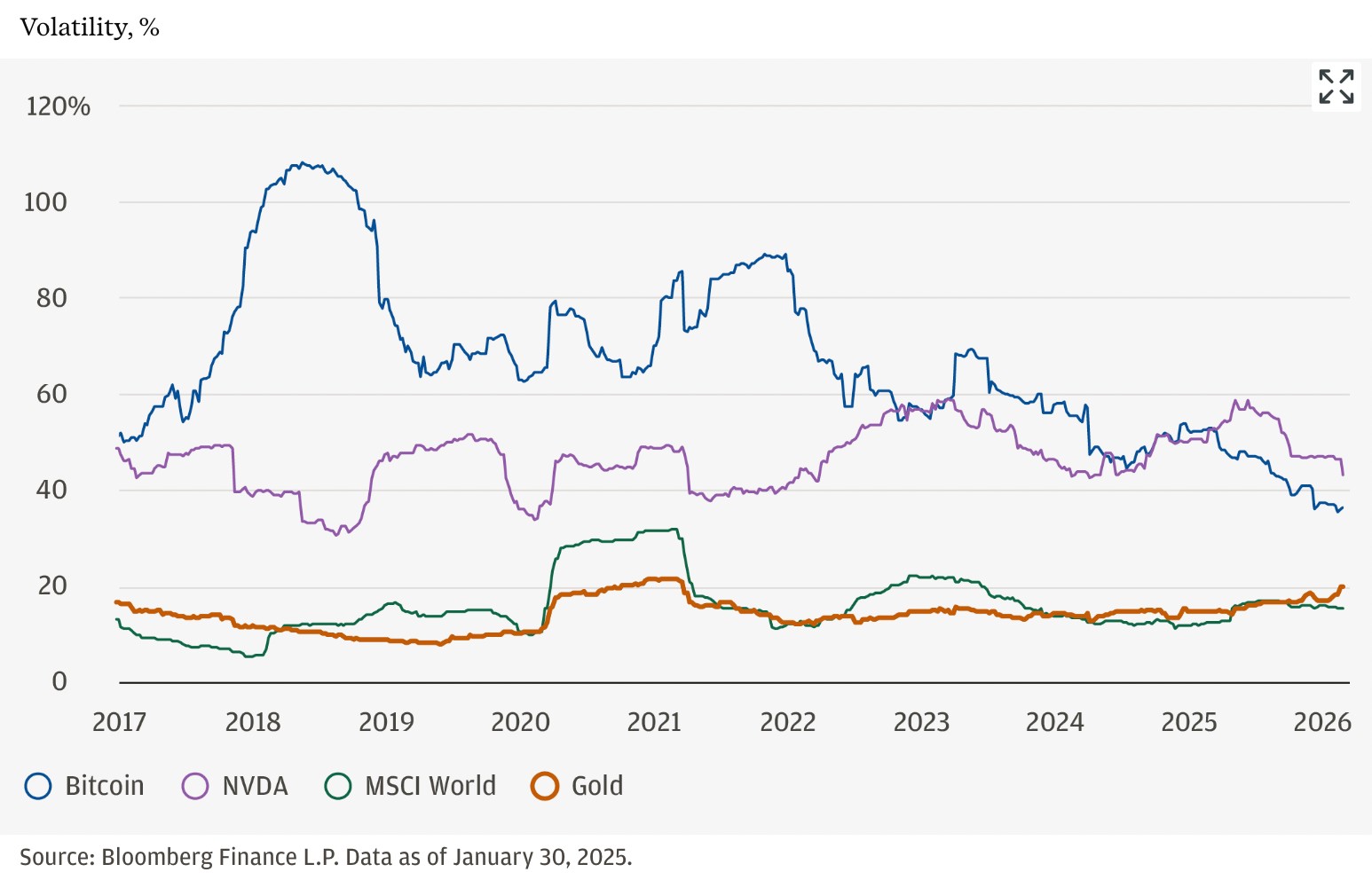
The Bank for International Settlements (BIS) also notes that Bitcoin’s volatility and speculative flows continue to limit its effectiveness as a stable store of value for most households.
Investors who actively follow Bitcoin market trends and short-term crypto opportunities can also monitor trading ideas and analytical updates published by experts on Telegram:
Anton Kharitonov – crypto trading ideas and market analysis;
Viktoras Karapetjanc – crypto signals and trading insights.
Theoretical research
From a theoretical perspective, Bitcoin partially satisfies several characteristics traditionally associated with gold and safe-haven assets.
Bitcoin’s fixed maximum supply of 21 million coins creates structural scarcity, which supports comparisons to gold. Unlike fiat currencies, Bitcoin cannot be expanded through central bank monetary policy.
Supporters of the “digital gold” thesis argue that Bitcoin offers:
scarcity;
global accessibility;
decentralization;
resistance to monetary debasement;
portability and divisibility.
However, critics point out that safe-haven assets must also demonstrate:
lower volatility;
stable purchasing power;
broad trust during crises;
behavior independent from speculative risk markets.
Academic and institutional studies show that Bitcoin still remains highly correlated with risk sentiment during many periods of financial stress. This creates a key contradiction: Bitcoin may theoretically function as a long-term inflation hedge while simultaneously behaving like a speculative technology asset in practice.
Survey data
To evaluate how retail investors actually perceive Bitcoin, TU conducted a proprietary quantitative study focused on inflation protection, investor trust, crisis behavior, and long-term capital preservation preferences.
Unlike many institutional studies focused on market performance and macroeconomic theory, TU specifically analyzed behavioral perception and practical investor preferences during periods of uncertainty.
Methodology
The research was based on a structured online survey conducted using the CAWI (Computer-Assisted Web Interviewing) methodology.
Sample composition: 1,386 retail investors.
Coverage: North America, Europe, Asia, and emerging markets.
Age: 18–60 years old.
Participation criteria: respondents with direct experience investing in cryptocurrency, stocks, gold, or foreign currencies during the previous market cycle.
Statistical confidence: 95%.
Estimated sampling deviation: ±2.6%.
Research team
The study was conducted by the analytical team at Traders Union:
Anastasiia Chabaniuk (Author, TU Research) – research design and interpretation.
Chinmay Soni (Fact-checker) – data validation and statistical verification.
Dan Blystone (Editor-in-Chief) – editorial and methodological supervision.
TU Research Team (Andrey Mastykin, Oleg Tkachenko) – data collection and analysis.
Bitcoin perception
To evaluate how investors classify Bitcoin conceptually, respondents were asked which description best matches their personal view of BTC.
How investors perceive Bitcoin:
Speculative high-growth asset – 49%.
Long-term inflation hedge – 27%.
Alternative payment system – 14%.
Temporary market trend – 10%.

Insight: Most retail investors still associate Bitcoin primarily with speculation rather than capital preservation.
Bitcoin as an inflation hedge
To analyze whether investors actually use Bitcoin defensively, respondents were asked how they react during periods of rising inflation.
| Actions during inflationary periods | Share of respondents |
|---|---|
| Buy gold | 38% |
| Hold US dollars/cash | 34% |
| Increase Bitcoin allocation | 18% |
| Use stablecoins | 10% |
Insight: Traditional defensive assets still dominate investor behavior during inflationary uncertainty.
Generational and income differences
The study identified significant demographic differences regarding Bitcoin trust and adoption.
Bitcoin viewed as “digital gold” by age:
18–34 years old – 41%.
35–49 years old – 24%.
50+ years old – 13%.
Bitcoin allocation willingness by income:
High income – 36%.
Middle income – 21%.
Lower income – 11%.

Insight: Younger and wealthier investors demonstrate significantly stronger confidence in Bitcoin’s long-term role.
Main concerns preventing “digital gold” adoption
To understand skepticism toward Bitcoin, respondents identified the main factors limiting their trust.
| Main concerns | Share of respondents |
|---|---|
| Extreme volatility | 71% |
| Regulatory uncertainty | 42% |
| Security risks and hacks | 33% |
| Lack of intrinsic value | 29% |
| Market manipulation concerns | 24% |
Insight: Volatility remains the single largest obstacle preventing Bitcoin from being viewed as a stable store of value.
Institutional narrative vs retail reality
To determine whether actual investor behavior aligns with institutional narratives about Bitcoin as “digital gold,” respondents were asked how closely their personal actions match the way large financial institutions describe Bitcoin.
| Response | Share of respondents |
|---|---|
| Partially – Bitcoin has potential, but remains too volatile | 44% |
| No – Bitcoin is still mainly speculative | 32% |
| Yes – Bitcoin already acts as “digital gold” | 18% |
| Unsure / no opinion | 6% |
Insight: Retail investors remain noticeably more cautious than institutional narratives suggest. While many acknowledge Bitcoin’s long-term potential, most still hesitate to treat it as a fully reliable defensive asset.
PDF version of the TU research
Download the full PDF version of the TU research to access additional analysis, detailed survey data, and extended findings from our analytical team. The report includes complete methodology, charts, and behavioral insights referenced throughout the study.
Practical implications for retail investors
The research suggests that Bitcoin occupies a hybrid position between speculative growth asset and emerging macro hedge rather than functioning as a full replacement for traditional safe havens.
Key practical takeaways include:
Bitcoin should not automatically be treated as a substitute for gold or cash reserves.
Portfolio diversification remains critical when investing in volatile digital assets.
Investor behavior during crises often differs from long-term ideological beliefs.
Institutional adoption improves legitimacy but does not eliminate volatility risks.
Bitcoin may function more effectively as a partial inflation hedge over long time horizons rather than as a short-term defensive asset.
Risk management and allocation sizing remain essential.
Separate speculative exposure from long-term capital preservation goals.
Understand that institutional narratives do not always reflect actual retail investor behavior.
As institutional participation continues growing through ETFs and regulated financial products, Bitcoin’s role in global portfolios may continue evolving. However, the research suggests that widespread perception of Bitcoin as “digital gold” remains incomplete and highly dependent on investor demographics, market conditions, and future regulatory developments.
Below is a comparison of leading crypto exchanges commonly used by long-term Bitcoin investors and crypto market participants:
| Coinbase | OKX | BTCC | Cryptohopper | Crypto.com | |
|---|---|---|---|---|---|
|
Demo account |
No | Yes | Yes | No | No |
|
Min. Deposit, $ |
10 | 10 | 10 | No | 1 |
|
Coins Supported |
400+ | 600+ | 399 | 1000 | 400+ |
|
Spot Taker fee, % |
0.5 | 0.1 | 0.3 | 0 | 0.5 |
|
Spot Maker Fee, % |
0.5 | 0.08 | 0.2 | 0 | 0.25 |
|
Alerts |
Yes | Yes | No | Yes | Yes |
|
Copy trading |
No | Yes | Yes | Yes | No |
|
TU overall score |
8.5 | 8.46 | 8.08 | 7.8 | 7.76 |
|
Open an account |
Go to broker Your capital is at risk. |
Go to broker Your capital is at risk. |
Go to broker Your capital is at risk.
|
Go to broker Your capital is at risk. |
Go to broker Your capital is at risk. |
TU analytical Bitcoin outlook for 2026
Based on the survey findings, institutional research, macroeconomic trends, and current retail investor behavior, our analysts expect BTC to remain positioned between a speculative growth asset and an increasingly institutionalized macro instrument in 2026.
While institutional participation through ETFs and regulated financial products may continue supporting long-term adoption, volatility and changing market sentiment are still expected to play a major role in BTC price dynamics. The table below presents the TU analytical outlook for BTC in 2026 under several market development scenarios.
| Month | Minimum Price, $ | Average Price, $ | Maximum Price, $ |
|---|---|---|---|
| November 2026 | 37 | 38 | 39 |
| December 2026 | 34 | 34 | 35 |
Data sources and methodology references
ARK Invest. Bitcoin as a Monetary Network and Store of Value Research.
BlackRock. Bitcoin: A Unique Diversifier.
Goldman Sachs. Crypto: A New Asset Class?
J.P. Morgan Private Bank. Bitcoin’s Role in Investing: What You Need to Know.
Bank for International Settlements (BIS, 2023). Crypto Shocks and Retail Losses.
National Bureau of Economic Research (NBER). Risks and Returns of Cryptocurrency.
European Securities and Markets Authority (ESMA, 2024). Annual Report 2024.
Portfolio Visualizer. Monte Carlo Simulation for Portfolio Risk Analysis.
ARK Invest. Big Ideas 2025: Bitcoin and Monetary Network Thesis.
International Monetary Fund (IMF, 2023). G20 Note on the Macrofinancial Implications of Crypto Assets.
World Bank (2022). Crypto-Assets Activity around the World: Evolution and Macro-Financial Drivers.
arXiv (2025). Institutional Adoption and Correlation Dynamics: Bitcoin's Evolving Role in Financial Markets.
Cambridge Centre for Alternative Finance (2025). Global Cryptoasset Benchmarking Study.
IdSurvey. CAWI Methodology Overview.
Previous volumes in this series
Conclusion
TU Research's findings make it clear: despite mainstream narratives hailing Bitcoin as 'digital gold,' the majority of investors remain unconvinced. With almost half labelling it a speculative asset and less than a third considering it an inflation hedge, Bitcoin's reputation is still rooted more in its volatility than its stability. For instance, sudden price surges and crashes continue to underscore the high-risk nature of crypto investments, making real-world adoption as a store of value slow at best. Ultimately, Bitcoin’s future identity will depend on whether it can transcend hype cycles and earn the widespread trust that true safe havens demand.
FAQs
How does Bitcoin’s volatility compare to traditional safe-haven assets like gold?
What are the most common investor behaviors during periods of financial crisis regarding Bitcoin?
Which characteristics make Bitcoin similar to and different from gold as a store of value?
Why do some investors consider Bitcoin a potential hedge against inflation?
Editors' Top Picks and Insights






Related Articles
Team that worked on the article
Anastasiia has 17 years of experience in finance and content marketing. She believes that the support of information and expert opinion is very important for the success of investors and new traders.
Dan Blystone began his trading career in 1998 as an arbitrage clerk on the floor of the Chicago Mercantile Exchange (CME). He later traded bond and Eurex futures at proprietary firms such as Altea Trading, gaining valuable experience in high-frequency trading and risk management.
Chinmay Soni is a financial analyst with more than 5 years of experience in working with stocks, Forex, derivatives, and other assets. As a founder of a boutique research firm and an active researcher, he covers various industries and fields, providing insights backed by statistical data.

-
 Afghanistan
-
 Albania
-
 Algeria
-
 Angola
-
 Argentina
-
 Armenia
-
 Australia
-
 Austria
-
 Azerbaijan
-
 Bahamas
-
 Bahrain
-
 Bangladesh
-
 Belarus
-
 Belgium
-
 Bolivia
-
 Botswana
-
 Brazil
-
 Brunei
-
 Bulgaria
-
 Cambodia
-
 Cameroon
-
 Canada
-
 Chile
Chile
-
 China
China
-
 Colombia
-
 Congo
Congo
-
 Costa Rica
-
 Cote d'Ivoire
-
 Croatia
-
 Cuba
Cuba
-
 Cyprus
-
 Czechia
-
 DR Congo
-
 Denmark
-
 Dominican Republic
-
 Ecuador
-
 Egypt
Egypt
-
 El Salvador
-
 Estonia
-
 Eswatini
-
 Ethiopia
-
 Finland
-
 France
-
 Georgia
-
 Germany
-
 Ghana
Ghana
-
 Greece
-
 Haiti
Haiti
-
 Hong Kong
-
 Hungary
-
 India
India
-
 Indonesia
-
 Iran, Islamic republic
-
 Iraq
Iraq
-
 Ireland
-
 Israel
-
 Italy
Italy
-
 Jamaica
-
 Japan
Japan
-
 Jordan
-
 Kazakhstan
-
 Kenya
Kenya
-
 Korea
Korea
-
 Kuwait
-
 Kyrgyzstan
-
 Laos
Laos
-
 Latvia
-
 Lebanon
-
 Lesotho
-
 Libya
Libya
-
 Lithuania
-
 Luxembourg
-
 Madagascar
-
 Malaysia
-
 Malta
Malta
-
 Mauritius
-
 Mexico
-
 Moldova
-
 Mongolia
-
 Montenegro
-
 Morocco
-
 Mozambique
-
 Myanmar
-
 Namibia
-
 Nepal
Nepal
-
 Netherlands
-
 New Zealand
-
 Nigeria
-
 North Macedonia
-
 Norway
-
 Oman
Oman
-
 Pakistan
-
 Palestine
-
 Panama
-
 Papua New Guinea
-
 Paraguay
-
 Peru
Peru
-
 Philippines
-
 Poland
-
 Portugal
-
 Puerto Rico
-
 Qatar
Qatar
-
 Reunion
-
 Romania
-
 Rwanda
-
 Saudi Arabia
-
 Serbia
-
 Singapore
-
 Slovakia
-
 Slovenia
-
 Somalia
-
 South Africa
-
 Spain
Spain
-
 Sri Lanka
-
 Sweden
-
 Switzerland
-
 Syria
Syria
-
 Taiwan
-
 Tajikistan
-
 Tanzania
-
 Thailand
-
 Trinidad and Tobago
-
 Tunisia
-
 Turkey
-
 UAE
UAE
-
 Uganda
-
 Ukraine
-
 United Kingdom
-
United States
-
 Uruguay
-
 Uzbekistan
-
 Venezuela
-
 Vietnam
-
 Yemen
Yemen
-
 Zambia
-
 Zimbabwe
- Forex
- Crypto












