
Socially Responsible Investing (SRI): Full Guide


Editorial Note: While we adhere to strict Editorial Integrity, this post may contain references to products from our partners. Here's an explanation for How We Make Money. None of the data and information on this webpage constitutes investment advice according to our Disclaimer.

Plus500 - Best Forex broker for 2026 (United States)

Socially Responsible Investing (SRI) is an investment strategy that focuses on selecting investment securities based on ethical, social, and environmental criteria, alongside financial considerations.
Socially responsible investing (SRI) is becoming one of the prominent ways of investing, especially in today’s world, where people are more conscious of the impact of a company’s activities on society and the environment. In this article, we discuss the principles and practices of SRI and how investors can align their portfolios with values they hold dear. Additionally, we stress the importance of monitoring investment portfolios to ensure ethical alignment in symbiosis with optimal performance.
What is Socially Responsible Investing (SRI)?
Socially Responsible Investing (SRI) is one of the investment strategies gaining popularity in the modern-day financial industry. It is an interesting concept where investors seek financial returns by investing in securities of companies that favor societal and environmentally friendly practices. This investment technique subtly promotes positive societal changes as investment decisions are strictly influenced by financial returns and the alignment of the company to ethical and sustainable practices.
Therefore, investors seek to make financial returns by investing in companies with positive environmental and social policies, while avoiding securities of companies that do not adhere to such policies. For example, investing in the renewable energy industry like solar, wind, and hydroelectric power offers both financial returns and encourages environmentally friendly practices.
Furthermore, it is worth noting that several indexes are designed to track the investment performance of a company’s securities based on environmental, social, and governance (ESG) criteria. Examples of SRI indexes include the MSCI Global sustainability indexes, Dow Jones sustainability indices, S&P 500 ESG index, NASDAQ OMX CRD Global sustainability index, etc.
Best socially responsible investments
As earlier noted, responsible investing is one of the subtle ways of promoting social changes for a safer environment. Hence, socially responsible funds are becoming more popular in modern investment practices, especially among investors who care about safe and better environmental practices.
J.P. Morgan noted that “ESG investing is fast growing in every geography and assets indicated as following ESG principles may soon represent 44% of the global asset under management (AUM).” Also, a survey reveals that “70% of Americans believe it’s either “somewhat” or “very important” for companies to make the world a better place.” These trends suggest that SRI holds great potential for investors as the global economy favors environmentally-friendly products.
Now, let’s explore some of the top socially responsible investment funds that enable SRI investing.
Comparison of SRI funds
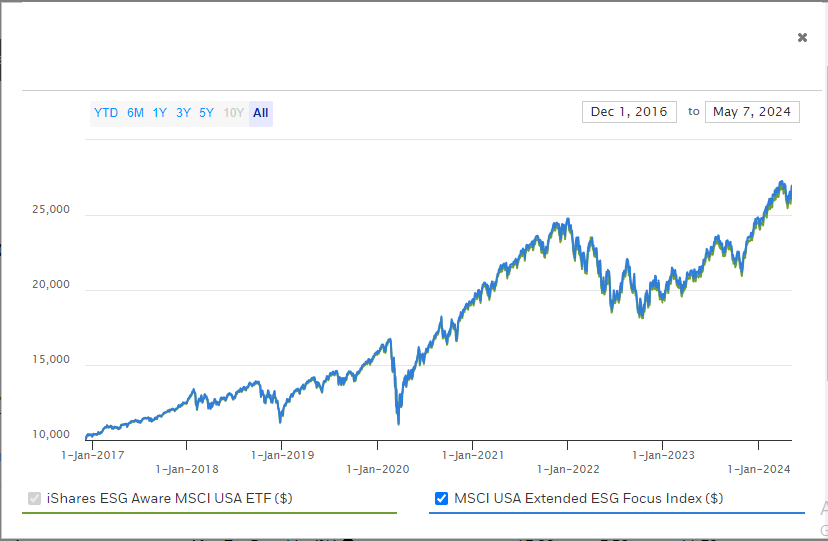 Image from Invesco.com
The above image shows the hypothetical performance of a $10,000 investment in Invesco Solar ETF from 2015 to March 31, 2024, assuming cash and assets were not withdrawn from the index.
iShares ESG Aware MSCI USA ETF (ESGU)
The iShares ESG Aware MSCI USA ETF (ESGU) is also an exchange-traded fund (ETF) that tracks the performance of the MSCI USA Extended ESG Focus Index while maintaining similar risk and returns of the parent index. It exposes investors to stocks within the U.S. Market, particularly stocks backed by favorable environmental, social, and government (ESG) metrics.
ESGU is a good choice for investors whose interest aligns with building a long-term portfolio of assets backed by ethical and social considerations. As of May 2024, ESGU has a total asset under management of $12.71B, a net expense ratio of 0.15, a management fee of 0.155, and a total return of 28.97%.
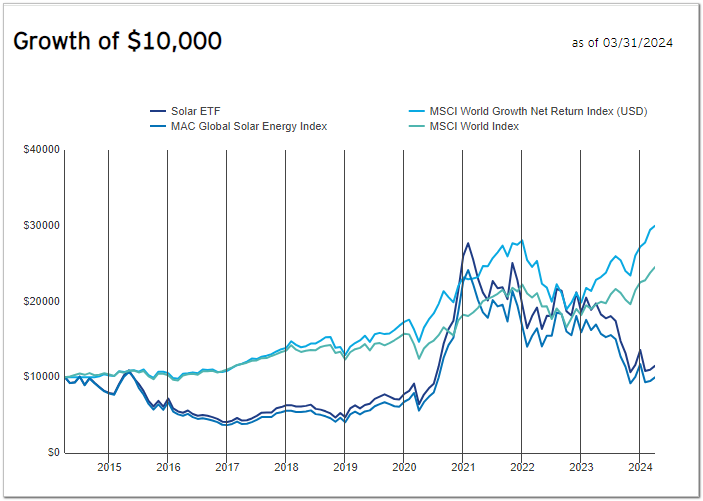 Image from ishares.com
The above chart depicts a hypothetical growth of investing $10,000 in ESGU from December 01, 2016, to May 07, 2024, assuming dividends and capital were reinvested.
Putnam Sustainable Leaders (PNOPX)
Putnam Sustainable Leaders (PNOPX) is a mutual fund established in 2009 with headquarters in Boston, Massachusetts, USA. The company aims to provide investors with sustainable investment opportunities with the potential for long-term capital appreciation. PNOPX has a total asset under management of 6.3B, an expense ratio of 0.92%, and a trailing twelve-month yield of 0.16% as of May 08, 2024. Besides, the fund has done a turnover (fiscal year end) of 25%.
 Image from Putnam.com
The above image shows the hypothetical growth of a $10,000 investment, assuming cash and assets were not withdrawn from the index.
TIAA-CREF Social Choice Equity (TICRX)
The TIAA-CREF Social Choice Equity is another recommended fund for investors interested in socially responsible investing. TICRX’s inception date was on March 31, 2006; it invests up to 80% of its assets in large-cap equity securities whose activities align with environmental, social, and governance (ESG) criteria. It has a total asset under management of $6.0B, a net expense ratio of 0.46%, a gross expense ratio of 0.46%, total holdings of 65, and a turnover of 15%, as of April 30, 2024.
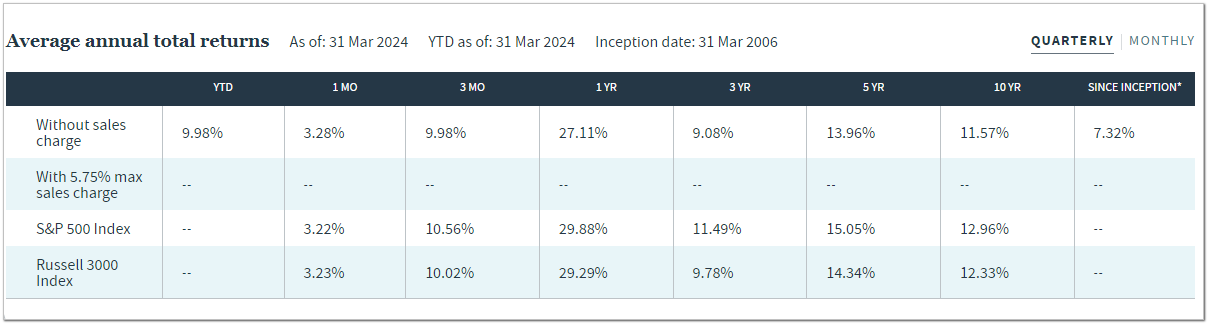 Image from nuveen.com
The above image shows the performance data of the investment returns since the fund’s inception.
Parnassus Mid Cap Fund (PARMX)
Parnassus Mid Cap Fund was established on April 29, 2005. It invests up to 80% of its net assets in small and mid-cap companies with potential for capital appreciation. PARMX requires a minimum initial investment of $2,000 and a minimum of $50 for subsequent investment. As of May 08, 2024, the fund has $3.359M as the total asset under management, an expense ratio of 0.96%, a gross expense ratio of 0.98%, and a turnover of 42%.
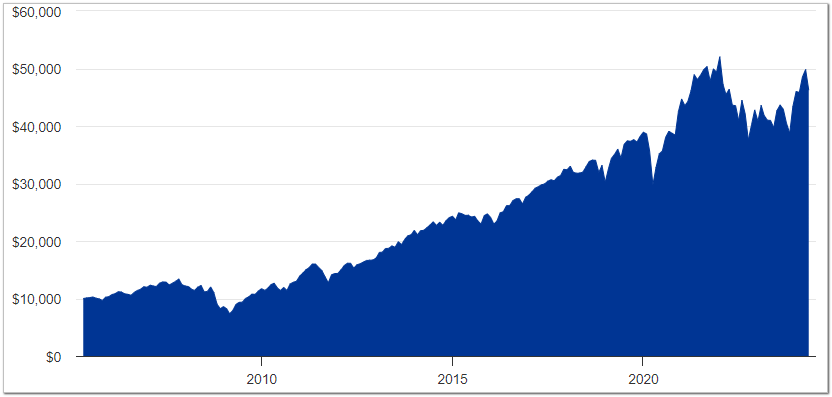 Image from Parnassus.com
The above chart depicts the hypothetical growth of $10,000 since the fund’s inception from April 29, 2005, to April 30, 2024, assuming dividends and capital gains were reinvested.
iShares ESG Aware MSCI EAFE ETF (ESGD)
iShares ESG Aware MSCI EAFE ETF seeks to track the performance of the MSCI EAFE ETF index composed of large and mid-cap stocks. It invests in stocks with positive environmental, social, and governance practices from developed markets, usually outside the U.S. and Canada. ESGD has a total asset under management of $8.2B, an expense ratio of 0.20%, and a daily volume of 213,384.00, as of May 08, 2024.
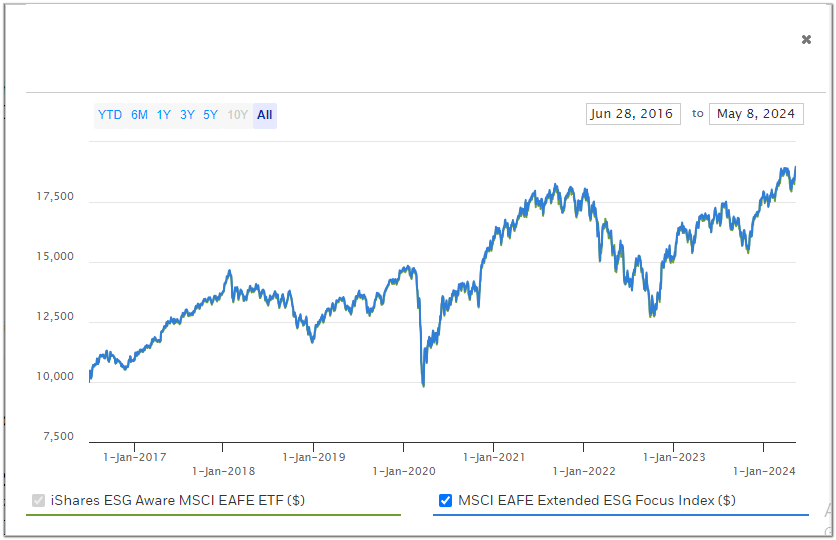 Image from ishares.com
The above chart depicts a hypothetical growth of a $10,000 investment from the fund from June 28, 2016, to May 08, 2024, assuming capital gain and dividend were reinvested.
iShares Global Clean Energy ETF (ICLN)
iShares Global Clean Energy ETF exposes investors to global companies involved in clean energy production from solar, wind, and other environmentally friendly technologies. ICLN seeks to track the investment performance of the index in the clean energy sector around the world. It has a total asset under management of $ 2.2B, an expense ratio of 0.41%, a daily volume of 3.2M, and a closing price of 13.91, as of May 08, 2024.
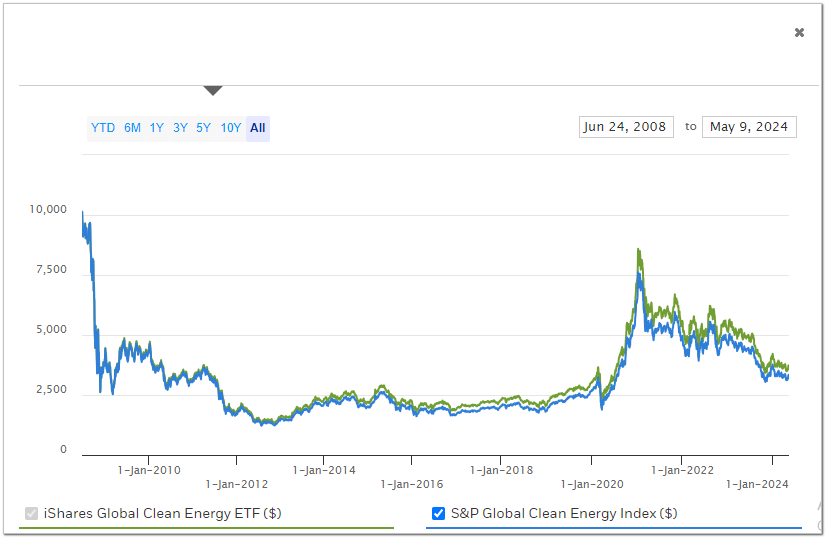 Image from ishares.com
The above chart shows the hypothetical growth of a $10,000 investment from June 24, 2008, to May 09, 2024, assuming dividends and capital gains were reinvested.
| ETF | Assets under management | Cost | Expense ratio |
|---|---|---|---|
Invesco Solar ETF (TAN) | $1.040B | $43.20 | 0.67% |
iShares ESG Aware MSCI USA ETF (ESGU) | $12.71B | $114.40 | 0.15% |
Putnam Sustainable Leaders (PNOPX) | 6.3B | $122.16 | 0.92% |
TIAA-CREF Social Choice Equity (TICRX) | $6.0B | $24.25 | 0.46% |
Parnassus Mid Cap Fund (PARMX) | $3.359M | $38.46 | 0.96% |
iShares ESG Aware MSCI EAFE ETF (ESGD) | $8.2B | $80.59 | 0.20% |
iShares Global Clean Energy ETF (ICLN) | $ 2.2B | $13.85 | 0.41% |
Choosing the right socially responsible investment is only half of the equation. To actually build and manage an SRI portfolio, investors also need a reliable broker that provides access to ESG-focused funds, transparent fees, and strong regulatory protection. Below is a comparison of top brokers that support socially responsible investing and offer convenient access to ESG ETFs, mutual funds, and global markets.
| Plus500 | Trading.com USA | OANDA | FOREX.com | Venom by Cobra Trading | |
|---|---|---|---|---|---|
|
Min. deposit, $ |
100 | 50 | No | 100 | 5000 |
|
Tradable assets |
2800 | 69 | 129 | 5500 | No |
|
Standard EUR/USD spread |
0.7 | 1.1 | 0.3 | 1.0 | 0.4 |
|
Max. leverage |
1:300 | 1:50 | 1:200 | 1:50 | 1:4 |
|
Max. Regulation Level |
Tier-1 | Tier-1 | Tier-1 | Tier-1 | Tier-1 |
|
TU overall score |
7.7 | 6.78 | 6.69 | 6.51 | 6.42 |
|
Open an account |
Go to broker 81% of retail CFD accounts lose money. |
Go to broker Your capital is at risk. |
Go to broker Your capital is at risk. |
Study review | Study review |
How to build an SRI Portfolio?
Follow the steps below to build an SRI portfolio:
Identify Your Values: The first step towards building an SRI portfolio is identifying companies that align with your values (e.g., climate change, human rights, etc.)
Research SRI Investment Options: Research and invest in a company’s SRI funds, ETFs (Exchange-traded funds), individual stocks, or bonds that align with your value. Evaluate companies based on their reputation, mission, and performance over time
Diversify Your Portfolio: Maintain a diversified SRI portfolio to reduce risk
Monitor Performance and Impact: Continually monitor the performance of your SRI investments. Also, keep a tab on the social and environmental impact of the company
Is socially responsible investing profitable?
Yes, socially responsible investing can be a profitable investment. Different studies have shown that investing with ethical considerations is a smart way to support a good course and earn financial returns. For example, a report by BlackRock in 2022 revealed that sustainable investment not only aligns with investors' values but also generates higher financial returns. Besides, in 2023, a study by MSCI conducted on over 3,000 companies shows that those with ESG ratings outperform their counterparts.
Remember that investing involves risks

The stock market can be volatile, and the value of your holdings may fluctuate. Stay informed about the companies you’ve invested in and keep an eye on market trends. Remember that investing is a long-term endeavor, and it’s essential to review and adjust your portfolio periodically based on your financial goals and risk tolerance.
By following these steps and staying informed, you can start your journey into the world of online stock investing. Remember that investing involves risks, and it’s crucial to do thorough research and seek professional advice if needed. Happy investing!
Conclusion
Socially Responsible Investing (SRI) represents a compelling way for investors to align their financial goals with their core values, enabling positive impact alongside potential profits. By choosing funds like the iShares ESG Aware MSCI USA ETF or the Parnassus Mid Cap Fund, investors not only support ethical and sustainable business practices but can also achieve strong portfolio performance. Studies show that companies with robust ESG ratings often outperform their peers, underlining the financial viability of responsible investing. Ultimately, SRI empowers individuals to drive meaningful change while building long-term wealth, proving that investing with purpose can be both rewarding and impactful.
FAQs
How does Socially Responsible Investing (SRI) differ from traditional investing approaches?
Can Socially Responsible Investing (SRI) be incorporated into a diversified global portfolio?
What types of investment vehicles are commonly used in Socially Responsible Investing (SRI)?
Why is ongoing portfolio monitoring important in Socially Responsible Investing (SRI)?
Editors' Top Picks and Insights




Related Articles
Team that worked on the article
Joshua Francis is a professional Forex trader with 4+ years of experience in the financial industry. He trades the XAU/USD and GBP/JPY pairs.
Dan Blystone began his trading career in 1998 as an arbitrage clerk on the floor of the Chicago Mercantile Exchange (CME). He later traded bond and Eurex futures at proprietary firms such as Altea Trading, gaining valuable experience in high-frequency trading and risk management.
Chinmay Soni is a financial analyst with more than 5 years of experience in working with stocks, Forex, derivatives, and other assets. As a founder of a boutique research firm and an active researcher, he covers various industries and fields, providing insights backed by statistical data.
CFD is a contract between an investor/trader and seller that demonstrates that the trader will need to pay the price difference between the current value of the asset and its value at the time of contract to the seller.
Forex leverage is a tool enabling traders to control larger positions with a relatively small amount of capital, amplifying potential profits and losses based on the chosen leverage ratio.
Diversification is an investment strategy that involves spreading investments across different asset classes, industries, and geographic regions to reduce overall risk.
Risk management is a risk management model that involves controlling potential losses while maximizing profits. The main risk management tools are stop loss, take profit, calculation of position volume taking into account leverage and pip value.
Ethereum is a decentralized blockchain platform and cryptocurrency that was proposed by Vitalik Buterin in late 2013 and development began in early 2014. It was designed as a versatile platform for creating decentralized applications (DApps) and smart contracts.
-
 Afghanistan
-
 Albania
-
 Algeria
-
 Angola
-
 Argentina
-
 Armenia
-
 Australia
-
 Austria
-
 Azerbaijan
-
 Bahamas
-
 Bahrain
-
 Bangladesh
-
 Belarus
-
 Belgium
-
 Bolivia
-
 Botswana
-
 Brazil
-
 Brunei
-
 Bulgaria
-
 Cambodia
-
 Cameroon
-
 Canada
-
 Chile
Chile
-
 China
China
-
 Colombia
-
 Congo
Congo
-
 Costa Rica
-
 Cote d'Ivoire
-
 Croatia
-
 Cuba
Cuba
-
 Cyprus
-
 Czechia
-
 DR Congo
-
 Denmark
-
 Dominican Republic
-
 Ecuador
-
 Egypt
Egypt
-
 El Salvador
-
 Estonia
-
 Eswatini
-
 Ethiopia
-
 Finland
-
 France
-
 Georgia
-
 Germany
-
 Ghana
Ghana
-
 Greece
-
 Haiti
Haiti
-
 Hong Kong
-
 Hungary
-
 India
India
-
 Indonesia
-
 Iran, Islamic republic
-
 Iraq
Iraq
-
 Ireland
-
 Israel
-
 Italy
Italy
-
 Jamaica
-
 Japan
Japan
-
 Jordan
-
 Kazakhstan
-
 Kenya
Kenya
-
 Korea
Korea
-
 Kuwait
-
 Kyrgyzstan
-
 Laos
Laos
-
 Latvia
-
 Lebanon
-
 Lesotho
-
 Libya
Libya
-
 Lithuania
-
 Luxembourg
-
 Madagascar
-
 Malaysia
-
 Malta
Malta
-
 Mauritius
-
 Mexico
-
 Moldova
-
 Mongolia
-
 Montenegro
-
 Morocco
-
 Mozambique
-
 Myanmar
-
 Namibia
-
 Nepal
Nepal
-
 Netherlands
-
 New Zealand
-
 Nigeria
-
 North Macedonia
-
 Norway
-
 Oman
Oman
-
 Pakistan
-
 Palestine
-
 Panama
-
 Papua New Guinea
-
 Paraguay
-
 Peru
Peru
-
 Philippines
-
 Poland
-
 Portugal
-
 Puerto Rico
-
 Qatar
Qatar
-
 Reunion
-
 Romania
-
 Rwanda
-
 Saudi Arabia
-
 Serbia
-
 Singapore
-
 Slovakia
-
 Slovenia
-
 Somalia
-
 South Africa
-
 Spain
Spain
-
 Sri Lanka
-
 Sweden
-
 Switzerland
-
 Syria
Syria
-
 Taiwan
-
 Tajikistan
-
 Tanzania
-
 Thailand
-
 Trinidad and Tobago
-
 Tunisia
-
 Turkey
-
 UAE
UAE
-
 Uganda
-
 Ukraine
-
 United Kingdom
-
United States
-
 Uruguay
-
 Uzbekistan
-
 Venezuela
-
 Vietnam
-
 Yemen
Yemen
-
 Zambia
-
 Zimbabwe
- Forex
- Crypto











