
What Is A Smart Contract In Crypto?


Editorial Note: While we adhere to strict Editorial Integrity, this post may contain references to products from our partners. Here's an explanation for How We Make Money. None of the data and information on this webpage constitutes investment advice according to our Disclaimer.
A crypto smart contract system is code on a blockchain that runs by itself once set rules are met. It powers swaps on DEXs, lending, NFT actions, and on-chain governance. Traders use these contracts for fast settlement, clear pricing, and 24 hour markets. Smart contracts remove middlemen and execute exactly as written, but they also carry risks like bugs, gas costs, and oracle issues.
Smart contracts are not only a feature of blockchain; they form its core system. They guide how DeFi lending works, how NFTs are minted, and how trades settle on decentralized exchanges. Without smart contracts, crypto would act only as digital money. With them, it becomes a full programmable market that runs without intermediaries.
This article explains what a smart contract in cryptocurrency is and shows how traders can gain from using them. It also highlights the risks that come from poor contract design or unsafe platforms, so traders can make informed choices in DeFi, NFTs, and on-chain trading.
Risk warning: Cryptocurrency markets are highly volatile, with sharp price swings and regulatory uncertainties. Research indicates that 75-90% of traders face losses. Only invest discretionary funds and consult an experienced financial advisor.
Crypto smart contracts explained
A cryptocurrency smart contract is a simple program stored on a blockchain that runs on its own when set rules are met. It does not need a broker or any manual approval. The logic is fixed in code, so every action follows the same steps each time.
For example, on a DeFi lending platform, if a user deposits $1,000 worth of ETH, the contract can approve a loan of up to $750 in stablecoins. The process is automatic and does not use any middleman.
This makes it different from traditional contracts that require enforcement by courts, brokers, or intermediaries. In short, smart crypto contract applications represent enforceable logic baked into code.
How smart contracts actually work
Smart contracts are not just automated agreements. They are small programs that run on a blockchain. Traders who use DeFi, NFTs, and DEXs benefit when they understand how these programs are written and executed.
The language of execution
A smart crypto contract is written in a language made for blockchains. Different chains use different languages. Keep these simple notes in mind:
Solidity. Used on Ethereum and many EVM chains. It is the most common language for a smart crypto contract.
Move. Used by Aptos and Sui. It focuses on safety and clear asset rules.
Rust. Used on Solana, NEAR, and others. It gives performance and memory safety for fast chains.
For non-developers there are tools that help you test contracts without risk. Remix and Hardhat let developers run contracts in a local environment. Contracts are compiled to bytecode and then deployed to the chain through a wallet or command line tool.
After deployment, a crypto smart contract gets an address on the chain. The source code may be visible if the team verifies it. The contract code is usually immutable. Some designs use upgradeable proxies, but those require extra trust.
The logic layer
A cryptocurrency smart contract program acts on inputs, checks conditions, and then runs actions. Inputs can be wallet addresses, token amounts, or data from an oracle. Conditions are the rules in the code. Actions include transfers, minting, or changing a protocol parameter.
Example. In a swap on Uniswap, the contract reads the tokens and amounts. It uses an AMM formula to calculate the result. Then it moves tokens and updates pool balances in a single transaction. This simple if-then style makes smart contracts crypto predictable. Anyone can audit the logic if the code is public.
Consensus-based enforcement
When you request a smart contract the network runs the code and records the result. The validation happens across many nodes. This gives trustless execution. It also makes the result final. Anyone with a wallet can interact with the contract from anywhere.
Gas fees
Executing a smart contract costs gas. Gas is a fee paid to the network. On busy days gas can be very high. High gas can wipe out small trades. Many traders use Layer 2 networks to lower fees.
High gas fees can turn profitable trades unprofitable. Traders should monitor tools like ETH Gas Station, Blocknative, or Etherscan Gas Tracker to optimize entry and exit timing, or use Layer 2 solutions like Arbitrum and Optimism for reduced costs.
Real use cases: where traders interact with smart contracts daily
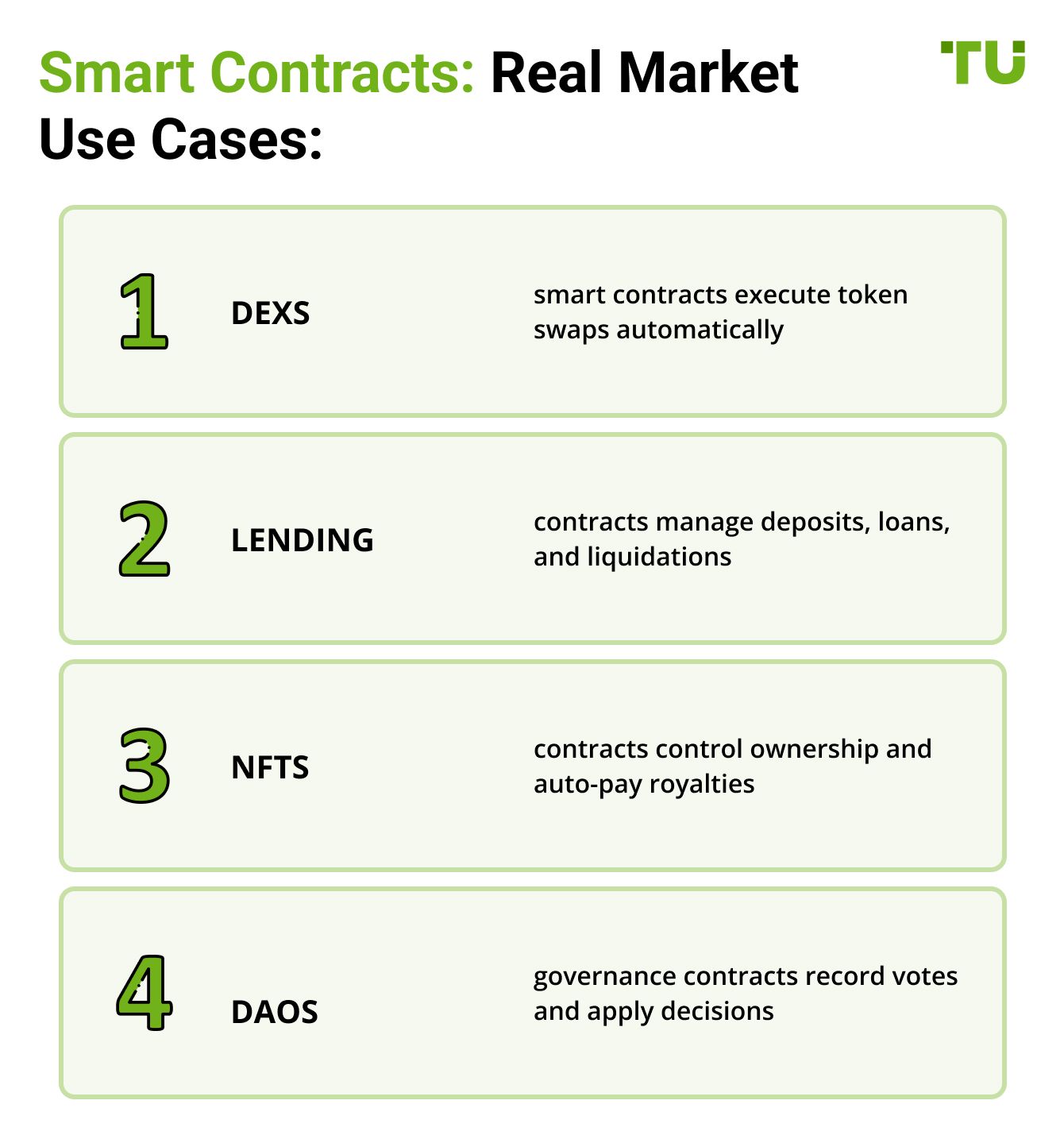
Smart contracts are not only tools for developers. Each time you swap a token, stake assets, or vote in Web3, you interact with a smart crypto contract. Traders use these contracts every day across many parts of the market.
Decentralized Exchanges (DEXs)
Smart crypto contracts power all trading on decentralized exchanges. Platforms like Uniswap, Curve, and PancakeSwap run all day using AMM formulas. They let traders swap tokens without order books or custodians.
When you initiate a swap on Uniswap:
The smart contract reads token reserves from the liquidity pool.
Applies the constant product formula (x * y = k) to calculate output.
Accounts for slippage tolerance and price impact.
Executes token transfers and adjusts the pool in a single atomic transaction.
Lending protocols
Lending platforms like Aave and Compound run fully on smart contracts. These contracts handle deposits, loans, and liquidations without manual control.
Smart contracts set interest rates, watch collateral levels, and trigger liquidations. They also enable flash loans that must be repaid in the same block. Traders can borrow stablecoins against assets like ETH or WBTC to take long or short positions. The smart contract enforces the rules and removes the need for a custodian.
NFT mechanics and royalties
NFTs use smart crypto contracts to control ownership, metadata, access rights, and royalties. Each mint, sale, or transfer is handled by a contract. Platforms like OpenSea and Blur use contracts to mint tokens, store metadata, and send royalties to creators.
Example. When you sell an NFT the contract checks the royalty rate and sends the correct share to the creator. This step is automatic and cannot be skipped.
DAOs and token governance
DAOs use smart crypto contracts to run governance. Token holders vote and the contract counts votes and applies changes.
Smart contracts in DAOs handle:
proposal submission and review logic;
snapshot or on-chain voting;
execution of winning proposals;
treasury disbursement and policy changes.
Examples:
Uniswap DAO governs the protocol’s fee tiers, liquidity mining, and cross-chain deployments.
MakerDAO uses voting contracts to change DAI stability fee, debt ceilings, or collateral onboarding.
Risks and pitfalls of smart contracts
Exploits, bugs, and protocol risk
Common risks include reentrancy bugs, faulty upgrade patterns, and weak access controls. Past hacks show how one small error in the code can drain a protocol. These incidents highlight why traders must check audits and review contract settings before they deposit funds.
Oracle failures
A smart crypto contract cannot pull outside data on its own. It needs an oracle for prices. If the oracle sends late or wrong data the contract may trigger bad trades or unwanted liquidations.
For example, a fast price drop in a thin market can cause sudden liquidations. The contract will treat the price as correct and act on it at once.
Gas wars and network clustering
When the network is busy gas fees rise fast. A trader may face failed transactions or pay more than expected. This can turn a profitable move into a loss. Watch the pending transaction pool during news events. Bots can race ahead of your trade. This can raise your cost or block your position entry.
Forex vs crypto smart contracts
Forex traders face a different system when they move into crypto. In Forex, you deal with brokers and platforms. In crypto, a smart contract in cryptocurrency controls the trade. This means the code itself becomes part of your risk. You must check safety, audits, and basic settings before you use any protocol.
| Feature | Forex | Crypto with smart contracts |
|---|---|---|
| Counterparty | Centralized; trades executed through brokers, banks, and liquidity providers | Decentralized; executed by on-chain, autonomous code without intermediaries |
| Execution time | Sub-second, high-frequency trades on centralized servers | Real-time but dependent on network congestion and gas fee prioritization |
| Market hours | 24/5; closed on weekends and public holidays | 24/7; global access, no downtime, continuous trading |
| Transparency | Limited; order books and pricing controlled by the broker | Full; contract logic and execution visible and auditable on-chain |
| Fees and costs | Spreads, commissions, overnight fees | Gas fees per transaction; no ongoing broker or rollover fees |
| Asset scope | Limited to fiat pairs and commodities offered by the broker | Thousands of tokens, DeFi pairs, NFTs, and synthetic assets |
Security and audits: how to know if a contract is safe
Using a smart crypto contract gives traders freedom but also places full risk on the user. There is no central party to reverse a wrong action or recover stolen funds. This is why checking contract safety is a key step before using any DeFi or NFT platform.
The steps below help traders review a contract before they deposit funds.
Audit status: independent code reviews
Check if the project has a recent audit. Audits review the code and list all risks. Trusted auditors include CertiK, Quantstamp, Trail of Bits, OpenZeppelin, and Halborn. If a contract has no audit, the risk is higher.
Look for public reports. They must be recent and show that issues were fixed. Projects should request new audits after upgrades.
Open-source code
If the code is not open source you cannot review it. Hidden code is a major warning sign. Check the project’s GitHub page. Good teams publish clear code, explain updates, and keep the repository active. Leading platforms like Uniswap and Aave share full repositories with notes and updates. This level of transparency is a positive sign.
Bug bounty programs: incentivized vigilance
Many top protocols engage the white-hat hacker community to proactively test and report bugs.
Key platforms:
Immunefi alone has helped recover over $170M worth of funds since 2020 by rewarding responsible disclosure of vulnerabilities.
Trader tip. Look for active bounties with meaningful rewards. They often signal a responsible team and safer contract design.
What the future holds for crypto smart contracts
Smart contracts are moving beyond simple automation. The next wave brings cross-chain tools, better security, and new ways for traders to use on-chain systems. The points below show how smart crypto contract technology is changing.
Interoperability: cross-chain smart contracts at scale
Blockchains used to work alone. Now projects such as LayerZero, Axelar, and Wormhole connect many chains. This lets contracts share data and send actions across networks.
This means a contract on Ethereum can check balances on another chain and trigger actions on a third chain. Traders get access to more liquidity and smoother movement across networks. These cross-chain systems now handle large volumes of messages and transfers. They support swaps, bridging, and NFT moves across many networks.
A trader can lock collateral on Ethereum and open a position on Solana in one flow. Cross-chain contracts make this possible and may reduce delays. Developers can build omnichain apps, cross-chainDAOs, and yield tools that use many networks at once.
Legal hybridization
Regulators are starting to work with blockchain teams. Future contracts may include built-in rules that match local laws. New frameworks may include on-chain identity checks, restricted transfers, and approved liquidity pools. Tools such as OpenZeppelin Defender and Chainlink DECO help projects follow rules while protecting user data. This matters for stablecoins, real world asset tokens, and identity systems.
These sectors need smart crypto contract designs that meet both legal and on-chain needs. Future contracts may link with national ID systems or issue compliant NFTs for assets like bonds or real estate.
Autonomous AI agents
AI tools are starting to work with smart contracts. These agents can watch markets, check rules, and trigger contract actions without waiting for a user. AI agents now help with portfolios, arbitrage, governance planning, and on-chain insurance reviews. These agents monitor markets and act by calling smart crypto contract functions directly. They use shared standards that work on many platforms.
Early research shows that AI agents can react faster than human traders and can improve returns when used with automated pools. Traders may soon use simple prompts to build complex trades. These may include swaps, loans, and hedges, all handled by an AI agent and a smart crypto contract.
If you want to explore or test any of these smart contract systems in practice, it helps to start with the best crypto exchanges in your region. These platforms give you a clean way to access the tokens, networks, and tools mentioned in this guide, making it easier to observe how smart contracts work in real trading conditions without adding unnecessary steps.
| Crypto | Foundation year | Min. Deposit, $ | Coins Supported | Spot Taker fee, % | Spot Maker Fee, % | Alerts | Copy trading | Tier-1 regulation | TU overall score | Open an account | |
|---|---|---|---|---|---|---|---|---|---|---|---|
| Yes | 2017 | 10 | 600+ | 0.1 | 0.08 | Yes | Yes | No | 8.48 | Go to broker Your capital is at risk. |
|
| Yes | 2012 | 10 | 400+ | 0.5 | 0.5 | Yes | No | Yes | 7.84 | Go to broker Your capital is at risk. |
|
| Yes | 2016 | 1 | 400+ | 0.5 | 0.25 | Yes | No | Yes | 7.8 | Go to broker Your capital is at risk. |
|
| Yes | 2018 | No | 1000 | 0 | 0 | Yes | Yes | No | 7.76 | Go to broker Your capital is at risk. |
|
| Yes | 2011 | 10 | 399 | 0.3 | 0.2 | No | Yes | Yes | 7.6 | Go to broker Your capital is at risk.
|
Treat code as counterparty. Verify, test and trade small

I have seen many traders jump into new platforms without checking the contract behind them, and that is where most losses start. From my experience, the safest way to use a smart crypto contract is to treat the code as the counterparty. Begin with a small test deposit, read the audit, and check who controls upgrades. A clear GitHub page, active updates, and a public audit tell me the team is serious. I also run a small withdrawal before I commit real funds, because it shows me how the contract behaves in practice.
Fast markets require close attention. I watch pending transactions and oracle feeds because a quick price move can trigger liquidations without warning. High gas can also hurt entries and exits, so I use Layer 2 networks to keep costs stable. I avoid platforms with hidden code or weak security notes. Traders who follow these simple steps keep more capital safe and avoid mistakes that come from rushing into new pools or tools.
Conclusion
Smart contracts have emerged as a transformative force in the crypto ecosystem, automating complex transactions and enabling trustless interactions across various domains like swaps, lending, and NFTs. Their programmability allows users to execute intricate strategies, such as cross-chain asset transfers, without intermediaries, reducing costs and inefficiencies. However, as with any technology, they are not without risks—vulnerabilities in code can lead to significant losses, highlighting the importance of robust security audits. Ultimately, smart contracts empower individuals to engage with decentralized finance on their own terms, but true innovation lies in balancing their revolutionary potential with vigilant risk management.
FAQs
How do gas fees impact the profitability of using smart contracts in crypto trading?
What programming languages are most commonly used to develop smart contracts in crypto?
How do smart contracts facilitate decentralized governance in crypto ecosystems?
What role do oracles play in the function of smart contracts within crypto networks?
Editors' Top Picks and Insights






Related Articles
Team that worked on the article
Viktoras Karapetjanc is a seasoned financial trader, market analyst, and content creator with over 20 years of expertise in Forex, cryptocurrency, and stock markets. As a contributor to the Traders Union website, he provides in-depth analysis, data-driven strategies, and educational content to empower traders of all levels.
Dan Blystone began his trading career in 1998 as an arbitrage clerk on the floor of the Chicago Mercantile Exchange (CME). He later traded bond and Eurex futures at proprietary firms such as Altea Trading, gaining valuable experience in high-frequency trading and risk management.
Chinmay Soni is a financial analyst with more than 5 years of experience in working with stocks, Forex, derivatives, and other assets. As a founder of a boutique research firm and an active researcher, he covers various industries and fields, providing insights backed by statistical data.
Ethereum is a decentralized blockchain platform and cryptocurrency that was proposed by Vitalik Buterin in late 2013 and development began in early 2014. It was designed as a versatile platform for creating decentralized applications (DApps) and smart contracts.
CFD is a contract between an investor/trader and seller that demonstrates that the trader will need to pay the price difference between the current value of the asset and its value at the time of contract to the seller.
Yield refers to the earnings or income derived from an investment. It mirrors the returns generated by owning assets such as stocks, bonds, or other financial instruments.
Index in trading is the measure of the performance of a group of stocks, which can include the assets and securities in it.
Cryptocurrency is a type of digital or virtual currency that relies on cryptography for security. Unlike traditional currencies issued by governments (fiat currencies), cryptocurrencies operate on decentralized networks, typically based on blockchain technology.

-
 Afghanistan
-
 Albania
-
 Algeria
-
 Angola
-
 Argentina
-
 Armenia
-
 Australia
-
 Austria
-
 Azerbaijan
-
 Bahamas
-
 Bahrain
-
 Bangladesh
-
 Belarus
-
 Belgium
-
 Bolivia
-
 Botswana
-
 Brazil
-
 Brunei
-
 Bulgaria
-
 Cambodia
-
 Cameroon
-
 Canada
-
 Chile
Chile
-
 China
China
-
 Colombia
-
 Congo
Congo
-
 Costa Rica
-
 Cote d'Ivoire
-
 Croatia
-
 Cuba
Cuba
-
 Cyprus
-
 Czechia
-
 DR Congo
-
 Denmark
-
 Dominican Republic
-
 Ecuador
-
 Egypt
Egypt
-
 El Salvador
-
 Estonia
-
 Eswatini
-
 Ethiopia
-
 Finland
-
 France
-
 Georgia
-
 Germany
-
 Ghana
Ghana
-
 Greece
-
 Haiti
Haiti
-
 Hong Kong
-
 Hungary
-
 India
India
-
 Indonesia
-
 Iran, Islamic republic
-
 Iraq
Iraq
-
 Ireland
-
 Israel
-
 Italy
Italy
-
 Jamaica
-
 Japan
Japan
-
 Jordan
-
 Kazakhstan
-
 Kenya
Kenya
-
 Korea
Korea
-
 Kuwait
-
 Kyrgyzstan
-
 Laos
Laos
-
 Latvia
-
 Lebanon
-
 Lesotho
-
 Libya
Libya
-
 Lithuania
-
 Luxembourg
-
 Madagascar
-
 Malaysia
-
 Malta
Malta
-
 Mauritius
-
 Mexico
-
 Moldova
-
 Mongolia
-
 Montenegro
-
 Morocco
-
 Mozambique
-
 Myanmar
-
 Namibia
-
 Nepal
Nepal
-
 Netherlands
-
 New Zealand
-
 Nigeria
-
 North Macedonia
-
 Norway
-
 Oman
Oman
-
 Pakistan
-
 Palestine
-
 Panama
-
 Papua New Guinea
-
 Paraguay
-
 Peru
Peru
-
 Philippines
-
 Poland
-
 Portugal
-
 Puerto Rico
-
 Qatar
Qatar
-
 Reunion
-
 Romania
-
 Rwanda
-
 Saudi Arabia
-
 Serbia
-
 Singapore
-
 Slovakia
-
 Slovenia
-
 Somalia
-
 South Africa
-
 Spain
Spain
-
 Sri Lanka
-
 Sweden
-
 Switzerland
-
 Syria
Syria
-
 Taiwan
-
 Tajikistan
-
 Tanzania
-
 Thailand
-
 Trinidad and Tobago
-
 Tunisia
-
 Turkey
-
 UAE
UAE
-
 Uganda
-
 Ukraine
-
 United Kingdom
-
United States
-
 Uruguay
-
 Uzbekistan
-
 Venezuela
-
 Vietnam
-
 Yemen
Yemen
-
 Zambia
-
 Zimbabwe
- Forex
- Crypto










- Crypto smart contracts explained
- How smart contracts actually work
- Real use cases: where traders interact with smart contracts daily
- Risks and pitfalls of smart contracts
- Forex vs crypto smart contracts
- Security and audits: how to know if a contract is safe
- What the future holds for crypto smart contracts
- Expert opinion
- Conclusion
- FAQs


