
Optimal Forex Trading Hours In Ethiopia



Editorial Note: While we adhere to strict Editorial Integrity, this post may contain references to products from our partners. Here's an explanation for How We Make Money. None of the data and information on this webpage constitutes investment advice according to our Disclaimer.
The best times to trade Forex in Ethiopia are during the London session (11:00 AM–2:00 PM EAT) and the London–New York overlap (4:00 PM–7:00 PM EAT). These hours offer the highest liquidity and volatility, particularly for pairs like USD/ETB and EUR/ETB.
Forex operates 24 hours a day, five days a week, but not all hours are equally favorable for traders. In Ethiopia, identifying the most active trading periods is essential for maximizing profits. The best time to trade Forex in Ethiopia aligns with global market overlaps and regional economic activity. This article reveals the optimal trading windows and practical tips for local traders.
In-depth insights into the best Forex trading hours in Ethiopia
Forex sessions run globally across different time zones, creating distinct windows of activity. For Ethiopian traders, timing is critical due to variations in liquidity and volatility:
London session (11:00 AM–7:00 PM EAT). Offers the highest liquidity with an influx of European and global institutional traders.
London–New York overlap (4:00 PM–7:00 PM EAT). Marks the most active trading hours globally, featuring sharp price movements.
Asian session (3:00 AM–12:00 PM EAT). Lower activity for pairs involving ETB but may offer setups on JPY and AUD pairs.
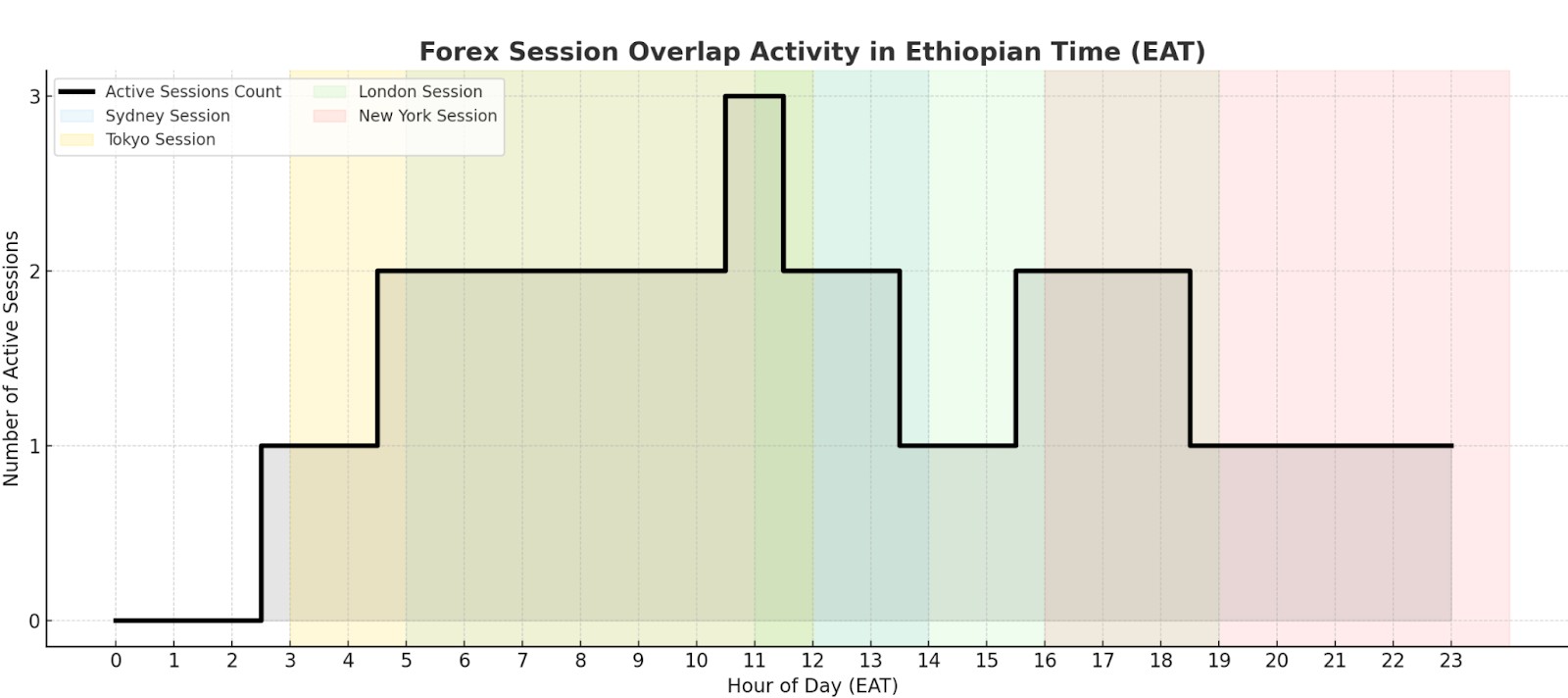
To help Ethiopian traders align their strategies with market dynamics, it’s essential to understand how global Forex sessions translate into local time. The following table provides a clear breakdown of each major trading session in Ethiopian Time (EAT), along with their typical characteristics — enabling traders to identify the most opportune windows for trading specific currency pairs:
| Session | Time (EAT) | Characteristics |
|---|---|---|
| Sydney | 5:00 AM – 2:00 PM | Lower liquidity; active for AUD/NZD |
| Tokyo | 3:00 AM – 12:00 PM | Moderate activity; focus on JPY pairs |
| London | 11:00 AM – 7:00 PM | High liquidity; active EUR, GBP pairs |
| New York | 4:00 PM – 12:00 AM | High volatility; USD pairs dominate |
Key factors impacting Forex trading in Ethiopia
Several factors influence Forex market behavior for Ethiopian traders:
Monetary Policy by National Bank of Ethiopia (NBE). Interest rates, interventions, and regulations impact ETB.
Ethiopian economic indicators. Inflation, GDP growth, employment data affect local and global perceptions of ETB stability.
Global economic news. Major events from the U.S., EU, and Asia can influence volatility in USD, EUR, and JPY pairs.
Market sentiment. Geopolitical developments in East Africa and shifts in global risk appetite impact trading conditions.
Top currency pairs to trade in Ethiopia
Ethiopian traders typically focus on two categories of Forex pairs: those with domestic economic relevance and those offering global liquidity and tight spreads.
Locally significant ETB pairs
USD/ETB – U.S. Dollar vs Ethiopian Birr. The most commonly traded pair in Ethiopia, heavily influenced by decisions from the National Bank of Ethiopia (NBE), including interest rate policies, foreign exchange interventions, and capital controls.
EUR/ETB – Euro vs Ethiopian Birr. Reflects Ethiopia’s strong trade relations with the Eurozone. This pair is moderately liquid and responds to both local policy shifts and European economic releases.
GBP/ETB – British Pound vs Ethiopian Birr. Relevant for import/export transactions with the UK, though typically less liquid than USD/ETB or EUR/ETB.
Note: Access to ETB pairs may be limited to specific regional or local brokers. Spreads are usually wider and leverage may be restricted compared to major pairs.
Globally liquid major pairs
EUR/USD – Euro vs U.S. Dollar. The most traded currency pair in the world. It offers tight spreads, deep liquidity, and predictable behavior, especially during the London session (11:00 AM – 7:00 PM EAT).
USD/JPY – U.S. Dollar vs Japanese Yen. Popular during the overlap of Asian and U.S. sessions. Known for sharp movements during major news events, making it suitable for volatility-based strategies.
Note: These pairs are supported by nearly all major brokers, with institutional-grade execution and consistent availability.
According to hourly volatility data, USD/ETB sees its most active periods between 11:00 AM and 4:00 PM EAT, aligning with Ethiopian business hours and overlapping with global financial flows. In contrast, EUR/USD and USD/JPY peak between 2:00 PM and 7:00 PM EAT, during the London–New York overlap — the most liquid window globally.
Expert tip: If you're just starting out, it's often best to focus on EUR/USD during high-volume windows. It offers clean technical setups and massive market participation. Once you've mastered the mechanics, consider adding USD/ETB for strategies tied to Ethiopian economic indicators and central bank activity.
Practical tips for Ethiopian Forex traders

Maximize profits with these actionable strategies:
Trade during high liquidity. Focus on London session (11:00 AM–2:00 PM EAT) and London–New York overlap (4:00 PM–7:00 PM EAT).
Stay informed. Use economic calendars to track announcements that could impact currency movements.
Risk management. Apply stop-loss orders and proper position sizing to mitigate unexpected volatility.
Leverage technical analysis. Identify optimal entry and exit points using price patterns and indicators.
How Forex brokers affect timing
While market sessions define the natural rhythm of Forex trading, your broker plays a critical role in how efficiently you can execute trades during these windows. Even if you trade at the “right” time, poor broker infrastructure can lead to missed opportunities or increased trading costs.
Here’s how brokers impact timing:
Spread variation by time of day. Most brokers offer the tightest spreads during the London and New York sessions, especially during the overlap. However, spreads can widen significantly during off-peak hours (like early morning in Ethiopia), making trades more expensive.
Server execution speed. During high-volatility periods, such as news releases at 3:30 PM or 5:00 PM EAT, execution delays can occur. A high-quality broker ensures low-latency trade processing to avoid slippage and missed entries.
Liquidity provider network. Brokers with multiple tier-one liquidity providers can maintain tight spreads and smooth order flow even in volatile sessions, while lower-tier brokers may freeze or requote under pressure.
Trading platforms and session cutoffs. Some brokers may restrict certain instruments or update spreads around rollover times (midnight EAT). Being aware of your broker’s platform behavior can help you avoid unexpected limitations.
Tip: Before committing capital, test your broker on a demo account during your target trading hours (e.g., 11:00 AM–2:00 PM or 4:00 PM–7:00 PM EAT) to evaluate spreads, speed, and platform responsiveness under real-market conditions.
Choosing the right broker is just as important as trading at the right time. A reliable broker ensures low spreads during peak sessions, fast execution during volatility, and access to the instruments you trade most.
To help you make an informed decision, the following table compares top Forex brokers available in Ethiopia based on regulation, trading costs, platform quality, and overall performance:
| TU overall score | Min. deposit, $ | Max. leverage | Max. Regulation | ECN Spread EUR/USD | ECN Commission | Currency pairs | Open an account | |
|---|---|---|---|---|---|---|---|---|
| 9.4 | 50 | 1:3000 | Tier-1 | 0.10 | 3.00 | 34 | Go to broker Your capital is at risk. |
|
| 9.3 | 5 | 1:1000 | Tier-1 | 0.2 | 3.5 | 57 | Go to broker Your capital is at risk. |
|
| 9.2 | 1 | 1:500 | Tier-1 | 0.1 | 2.25 | 90 | Go to broker Your capital is at risk. |
|
| 9.15 | 10 | 1:2000 | Tier-3 | 0.2 | 2 | 28 | Go to broker Your capital is at risk. |
|
| 9.1 | 10 | 1:2000 | Tier-1 | 0.1 | 3 | 100 | Go to broker Your capital is at risk.
|
|
| 9.1 | 1 | 1:2000 | Tier-3 | 0.1 | 2.0 | 60 | Go to broker Your capital is at risk.
|
| TU overall score | Min. deposit, $ | Max. leverage | Max. Regulation | ECN Spread EUR/USD | ECN Commission | Currency pairs | Open an account | |
|---|---|---|---|---|---|---|---|---|
| 9.4 | 50 | 1:3000 | Tier-1 | 0.10 | 3.00 | 34 | Go to broker Your capital is at risk. |
|
| 9.3 | 5 | 1:1000 | Tier-1 | 0.2 | 3.5 | 57 | Go to broker Your capital is at risk. |
|
| 9.2 | 1 | 1:500 | Tier-1 | 0.1 | 2.25 | 90 | Go to broker Your capital is at risk. |
|
| 9.15 | 10 | 1:2000 | Tier-3 | 0.2 | 2 | 28 | Go to broker Your capital is at risk. |
|
| 9.1 | 10 | 1:2000 | Tier-1 | 0.1 | 3 | 100 | Go to broker Your capital is at risk.
|
|
| 9.1 | 1 | 1:2000 | Tier-3 | 0.1 | 2.0 | 60 | Go to broker Your capital is at risk.
|
My approach to timing Forex trades in Ethiopia

I’ve learned that timing is everything. Over the years, I’ve refined my approach to align with the periods when liquidity and volatility are at their peak — specifically, the London session and the overlap between London and New York. These hours offer a dynamic environment where spreads tighten, and opportunities for breakout trades are plentiful.
Personally, I avoid trading during the early morning in Ethiopia because the market tends to be sluggish, and spreads can widen significantly. Instead, I focus my trading efforts around 11:00 AM to 2:00 PM EAT during the London session and continue through the 4:00 PM to 7:00 PM EAT window when the London and New York sessions overlap. This strategy has consistently provided me with the best trading conditions and clearer price action.
I always stress the importance of preparation. Before each trading day, I review both local economic reports and global market news, making sure I understand the context driving currency movements. I’ve found that patience and discipline in choosing the right trading windows can significantly enhance results, and it’s something I encourage every Forex trader in Ethiopia to master.
Conclusion
The best time to trade Forex in Ethiopia centers on the London session and the London–New York overlap. These windows provide peak liquidity, tighter spreads, and greater volatility — key ingredients for successful trading. Ethiopian traders should focus on these hours, stay informed of both local and international economic indicators, and apply sound trading strategies to maximize success.
FAQs
What time does the Forex market open in Ethiopia?
The Forex market is open 24 hours a day from Monday 5:00 AM EAT to Saturday 5:00 AM EAT.
Is the London session ideal for trading in Ethiopia?
Absolutely. The London session (11:00 AM–7:00 PM EAT) sees high trading volume, making it an excellent time for Ethiopian traders to enter the market.
Which currency pairs are best for Ethiopian traders?
USD/ETB, EUR/ETB, GBP/ETB for local focus; EUR/USD and USD/JPY during active global sessions.
Should I trade Forex overnight in Ethiopia?
Overnight trading has lower liquidity and wider spreads. It’s best to trade during London and London–New York overlaps for optimal conditions.
Editors' Top Picks and Insights

CBDC ban: Why the U.S. does not need a digital dollar

Bitcoin price prediction and Bollinger Bands: Can BTC recover after falling to $63,000?

FIFA World Cup on blockchain: Where football meets crypto

Aliens, Satoshi, and Bitcoin: How the extraterrestrial theory emerged

Blockchain nation in crisis: How a power struggle split Liberland

Shifting priorities: Governments back mining as businesses turn to AI
Related Articles
Team that worked on the article
Rinat Gismatullin is an entrepreneur and a business expert with 9 years of experience in trading. He focuses on long-term investing, but also uses intraday trading.
Chinmay Soni is a financial analyst with more than 5 years of experience in working with stocks, Forex, derivatives, and other assets. As a founder of a boutique research firm and an active researcher, he covers various industries and fields, providing insights backed by statistical data.
Mirjan Hipolito is a journalist and news editor at Traders Union. She is an expert crypto writer with five years of experience in the financial markets.

-
 Afghanistan
-
 Albania
-
 Algeria
-
 Angola
-
 Argentina
-
 Armenia
-
 Australia
-
 Austria
-
 Azerbaijan
-
 Bahamas
-
 Bahrain
-
 Bangladesh
-
 Belarus
-
 Belgium
-
 Bolivia
-
 Botswana
-
 Brazil
-
 Brunei
-
 Bulgaria
-
 Cambodia
-
 Cameroon
-
 Canada
-
 Chile
Chile
-
 China
China
-
 Colombia
-
 Congo
Congo
-
 Costa Rica
-
 Cote d'Ivoire
-
 Croatia
-
 Cuba
Cuba
-
 Cyprus
-
 Czechia
-
 DR Congo
-
 Denmark
-
 Dominican Republic
-
 Ecuador
-
 Egypt
Egypt
-
 El Salvador
-
 Estonia
-
 Eswatini
-
 Ethiopia
-
 Finland
-
 France
-
 Georgia
-
 Germany
-
 Ghana
Ghana
-
 Greece
-
 Haiti
Haiti
-
 Hong Kong
-
 Hungary
-
 India
India
-
 Indonesia
-
 Iran, Islamic republic
-
 Iraq
Iraq
-
 Ireland
-
 Israel
-
 Italy
Italy
-
 Jamaica
-
 Japan
Japan
-
 Jordan
-
 Kazakhstan
-
 Kenya
Kenya
-
 Korea
Korea
-
 Kuwait
-
 Kyrgyzstan
-
 Laos
Laos
-
 Latvia
-
 Lebanon
-
 Lesotho
-
 Libya
Libya
-
 Lithuania
-
 Luxembourg
-
 Madagascar
-
 Malaysia
-
 Malta
Malta
-
 Mauritius
-
 Mexico
-
 Moldova
-
 Mongolia
-
 Montenegro
-
 Morocco
-
 Mozambique
-
 Myanmar
-
 Namibia
-
 Nepal
Nepal
-
 Netherlands
-
 New Zealand
-
 Nigeria
-
 North Macedonia
-
 Norway
-
 Oman
Oman
-
 Pakistan
-
 Palestine
-
 Panama
-
 Papua New Guinea
-
 Paraguay
-
 Peru
Peru
-
 Philippines
-
 Poland
-
 Portugal
-
 Puerto Rico
-
 Qatar
Qatar
-
 Reunion
-
 Romania
-
 Rwanda
-
 Saudi Arabia
-
 Serbia
-
 Singapore
-
 Slovakia
-
 Slovenia
-
 Somalia
-
 South Africa
-
 Spain
Spain
-
 Sri Lanka
-
 Sweden
-
 Switzerland
-
 Syria
Syria
-
 Taiwan
-
 Tajikistan
-
 Tanzania
-
 Thailand
-
 Trinidad and Tobago
-
 Tunisia
-
 Turkey
-
 UAE
UAE
-
 Uganda
-
 Ukraine
-
 United Kingdom
-
United States
-
 Uruguay
-
 Uzbekistan
-
 Venezuela
-
 Vietnam
-
 Yemen
Yemen
-
 Zambia
-
 Zimbabwe
- Forex
- Crypto











