

WTI tests $95 resistance as Middle East risks and tighter inventories support prices

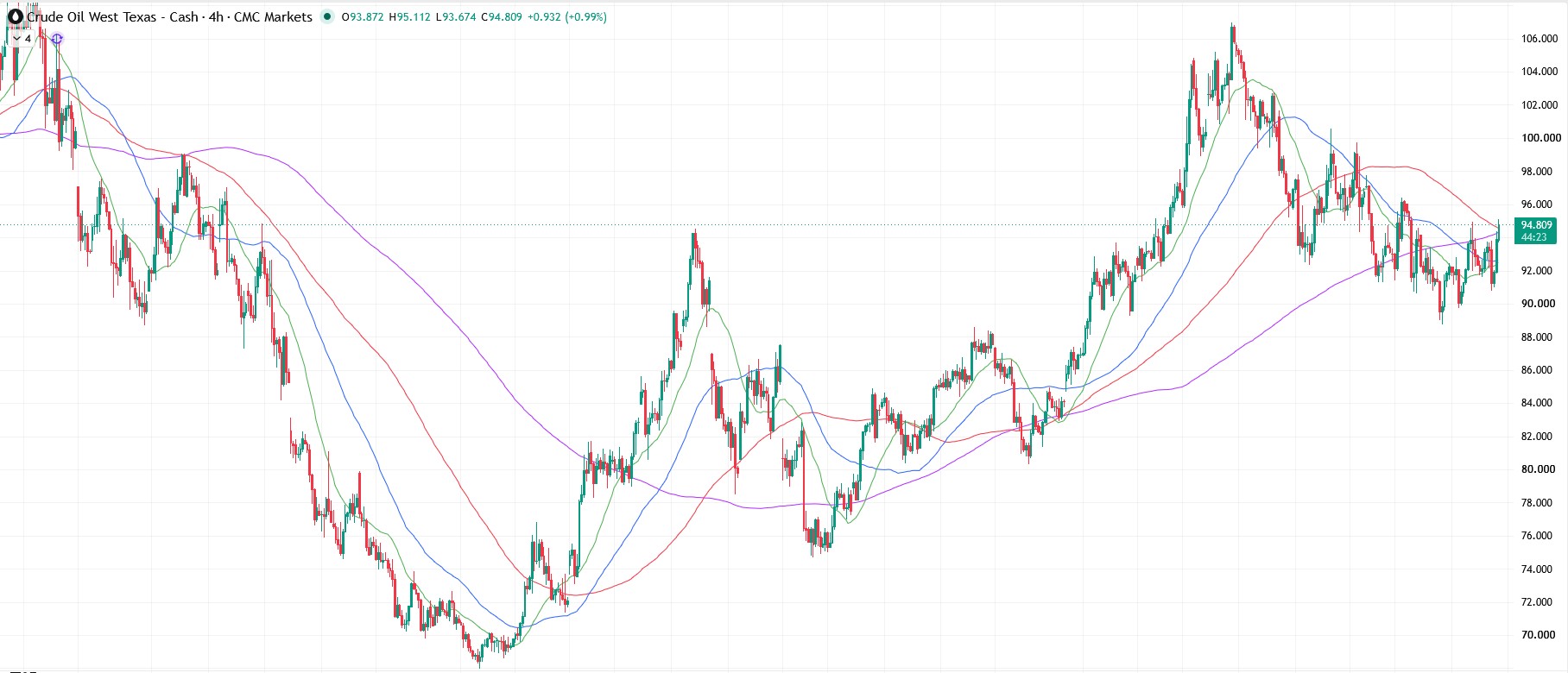
WTI is recovering toward $94.80–95.00 per barrel on October 12 after a volatile previous week, during which prices repeatedly tested the $90–92 area. On the 4-hour chart, the price has once again approached the medium-term moving averages clustered around $94.50–95.50, although the sequence of lower highs following the September peak above $106 remains intact.
⠀
U.S. crude inventories decline amid strong refinery demand
⠀U.S. statistics continue to indicate a relatively tight supply-demand balance. According to the latest EIA report, commercial crude oil inventories fell by 3.19 million barrels to 424.1 million in the week ending October 2, although analysts had expected an increase of approximately 1.7 million barrels. Refinery utilization rose to 92.7%, while U.S. crude oil production reached approximately 14 million barrels per day.⠀Meanwhile, inventories at Cushing increased by 444,000 barrels to 24.7 million, gasoline stocks rose by 382,000 barrels, and distillate inventories declined by just 42,000 barrels to 105.1 million. Thus, the decline in crude oil inventories supports prices, but the mixed performance of petroleum product stocks does not indicate equally strong demand across all segments of the U.S. market.⠀Geopolitical uncertainty raises concerns over global supply
⠀The Middle East remains the main source of uncertainty, where Houthi attacks on Saudi Arabia intensified over the weekend, including strikes on Riyadh International Airport. At the same time, threats to oil tankers near the Strait of Hormuz persist, although crude shipments through the region are gradually recovering. Additional uncertainty has emerged from reports of a possible energy ceasefire between Russia and Ukraine and agreements on Russian diesel supplies to the United States, which could partially ease tensions in the petroleum products market.⠀In its forecast published on October 6, the EIA raised its expected average Brent price for the fourth quarter to $105 per barrel, $14 above its September estimate. The agency also expects global oil inventories to decline by approximately 0.7 million barrels per day in the fourth quarter. However, as Middle Eastern supplies recover, it forecasts a decline in the average Brent price to $84 in 2027.⠀OPEC+ policy and technical levels shape the outlook
⠀Additional support for the market comes from the October 4 decision by seven OPEC+ members to maintain existing production restrictions for November. Meanwhile, the future direction of WTI will depend on actual Middle Eastern export volumes, conditions in the global diesel market, and new U.S. inventory data scheduled for release on October 15.⠀The ability to avoid a decline below $91.00–90.00 indicates that the bulls have not yet lost control of the situation, but they still need to overcome resistance around $95.00. If successful, they could test resistance in the $96.00–97.00 area; otherwise, as noted in WTI remains range-bound as Middle East supply concerns offset weak momentum, support at $94.00 will be broken, allowing the bears to attack the $93.00 support level.
This material may contain third-party opinions, none of the data and information on this webpage constitutes investment advice according to our Disclaimer. While we adhere to strict Editorial Integrity, this post may contain references to products from our partners.
Subscribe to TU news


Did you like the article?



Latest WTI News



Top News


Top 5 companies for you

United States
-
 Afghanistan
-
 Albania
-
 Algeria
-
 Angola
-
 Argentina
-
 Armenia
-
 Australia
-
 Austria
-
 Azerbaijan
-
 Bahamas
-
 Bahrain
-
 Bangladesh
-
 Belarus
-
 Belgium
-
 Bolivia
-
 Botswana
-
 Brazil
-
 Brunei
-
 Bulgaria
-
 Cambodia
-
 Cameroon
-
 Canada
-
 Chile
Chile
-
 China
China
-
 Colombia
-
 Congo
Congo
-
 Costa Rica
-
 Cote d'Ivoire
-
 Croatia
-
 Cuba
Cuba
-
 Cyprus
-
 Czechia
-
 DR Congo
-
 Denmark
-
 Dominican Republic
-
 Ecuador
-
 Egypt
Egypt
-
 El Salvador
-
 Estonia
-
 Eswatini
-
 Ethiopia
-
 Finland
-
 France
-
 Georgia
-
 Germany
-
 Ghana
Ghana
-
 Greece
-
 Haiti
Haiti
-
 Hong Kong
-
 Hungary
-
 India
India
-
 Indonesia
-
 Iran, Islamic republic
-
 Iraq
Iraq
-
 Ireland
-
 Israel
-
 Italy
Italy
-
 Jamaica
-
 Japan
Japan
-
 Jordan
-
 Kazakhstan
-
 Kenya
Kenya
-
 Korea
Korea
-
 Kuwait
-
 Kyrgyzstan
-
 Laos
Laos
-
 Latvia
-
 Lebanon
-
 Lesotho
-
 Libya
Libya
-
 Lithuania
-
 Luxembourg
-
 Madagascar
-
 Malaysia
-
 Malta
Malta
-
 Mauritius
-
 Mexico
-
 Moldova
-
 Mongolia
-
 Montenegro
-
 Morocco
-
 Mozambique
-
 Myanmar
-
 Namibia
-
 Nepal
Nepal
-
 Netherlands
-
 New Zealand
-
 Nigeria
-
 North Macedonia
-
 Norway
-
 Oman
Oman
-
 Pakistan
-
 Palestine
-
 Panama
-
 Papua New Guinea
-
 Paraguay
-
 Peru
Peru
-
 Philippines
-
 Poland
-
 Portugal
-
 Puerto Rico
-
 Qatar
Qatar
-
 Reunion
-
 Romania
-
 Rwanda
-
 Saudi Arabia
-
 Serbia
-
 Singapore
-
 Slovakia
-
 Slovenia
-
 Somalia
-
 South Africa
-
 Spain
Spain
-
 Sri Lanka
-
 Sweden
-
 Switzerland
-
 Syria
Syria
-
 Taiwan
-
 Tajikistan
-
 Tanzania
-
 Thailand
-
 Trinidad and Tobago
-
 Tunisia
-
 Turkey
-
 UAE
UAE
-
 Uganda
-
 Ukraine
-
 United Kingdom
-
United States
-
 Uruguay
-
 Uzbekistan
-
 Venezuela
-
 Vietnam
-
 Yemen
Yemen
-
 Zambia
-
 Zimbabwe
- Forex
- Crypto










Live News


