
Low volatility signals major test ahead for Ethereum

Market sentiment remains negative, yet Ethereum continues to hold a critical support level.
A series of macroeconomic and geopolitical developments has so far failed to push ETH significantly lower. Yesterday, U.S. CPI data came in at 4.2%, matching analysts' expectations.
Meanwhile, overnight developments saw the United States resume strikes against Iran, leading to another closure of the Strait of Hormuz. Iran has already responded with strikes against U.S. allies in the Middle East.
However, these developments were largely anticipated by cryptocurrency market participants, allowing the current “dead cat bounce” to continue.
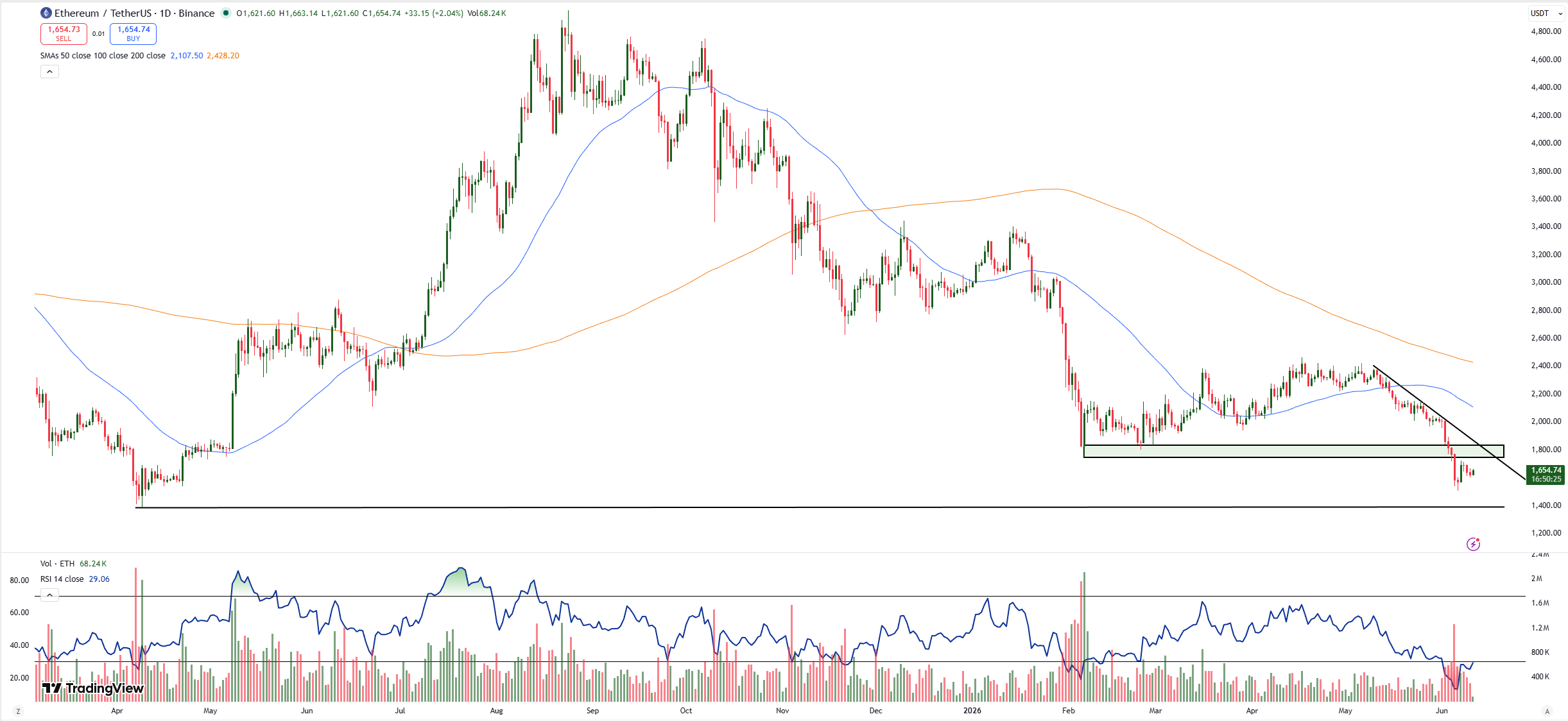
Low volatility puts Ethereum on breakout watch
Ethereum trading volume has fallen to its lowest level in two years. At the same time, the number of non-empty wallets holding ETH has risen to 59 million.
ETH/USD continues to trade within a narrow range between $1,550 and $1,700. This range is likely to remain intact until a decisive breakout occurs.
At the moment, the probability of a move toward the $1,700–$1,750 zone appears higher. Short-term traders continue to take profits, while long-term holders are gradually accumulating positions.
Ethereum's 60-day volatility has declined to 2.45%, its lowest level since November 2024. Historically, periods of unusually low volatility have often been followed by sharp market moves. The longer Ethereum remains trapped in a narrow range, the greater the probability of a significant breakout once the range is breached.
Bitcoin capitulation remains absent, keeping pressure on Ethereum
In the near term, Bitcoin's price action will remain a key driver for Ethereum.
Bitcoin's correction has not yet reached a capitulation phase.
Realized losses over the past 30 days have totaled approximately 187,000 BTC, well below the panic-driven 400,000 BTC recorded in February and far below the 1.2 million BTC spike seen following the collapse of FTX.
Historically, market bottoms tend to form only after sellers become exhausted. For now, there is little evidence that such a process has begun.












-
 Afghanistan
-
 Albania
-
 Algeria
-
 Angola
-
 Argentina
-
 Armenia
-
 Australia
-
 Austria
-
 Azerbaijan
-
 Bahamas
-
 Bahrain
-
 Bangladesh
-
 Belarus
-
 Belgium
-
 Bolivia
-
 Botswana
-
 Brazil
-
 Brunei
-
 Bulgaria
-
 Cambodia
-
 Cameroon
-
 Canada
-
 Chile
Chile
-
 China
China
-
 Colombia
-
 Congo
Congo
-
 Costa Rica
-
 Cote d'Ivoire
-
 Croatia
-
 Cuba
Cuba
-
 Cyprus
-
 Czechia
-
 DR Congo
-
 Denmark
-
 Dominican Republic
-
 Ecuador
-
 Egypt
Egypt
-
 El Salvador
-
 Estonia
-
 Eswatini
-
 Ethiopia
-
 Finland
-
 France
-
 Georgia
-
 Germany
-
 Ghana
Ghana
-
 Greece
-
 Haiti
Haiti
-
 Hong Kong
-
 Hungary
-
 India
India
-
 Indonesia
-
 Iran, Islamic republic
-
 Iraq
Iraq
-
 Ireland
-
 Israel
-
 Italy
Italy
-
 Jamaica
-
 Japan
Japan
-
 Jordan
-
 Kazakhstan
-
 Kenya
Kenya
-
 Korea
Korea
-
 Kuwait
-
 Kyrgyzstan
-
 Laos
Laos
-
 Latvia
-
 Lebanon
-
 Lesotho
-
 Libya
Libya
-
 Lithuania
-
 Luxembourg
-
 Madagascar
-
 Malaysia
-
 Malta
Malta
-
 Mauritius
-
 Mexico
-
 Moldova
-
 Mongolia
-
 Montenegro
-
 Morocco
-
 Mozambique
-
 Myanmar
-
 Namibia
-
 Nepal
Nepal
-
 Netherlands
-
 New Zealand
-
 Nigeria
-
 North Macedonia
-
 Norway
-
 Oman
Oman
-
 Pakistan
-
 Palestine
-
 Panama
-
 Papua New Guinea
-
 Paraguay
-
 Peru
Peru
-
 Philippines
-
 Poland
-
 Portugal
-
 Puerto Rico
-
 Qatar
Qatar
-
 Reunion
-
 Romania
-
 Rwanda
-
 Saudi Arabia
-
 Serbia
-
 Singapore
-
 Slovakia
-
 Slovenia
-
 Somalia
-
 South Africa
-
 Spain
Spain
-
 Sri Lanka
-
 Sweden
-
 Switzerland
-
 Syria
Syria
-
 Taiwan
-
 Tajikistan
-
 Tanzania
-
 Thailand
-
 Trinidad and Tobago
-
 Tunisia
-
 Turkey
-
 UAE
UAE
-
 Uganda
-
 Ukraine
-
 United Kingdom
-
United States
-
 Uruguay
-
 Uzbekistan
-
 Venezuela
-
 Vietnam
-
 Yemen
Yemen
-
 Zambia
-
 Zimbabwe
- Forex
- Crypto











