


Jito (JTO) plunged 10.18% today under continuing seller pressure, as marked by aggressive downside momentum and a lack of new fundamental catalysts. The drop is reinforced by JTO trading below major moving averages, underscoring the dominance of bears across all timeframes.
 0.2671
0.3408
Highlights
- JTO/USD trades below key moving averages, with downside session gap and closing near session low signaling persistent selling pressure.
- Momentum indicators conflict with current price action, as MACD, RSI, and Stochastic RSI point to buy signals but price declines 10.18% intraday.
- Expected five-day range is $0.4468 to $0.552, with a 70% probability of sideways or upward movement and key support at $0.4931.
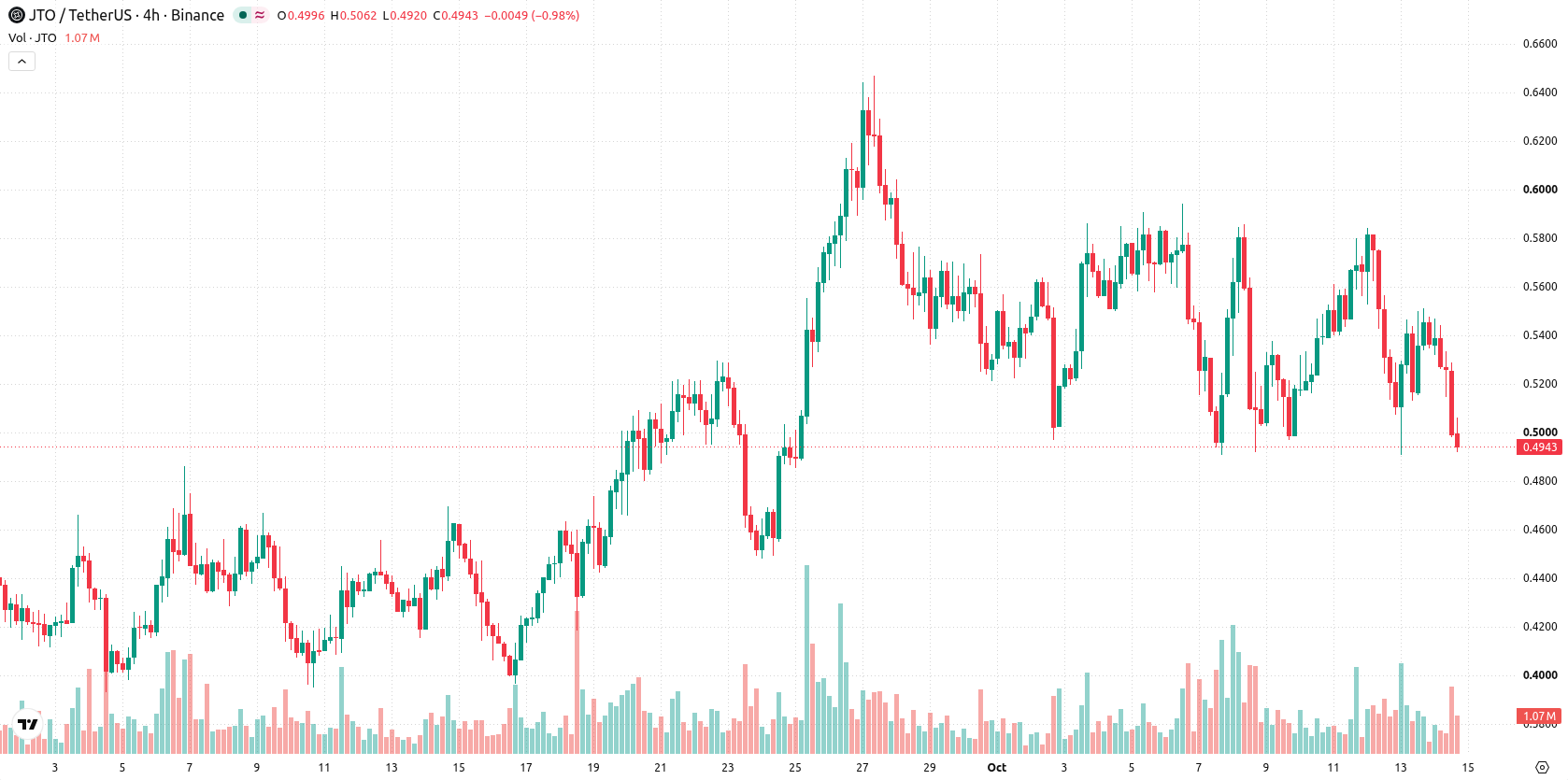
Mixed technical momentum amid firm resistance and bearish structure
JTO/USD remains below its 20-day, 50-day, and 200-day moving averages ($0.5493, $0.4944, and $0.5116, respectively), signaling sustained downward pressure from sellers spanning all major timeframes. The nearest overhead resistance stands at $0.4944, with key support at $0.4931 and Ichimoku resistance at $0.5327, highlighting a bearish trend structure. Momentum signals present a mixed landscape: MACD is positive and suggests a strong buy, while the ADX is neutral, indicating the absence of a dominant trend. Both the RSI and Stochastic RSI favor a potential upside, with respective “Buy” and “Strong Buy” signals. However, the CCI points to continued selling conditions. Intraday momentum currently favors buyers per Bull/Bear Power (BBP) at 0.0112. The price action is marked by a session loss of $0.056 and high daily volatility at 10.91%. The Awesome Oscillator remains neutral, emphasizing a lack of clear trend direction despite diverging bullish and bearish signals.
Earlier, analysts noted that sustained bearish momentum had dominated Jito’s price action despite recent protocol upgrades. The current analysis strengthens this view with ongoing downside pressure and elevated volatility, making the $0.4931 support level the key threshold for traders to monitor for potential directional shifts.






Latest Jito News





-
 Afghanistan
-
 Albania
-
 Algeria
-
 Angola
-
 Argentina
-
 Armenia
-
 Australia
-
 Austria
-
 Azerbaijan
-
 Bahamas
-
 Bahrain
-
 Bangladesh
-
 Belarus
-
 Belgium
-
 Bolivia
-
 Botswana
-
 Brazil
-
 Brunei
-
 Bulgaria
-
 Cambodia
-
 Cameroon
-
 Canada
-
 Chile
-
 China
-
 Colombia
-
 Congo
-
 Costa Rica
-
 Cote d'Ivoire
-
 Croatia
-
 Cuba
-
 Cyprus
-
 Czechia
-
 DR Congo
-
 Denmark
-
 Dominican Republic
-
 Ecuador
-
 Egypt
-
 El Salvador
-
 Estonia
-
 Eswatini
-
 Ethiopia
-
 Finland
-
 France
-
 Georgia
-
 Germany
-
 Ghana
-
 Greece
-
 Haiti
-
 Hong Kong
-
 Hungary
-
 India
-
 Indonesia
-
 Iran, Islamic republic
-
 Iraq
-
 Ireland
-
 Israel
-
 Italy
-
 Jamaica
-
 Japan
-
 Jordan
-
 Kazakhstan
-
 Kenya
-
 Korea
-
 Kuwait
-
 Kyrgyzstan
-
 Laos
-
 Latvia
-
 Lebanon
-
 Lesotho
-
 Libya
-
 Lithuania
-
 Luxembourg
-
 Madagascar
-
 Malaysia
-
 Malta
-
 Mauritius
-
 Mexico
-
 Moldova
-
 Mongolia
-
 Montenegro
-
 Morocco
-
 Mozambique
-
 Myanmar
-
 Namibia
-
 Nepal
-
 Netherlands
-
 New Zealand
-
 Nigeria
-
 North Macedonia
-
 Norway
-
 Oman
-
 Pakistan
-
 Palestine
-
 Panama
-
 Papua New Guinea
-
 Paraguay
-
 Peru
-
 Philippines
-
 Poland
-
 Portugal
-
 Puerto Rico
-
 Qatar
-
 Reunion
-
 Romania
-
 Rwanda
-
 Saudi Arabia
-
 Serbia
-
 Singapore
-
 Slovakia
-
 Slovenia
-
 Somalia
-
 South Africa
-
 Spain
-
 Sri Lanka
-
 Sweden
-
 Switzerland
-
 Syria
-
 Taiwan
-
 Tajikistan
-
 Tanzania
-
 Thailand
-
 Trinidad and Tobago
-
 Tunisia
-
 Turkey
-
 UAE
-
 Uganda
-
 Ukraine
-
 United Kingdom
-
United States
-
 Uruguay
-
 Uzbekistan
-
 Venezuela
-
 Vietnam
-
 Yemen
-
 Zambia
-
 Zimbabwe
- Forex
- Crypto












