

Bitcoin falls as OFAC sanctions target North Korean crypto laundering

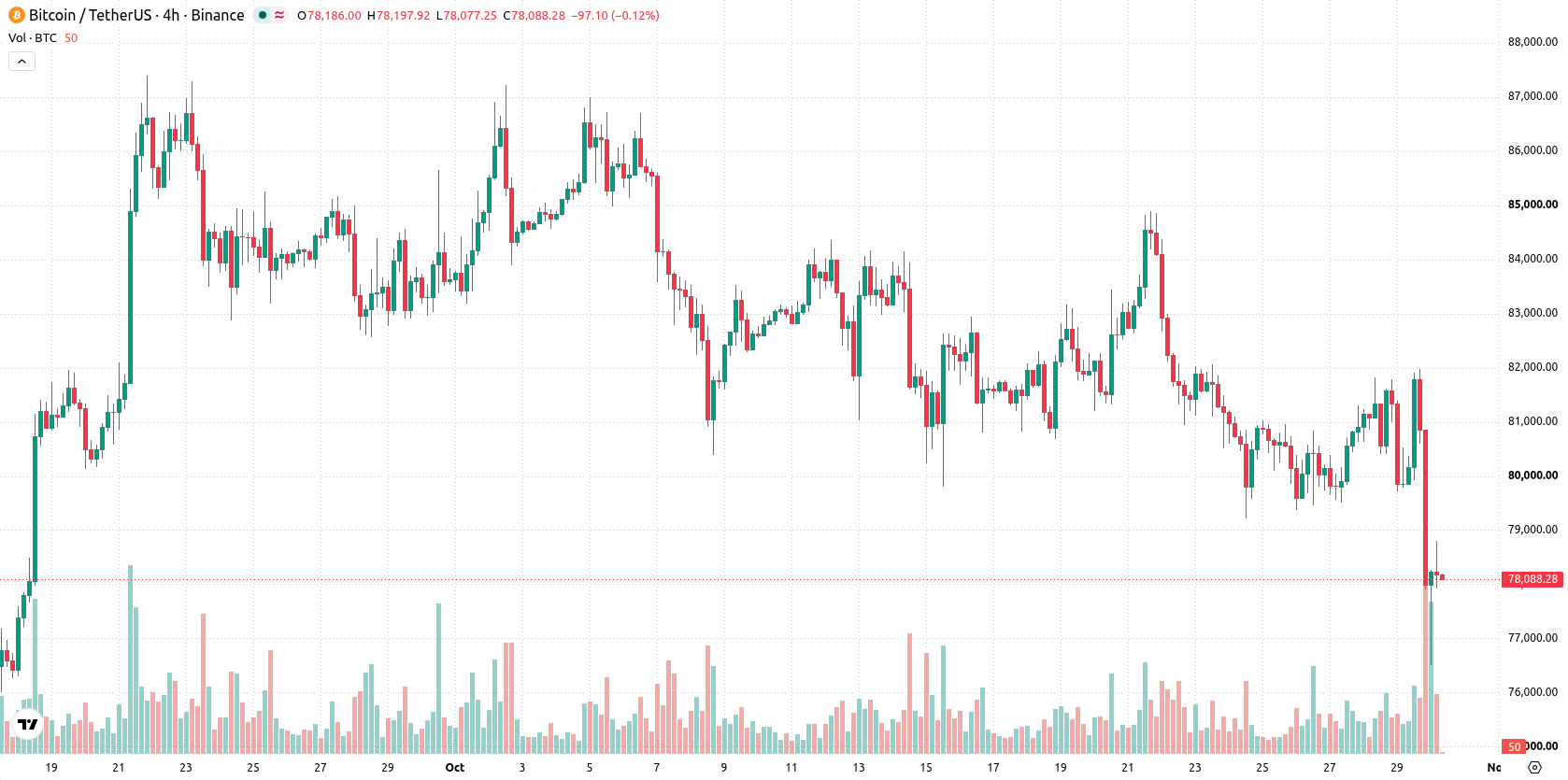
Bitcoin (BTC) is trading at $78,183, marking a 2.13% decline for the day. The price sits below its key short-term and medium-term moving averages, though it remains above the longer-term trend benchmark.
 66132.01
75599.22
Highlights
- The U.S. Treasury imposed new sanctions on 10 individuals and one entity for North Korean crypto money laundering ties.
- These sanctions raise legal and operational risks for the crypto sector and introduce short-term uncertainties for market participants.
- BTC/USD trades below key short- and medium-term moving averages with downside momentum, expecting a range of $76,367 to $79,999 over the next 2 to 3 days.
Compliance risks rise as sanctions reshape crypto sentiment
On October 28, the U.S. Department of the Treasury's Office of Foreign Assets Control (OFAC) published new sanctions targeting 10 individuals and one entity linked to North Korean crypto money laundering, according to Techflowpost. These actions increase the compliance and operational risks for participants across the broader crypto ecosystem. Elevated regulatory activity of this nature tends to weigh on short-term market sentiment, as participants reprice heightened legal and transactional uncertainties.
Downside momentum builds as signals favor seller control
Technically, BTC has slipped below both the MA-20 and MA-50 on the h4 timeframe, while remaining above the MA-200 on the daily chart. The immediate resistance level is marked by the daily Ichimoku Kijun at $79,365, with key support at $76,367. Momentum indicators including the MACD and ADX both signal persistent downside pressure. RSI, Stochastic RSI, CCI, and Bull/Bear Power continue to indicate oversold or sell conditions, underlining clear seller dominance and a stretched move lower. The Awesome Oscillator is neutral and provides no additional directional signal.
Downside bias persists as limited upside breakout potential
Over the next two to three trading days, BTC is projected to consolidate within a range of $76,367 to $79,999. The likelihood of an upward breakout is considered very low, with probabilities skewed towards further downside should support at $76,367 give way. A sustained break above $79,365 could reverse the downside bias and trigger additional buying, whereas a slide below $76,367 would likely confirm an extended corrective phase.
Earlier, analysts noted that Bitcoin remained under technical and macro pressure as selling dominated, with downside risk prevailing barring a significant shift in market dynamics. The current analysis builds on this view by highlighting that new regulatory actions are compounding operational uncertainty, making the $76,367 support a crucial level to monitor for potential further weakness in the near term.










-
 Afghanistan
-
 Albania
-
 Algeria
-
 Angola
-
 Argentina
-
 Armenia
-
 Australia
-
 Austria
-
 Azerbaijan
-
 Bahamas
-
 Bahrain
-
 Bangladesh
-
 Belarus
-
 Belgium
-
 Bolivia
-
 Botswana
-
 Brazil
-
 Brunei
-
 Bulgaria
-
 Cambodia
-
 Cameroon
-
 Canada
-
 Chile
-
 China
-
 Colombia
-
 Congo
-
 Costa Rica
-
 Cote d'Ivoire
-
 Croatia
-
 Cuba
-
 Cyprus
-
 Czechia
-
 DR Congo
-
 Denmark
-
 Dominican Republic
-
 Ecuador
-
 Egypt
-
 El Salvador
-
 Estonia
-
 Eswatini
-
 Ethiopia
-
 Finland
-
 France
-
 Georgia
-
 Germany
-
 Ghana
-
 Greece
-
 Haiti
-
 Hong Kong
-
 Hungary
-
 India
-
 Indonesia
-
 Iran, Islamic republic
-
 Iraq
-
 Ireland
-
 Israel
-
 Italy
-
 Jamaica
-
 Japan
-
 Jordan
-
 Kazakhstan
-
 Kenya
-
 Korea
-
 Kuwait
-
 Kyrgyzstan
-
 Laos
-
 Latvia
-
 Lebanon
-
 Lesotho
-
 Libya
-
 Lithuania
-
 Luxembourg
-
 Madagascar
-
 Malaysia
-
 Malta
-
 Mauritius
-
 Mexico
-
 Moldova
-
 Mongolia
-
 Montenegro
-
 Morocco
-
 Mozambique
-
 Myanmar
-
 Namibia
-
 Nepal
-
 Netherlands
-
 New Zealand
-
 Nigeria
-
 North Macedonia
-
 Norway
-
 Oman
-
 Pakistan
-
 Palestine
-
 Panama
-
 Papua New Guinea
-
 Paraguay
-
 Peru
-
 Philippines
-
 Poland
-
 Portugal
-
 Puerto Rico
-
 Qatar
-
 Reunion
-
 Romania
-
 Rwanda
-
 Saudi Arabia
-
 Serbia
-
 Singapore
-
 Slovakia
-
 Slovenia
-
 Somalia
-
 South Africa
-
 Spain
-
 Sri Lanka
-
 Sweden
-
 Switzerland
-
 Syria
-
 Taiwan
-
 Tajikistan
-
 Tanzania
-
 Thailand
-
 Trinidad and Tobago
-
 Tunisia
-
 Turkey
-
 UAE
-
 Uganda
-
 Ukraine
-
 United Kingdom
-
United States
-
 Uruguay
-
 Uzbekistan
-
 Venezuela
-
 Vietnam
-
 Yemen
-
 Zambia
-
 Zimbabwe
- Forex
- Crypto












