

Synthetix technical analysis: Weak momentum dominates below $0.1723 support

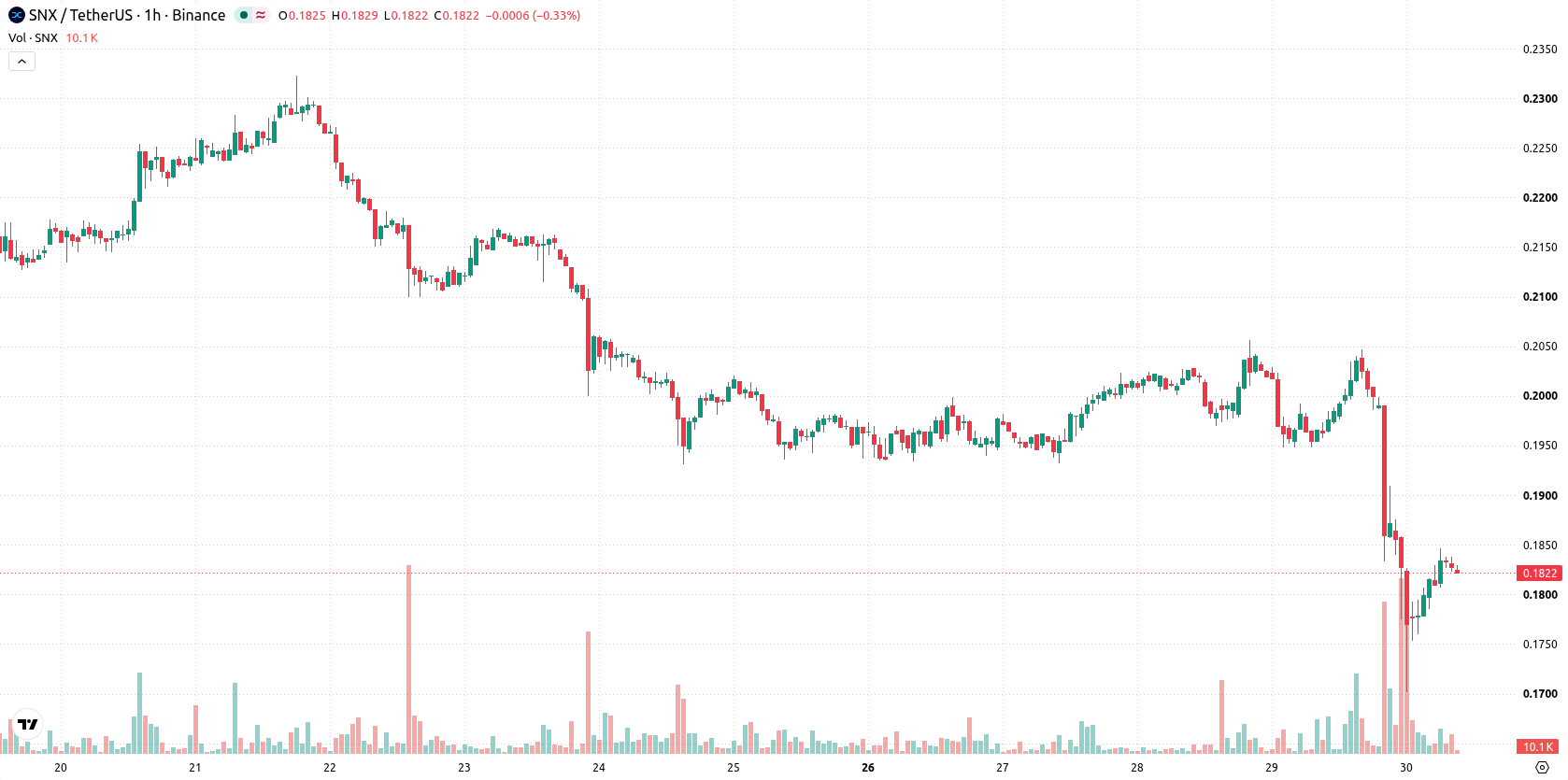
Synthetix (SNX) is trading at $0.1827, down 7.16% from the prior day. The price currently stands below its key moving averages, indicating prevailing downward momentum.
 0.1776
0.2056
Highlights
- SNX/USD trades below key short- and long-term moving averages, signaling persistent bearish pressure across all timeframes.
- Momentum and oscillator indicators are predominantly bearish, with sellers dominating and no sign of material bullish divergence.
- Price stands at $0.1827, with an expected trading range of $0.1723 to $0.1891 and a high probability for further downside.
Sustained weakness as technical resistance aligns with active selling
On the hourly chart, SNX/USD is positioned below the MA-20 ($0.1887), MA-50 ($0.1951), and the long-term MA-200 ($0.2477). The Ichimoku Kijun at $0.1874 serves as immediate resistance. Technical momentum remains weak: the MACD signals a strong sell, while the ADX points to active selling activity. RSI is at 37.48, supporting a negative outlook, with Stochastic RSI and CCI both neutral and the Awesome Oscillator presenting no additional bias. Intraday, Bull/Bear Power reflects seller control, and the price action exhibits high volatility near today's high, consistent with recent negative momentum.
Sideways bias holds as volatility and downside pressure persist
Over the next 2 to 3 days, SNX/USD is expected to consolidate between $0.1723 and $0.1891, reflecting the current volatility band relative to recent levels. An upward breakout appears unlikely given prevailing technicals, while an extension lower is probable if the $0.1723 support is breached. The baseline scenario anticipates sideways movement within this range, with a bullish turn dependent on a move above the $0.1874 resistance zone.
Earlier, analysts noted that Synthetix was operating in a bearish technical regime with ongoing downside risk. The latest price action reinforces this negative outlook, with traders advised to monitor support at $0.1723 as a potential inflection point for further declines.






Latest Synthetix News




-
 Afghanistan
-
 Albania
-
 Algeria
-
 Angola
-
 Argentina
-
 Armenia
-
 Australia
-
 Austria
-
 Azerbaijan
-
 Bahamas
-
 Bahrain
-
 Bangladesh
-
 Belarus
-
 Belgium
-
 Bolivia
-
 Botswana
-
 Brazil
-
 Brunei
-
 Bulgaria
-
 Cambodia
-
 Cameroon
-
 Canada
-
 Chile
-
 China
-
 Colombia
-
 Congo
-
 Costa Rica
-
 Cote d'Ivoire
-
 Croatia
-
 Cuba
-
 Cyprus
-
 Czechia
-
 DR Congo
-
 Denmark
-
 Dominican Republic
-
 Ecuador
-
 Egypt
-
 El Salvador
-
 Estonia
-
 Eswatini
-
 Ethiopia
-
 Finland
-
 France
-
 Georgia
-
 Germany
-
 Ghana
-
 Greece
-
 Haiti
-
 Hong Kong
-
 Hungary
-
 India
-
 Indonesia
-
 Iran, Islamic republic
-
 Iraq
-
 Ireland
-
 Israel
-
 Italy
-
 Jamaica
-
 Japan
-
 Jordan
-
 Kazakhstan
-
 Kenya
-
 Korea
-
 Kuwait
-
 Kyrgyzstan
-
 Laos
-
 Latvia
-
 Lebanon
-
 Lesotho
-
 Libya
-
 Lithuania
-
 Luxembourg
-
 Madagascar
-
 Malaysia
-
 Malta
-
 Mauritius
-
 Mexico
-
 Moldova
-
 Mongolia
-
 Montenegro
-
 Morocco
-
 Mozambique
-
 Myanmar
-
 Namibia
-
 Nepal
-
 Netherlands
-
 New Zealand
-
 Nigeria
-
 North Macedonia
-
 Norway
-
 Oman
-
 Pakistan
-
 Palestine
-
 Panama
-
 Papua New Guinea
-
 Paraguay
-
 Peru
-
 Philippines
-
 Poland
-
 Portugal
-
 Puerto Rico
-
 Qatar
-
 Reunion
-
 Romania
-
 Rwanda
-
 Saudi Arabia
-
 Serbia
-
 Singapore
-
 Slovakia
-
 Slovenia
-
 Somalia
-
 South Africa
-
 Spain
-
 Sri Lanka
-
 Sweden
-
 Switzerland
-
 Syria
-
 Taiwan
-
 Tajikistan
-
 Tanzania
-
 Thailand
-
 Trinidad and Tobago
-
 Tunisia
-
 Turkey
-
 UAE
-
 Uganda
-
 Ukraine
-
 United Kingdom
-
United States
-
 Uruguay
-
 Uzbekistan
-
 Venezuela
-
 Vietnam
-
 Yemen
-
 Zambia
-
 Zimbabwe
- Forex
- Crypto












