

Saros rises over 22% as technical momentum drives intraday gains

Saros (SAROS) jumped 22.14% on technical momentum as intraday price action remained confined to a tight range. The up move looks limited, with SAROS still trading below both its 50-day and 200-day moving averages, underscoring persistent medium- and long-term selling pressure.
 0.0001
57
Highlights
- SAROS/USD is consolidating at $0.0001, trading just above its short-term moving average but below longer-term averages, indicating persistent downward pressure.
- Momentum signals are mixed, with some technical buys but a majority of sell signals and intraday metrics neutral to negative.
- Over the next five days, the pair is expected to remain confined to a tight $0.0001 to $0.0001 range, with a high probability of a downward move.
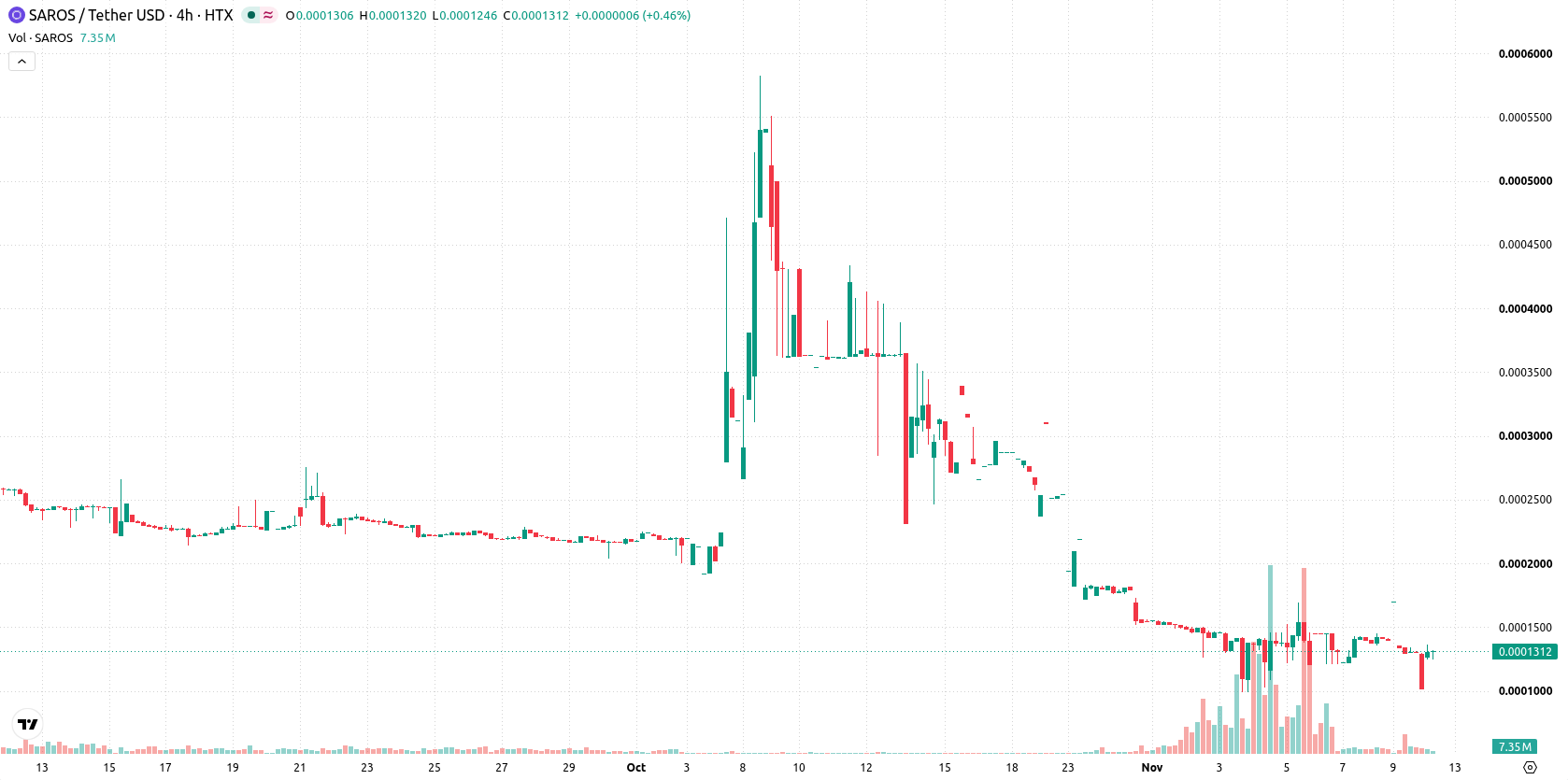
Bearish outlook confirmed as resistance holds and momentum stays mixed
SAROS/USD is currently trading just above its 20-day moving average at $0.0001, but remains below both the 50-day ($0.0002) and 200-day ($0.0004) moving averages. This setup indicates short-term stability alongside continued medium- and long-term downward pressure for the pair. Both immediate resistance and support are pegged at $0.0001, reflecting extremely limited range-bound movement. Higher moving averages sitting well above current levels confirm that the broader trend remains bearish. Momentum readings are mixed: MACD is flat at 0 with a strong sell signal, while ADX and the Hull Moving Average (HMA) point to buy signals. Oscillators including RSI, Stochastic RSI, and CCI all remain neutral, showing no clear overbought or oversold risks. Bull/Bear Power sits at 0, highlighting seller dominance in intraday momentum. The Awesome Oscillator (AO) is neutral, and overall intraday tone reflects sideways consolidation without a decisive directional break.
Earlier, analysts noted that Saros was entrenched in a bearish trend with limited prospects for a sustained rebound. The latest technical setup strengthens this view, highlighting that a break below $0.0001 would signal renewed downside risk, while sustained consolidation at current levels remains the baseline scenario.










-
 Afghanistan
-
 Albania
-
 Algeria
-
 Angola
-
 Argentina
-
 Armenia
-
 Australia
-
 Austria
-
 Azerbaijan
-
 Bahamas
-
 Bahrain
-
 Bangladesh
-
 Belarus
-
 Belgium
-
 Bolivia
-
 Botswana
-
 Brazil
-
 Brunei
-
 Bulgaria
-
 Cambodia
-
 Cameroon
-
 Canada
-
 Chile
-
 China
-
 Colombia
-
 Congo
-
 Costa Rica
-
 Cote d'Ivoire
-
 Croatia
-
 Cuba
-
 Cyprus
-
 Czechia
-
 DR Congo
-
 Denmark
-
 Dominican Republic
-
 Ecuador
-
 Egypt
-
 El Salvador
-
 Estonia
-
 Eswatini
-
 Ethiopia
-
 Finland
-
 France
-
 Georgia
-
 Germany
-
 Ghana
-
 Greece
-
 Haiti
-
 Hong Kong
-
 Hungary
-
 India
-
 Indonesia
-
 Iran, Islamic republic
-
 Iraq
-
 Ireland
-
 Israel
-
 Italy
-
 Jamaica
-
 Japan
-
 Jordan
-
 Kazakhstan
-
 Kenya
-
 Korea
-
 Kuwait
-
 Kyrgyzstan
-
 Laos
-
 Latvia
-
 Lebanon
-
 Lesotho
-
 Libya
-
 Lithuania
-
 Luxembourg
-
 Madagascar
-
 Malaysia
-
 Malta
-
 Mauritius
-
 Mexico
-
 Moldova
-
 Mongolia
-
 Montenegro
-
 Morocco
-
 Mozambique
-
 Myanmar
-
 Namibia
-
 Nepal
-
 Netherlands
-
 New Zealand
-
 Nigeria
-
 North Macedonia
-
 Norway
-
 Oman
-
 Pakistan
-
 Palestine
-
 Panama
-
 Papua New Guinea
-
 Paraguay
-
 Peru
-
 Philippines
-
 Poland
-
 Portugal
-
 Puerto Rico
-
 Qatar
-
 Reunion
-
 Romania
-
 Rwanda
-
 Saudi Arabia
-
 Serbia
-
 Singapore
-
 Slovakia
-
 Slovenia
-
 Somalia
-
 South Africa
-
 Spain
-
 Sri Lanka
-
 Sweden
-
 Switzerland
-
 Syria
-
 Taiwan
-
 Tajikistan
-
 Tanzania
-
 Thailand
-
 Trinidad and Tobago
-
 Tunisia
-
 Turkey
-
 UAE
-
 Uganda
-
 Ukraine
-
 United Kingdom
-
United States
-
 Uruguay
-
 Uzbekistan
-
 Venezuela
-
 Vietnam
-
 Yemen
-
 Zambia
-
 Zimbabwe
- Forex
- Crypto












