


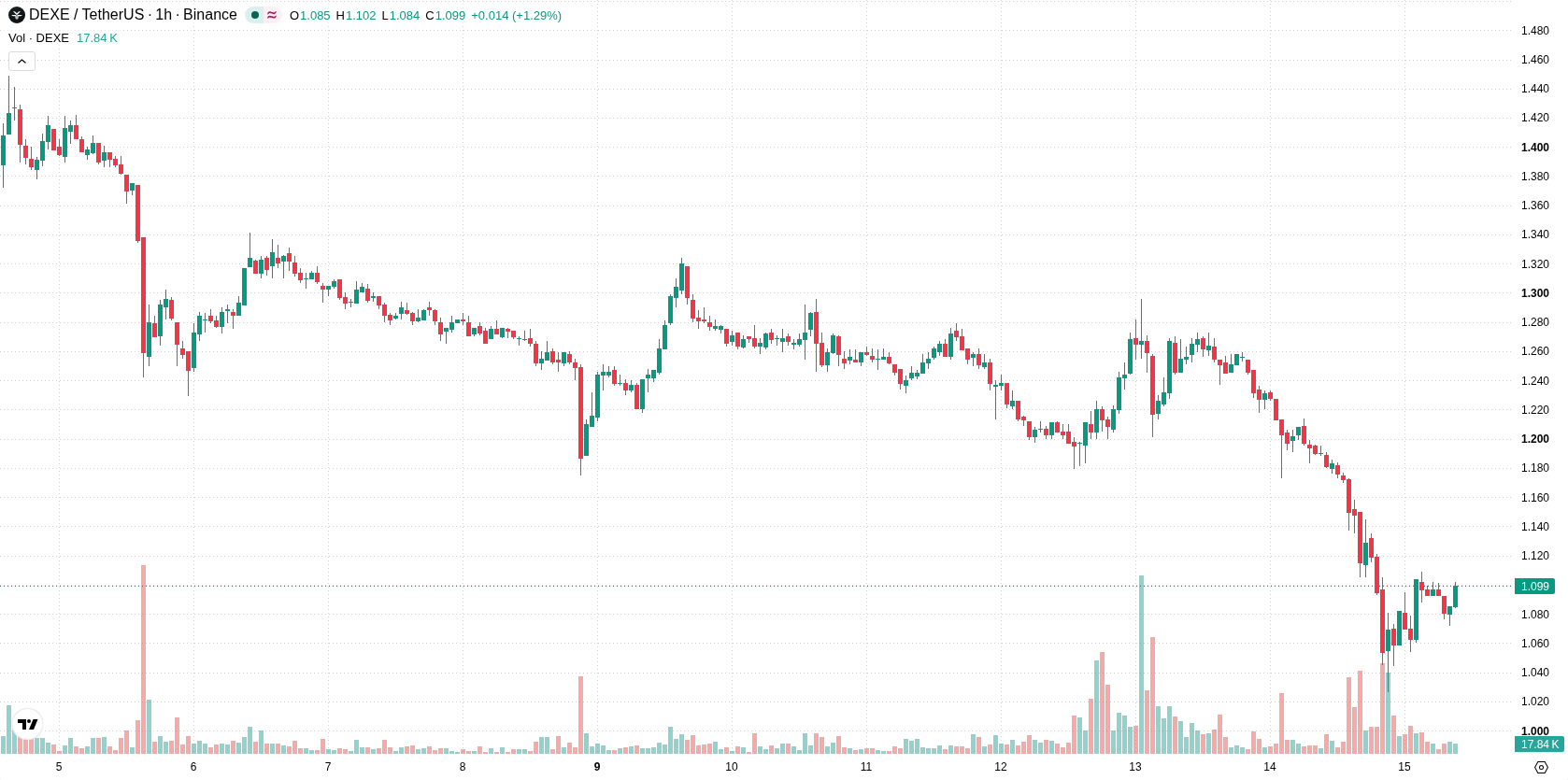
DeXe (DEXE) is trading at $1.1, down 7.97% today. The price sits above its short-term averages but remains under pressure when viewed against longer trend markers.
 1.11
1.32
Highlights
- DEXE/USD trades above its short-term moving average but remains below both medium- and long-term trend indicators.
- Momentum and trend indicators stay bearish, with selling pressure dominant and oscillators showing no clear overbought or oversold signal.
- Price declined 7.97% to $1.1 and is expected to consolidate within $1.04 to $1.16, with high probability of further downside.
Seller momentum confirmed as price stalls below key resistance
On the technical side, DEXE/USD is trading above the MA-20 but remains below the MA-50 and MA-200, reflecting short-term momentum within a fundamentally bearish structure. The Ichimoku Kijun line sits at $1.11, providing immediate resistance. Momentum indicators confirm seller dominance, with the MACD on a strong sell and the ADX showing sellers in control. RSI, Stochastic RSI, and CCI remain neutral, indicating neither overbought nor oversold conditions, while Bull/Bear Power is slightly negative and the Awesome Oscillator is neutral, pointing to mixed but mostly bearish intraday momentum.
Consolidation likely as breakout odds remain low
Over the next two to three days, DEXE/USD is expected to fluctuate between $1.04 and $1.16, representing the typical volatility band relative to current levels. The likelihood of an upward breakout is very low, while further downside remains highly probable. The most likely scenario is a period of consolidation within the established range. A breakout above resistance at $1.11 would be required for a bullish reversal, while a drop below support at $1.04 would likely accelerate further declines.
Previously it was reported that DeXe faced persistent downward pressure, with analysts highlighting a bearish outlook and elevated downside risks. The current analysis confirms this prevailing scenario, and traders should closely monitor the $1.04 support level as a potential trigger for accelerated losses.










-
 Afghanistan
-
 Albania
-
 Algeria
-
 Angola
-
 Argentina
-
 Armenia
-
 Australia
-
 Austria
-
 Azerbaijan
-
 Bahamas
-
 Bahrain
-
 Bangladesh
-
 Belarus
-
 Belgium
-
 Bolivia
-
 Botswana
-
 Brazil
-
 Brunei
-
 Bulgaria
-
 Cambodia
-
 Cameroon
-
 Canada
-
 Chile
-
 China
-
 Colombia
-
 Congo
-
 Costa Rica
-
 Cote d'Ivoire
-
 Croatia
-
 Cuba
-
 Cyprus
-
 Czechia
-
 DR Congo
-
 Denmark
-
 Dominican Republic
-
 Ecuador
-
 Egypt
-
 El Salvador
-
 Estonia
-
 Eswatini
-
 Ethiopia
-
 Finland
-
 France
-
 Georgia
-
 Germany
-
 Ghana
-
 Greece
-
 Haiti
-
 Hong Kong
-
 Hungary
-
 India
-
 Indonesia
-
 Iran, Islamic republic
-
 Iraq
-
 Ireland
-
 Israel
-
 Italy
-
 Jamaica
-
 Japan
-
 Jordan
-
 Kazakhstan
-
 Kenya
-
 Korea
-
 Kuwait
-
 Kyrgyzstan
-
 Laos
-
 Latvia
-
 Lebanon
-
 Lesotho
-
 Libya
-
 Lithuania
-
 Luxembourg
-
 Madagascar
-
 Malaysia
-
 Malta
-
 Mauritius
-
 Mexico
-
 Moldova
-
 Mongolia
-
 Montenegro
-
 Morocco
-
 Mozambique
-
 Myanmar
-
 Namibia
-
 Nepal
-
 Netherlands
-
 New Zealand
-
 Nigeria
-
 North Macedonia
-
 Norway
-
 Oman
-
 Pakistan
-
 Palestine
-
 Panama
-
 Papua New Guinea
-
 Paraguay
-
 Peru
-
 Philippines
-
 Poland
-
 Portugal
-
 Puerto Rico
-
 Qatar
-
 Reunion
-
 Romania
-
 Rwanda
-
 Saudi Arabia
-
 Serbia
-
 Singapore
-
 Slovakia
-
 Slovenia
-
 Somalia
-
 South Africa
-
 Spain
-
 Sri Lanka
-
 Sweden
-
 Switzerland
-
 Syria
-
 Taiwan
-
 Tajikistan
-
 Tanzania
-
 Thailand
-
 Trinidad and Tobago
-
 Tunisia
-
 Turkey
-
 UAE
-
 Uganda
-
 Ukraine
-
 United Kingdom
-
United States
-
 Uruguay
-
 Uzbekistan
-
 Venezuela
-
 Vietnam
-
 Yemen
-
 Zambia
-
 Zimbabwe
- Forex
- Crypto












