

Bitcoin falls as upcoming Federal Reserve decisions and stronger dollar challenge demand

Bitcoin (BTC) is trading down, with external pressures maintaining a cautious tone as of November 15, 2026. Market participants are watching for signals from upcoming US inflation data and Federal Reserve decisions as macroeconomic conditions challenge sentiment.
 66132.01
75599.22
Highlights
- Expectations of a potential US Federal Reserve rate hike and a stronger dollar have pressured Bitcoin as investors reassess risk in non-yielding assets.
- Large outflows from Bitcoin spot ETFs have reduced liquidity and diminished buying interest across the cryptocurrency market.
- Bitcoin trades below key short-term and long-term moving averages, with weak momentum signaling continued bearish pressure unless ETF redemptions slow and price reclaims $68,409.
US rate hike expectations and ETF outflows weigh on Bitcoin
According to Cointribune, on November 14, 2026, market expectations for a possible Federal Reserve rate hike in December, alongside a strengthening US dollar and substantial outflows from Bitcoin spot ETFs, contributed to continued downside pressure on Bitcoin. The focus has shifted to US inflation readings and central bank policy as investors reassess risk in non-yielding assets such as cryptocurrencies.
A potential US rate hike boosts Treasury yields and supports the dollar, which reduces the attractiveness of Bitcoin as a non-yielding, alternative asset. Simultaneously, large redemptions from spot ETFs further diminish buying interest and liquidity in the Bitcoin market.
These factors combined have kept risk appetite in check for Bitcoin, with US policy signals and ETF flows now playing a critical role in near-term price direction.
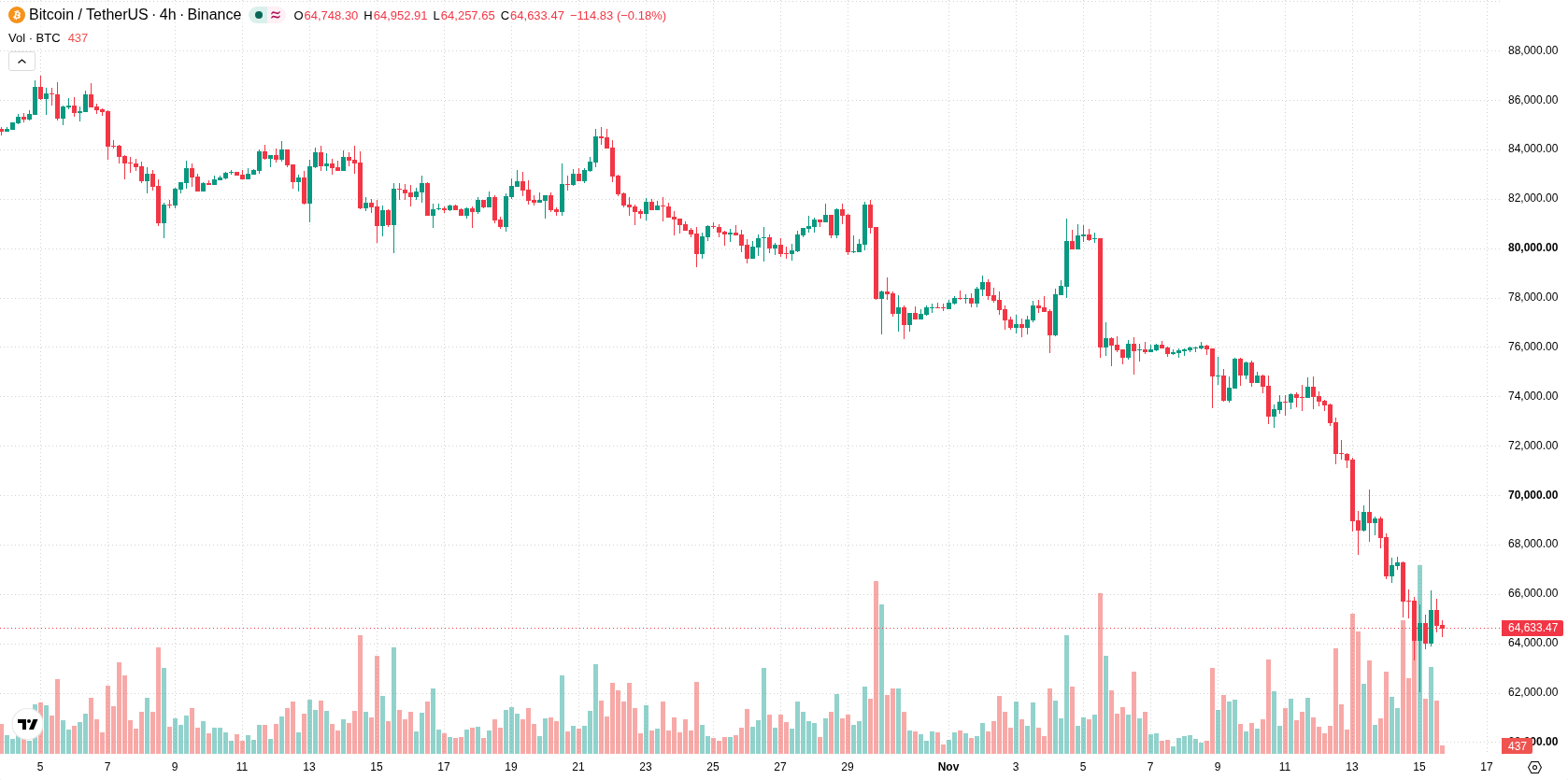
Macro-driven weakness confirmed on BTC's 4H technical chart
The 4-hour chart shows BTC trading below the 50-period and 200-period SMAs, reflecting sustained pressure after recent macro-driven moves. The current price remains below the H4 Kijun resistance level, and momentum readings from MACD and ADX both point to ongoing selling activity.
Shorter-term momentum remains weak, with prices failing to reclaim the 20-period SMA on the 4H timeframe. The technical setup confirms that BTC remains in a bearish stance while the price stays under these moving averages and resistance points.
Fed actions and ETF flows to determine next BTC move
If US inflation data surprises to the downside or the Federal Reserve hints at a pause in its tightening cycle, downward pressure on BTC could ease. Sustained stabilization will likely require slowing ETF outflows and a move above the H4 Kijun resistance near $68,409. Until then, macro developments and US policy signals remain the dominant risk factors for further price action.
Earlier, analysts noted that persistent ETF outflows, forced deleveraging, and mounting macroeconomic risks had undermined institutional demand for Bitcoin, resulting in substantial market pressure. The current analysis reinforces this assessment, emphasizing that the outlook for Bitcoin now hinges on upcoming US inflation data and Federal Reserve policy signals as key determinants for any potential shift in trend.










-
 Afghanistan
-
 Albania
-
 Algeria
-
 Angola
-
 Argentina
-
 Armenia
-
 Australia
-
 Austria
-
 Azerbaijan
-
 Bahamas
-
 Bahrain
-
 Bangladesh
-
 Belarus
-
 Belgium
-
 Bolivia
-
 Botswana
-
 Brazil
-
 Brunei
-
 Bulgaria
-
 Cambodia
-
 Cameroon
-
 Canada
-
 Chile
-
 China
-
 Colombia
-
 Congo
-
 Costa Rica
-
 Cote d'Ivoire
-
 Croatia
-
 Cuba
-
 Cyprus
-
 Czechia
-
 DR Congo
-
 Denmark
-
 Dominican Republic
-
 Ecuador
-
 Egypt
-
 El Salvador
-
 Estonia
-
 Eswatini
-
 Ethiopia
-
 Finland
-
 France
-
 Georgia
-
 Germany
-
 Ghana
-
 Greece
-
 Haiti
-
 Hong Kong
-
 Hungary
-
 India
-
 Indonesia
-
 Iran, Islamic republic
-
 Iraq
-
 Ireland
-
 Israel
-
 Italy
-
 Jamaica
-
 Japan
-
 Jordan
-
 Kazakhstan
-
 Kenya
-
 Korea
-
 Kuwait
-
 Kyrgyzstan
-
 Laos
-
 Latvia
-
 Lebanon
-
 Lesotho
-
 Libya
-
 Lithuania
-
 Luxembourg
-
 Madagascar
-
 Malaysia
-
 Malta
-
 Mauritius
-
 Mexico
-
 Moldova
-
 Mongolia
-
 Montenegro
-
 Morocco
-
 Mozambique
-
 Myanmar
-
 Namibia
-
 Nepal
-
 Netherlands
-
 New Zealand
-
 Nigeria
-
 North Macedonia
-
 Norway
-
 Oman
-
 Pakistan
-
 Palestine
-
 Panama
-
 Papua New Guinea
-
 Paraguay
-
 Peru
-
 Philippines
-
 Poland
-
 Portugal
-
 Puerto Rico
-
 Qatar
-
 Reunion
-
 Romania
-
 Rwanda
-
 Saudi Arabia
-
 Serbia
-
 Singapore
-
 Slovakia
-
 Slovenia
-
 Somalia
-
 South Africa
-
 Spain
-
 Sri Lanka
-
 Sweden
-
 Switzerland
-
 Syria
-
 Taiwan
-
 Tajikistan
-
 Tanzania
-
 Thailand
-
 Trinidad and Tobago
-
 Tunisia
-
 Turkey
-
 UAE
-
 Uganda
-
 Ukraine
-
 United Kingdom
-
United States
-
 Uruguay
-
 Uzbekistan
-
 Venezuela
-
 Vietnam
-
 Yemen
-
 Zambia
-
 Zimbabwe
- Forex
- Crypto












