

AI sector woes put pressure on NEAR as lower bond yields cloud crypto market liquidity

NEAR (NEAR) is trading lower at $2.87, down 10.25% as of November 20, 2026. A sharp drop in global bond yields following weakness in the AI sector has driven a flight to safety, influencing funding and liquidity conditions across risk assets. Investors in NEAR are closely watching for further volatility in global bond markets and their potential impact on crypto market flows.
 2.933
3.4770
Highlights
- Global bond yields fell sharply as investors moved to safer assets due to a downturn in the AI sector.
- Reduced risk appetite and tightening liquidity conditions increase vulnerability for NEAR, regardless of its own fundamentals.
- NEAR trades below key moving averages with negative momentum and oversold signals, facing resistance near $3.13.
Global bond yield drop after AI sector downturn
According to Investing.com, bond yields around the world fell sharply on November 20, 2026, as the AI sector experienced a notable downturn, prompting investors to shift into safer assets amid heightened risk aversion.
This global move into safer assets reflects a broader risk-off sentiment, which can restrict funding and reduce liquidity available for risk assets, including cryptocurrencies such as NEAR. As a result, NEAR is exposed to increased vulnerability from tighter financial conditions, regardless of its own fundamentals.
The linkage remains conditional: while immediate outflows into safer holdings can pressure crypto prices, the ultimate impact on NEAR depends on whether risk appetite and global liquidity stabilize or continue to deteriorate.
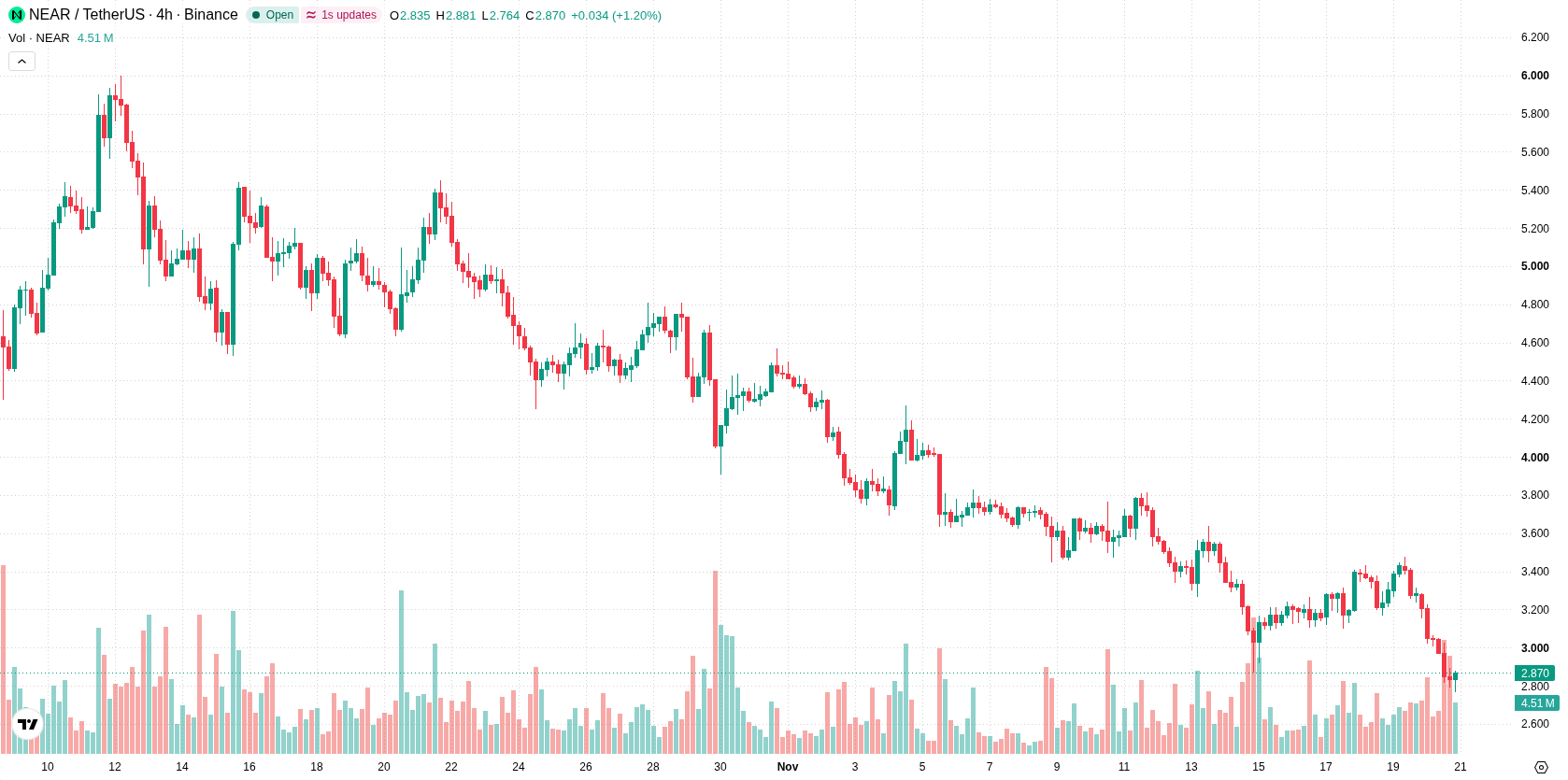
NEAR remains below key 4H moving averages
On the 4H chart, NEAR is trading below the SMA-50 at $3.25 and the SMA-200 at $4.02, suggesting a weak technical backdrop amplified by the macro-driven decline in risk sentiment.
The RSI is deeply oversold, while both MACD and ADX continue to signal a sell bias. Momentum is negative, and the nearest visible resistance comes in at the H4 Kijun level near $3.13.
Recovery depends on stabilization in global risk conditions
A sustained recovery in risk appetite or a firming of global bond yields could help stabilize NEAR. If price remains unable to reclaim the area around the $3.13 H4 Kijun, downside pressure may persist. However, a decisive move back above this resistance zone could be an early sign of improving liquidity conditions.
Previously it was reported that NEAR faced sustained bearish pressure, with technical analysis indicating sellers were in control and downside risks persisted. The latest developments reinforce this weak outlook, as heightened global risk aversion and tighter liquidity remain the key factors to watch for any potential stabilization in NEAR's performance.










-
 Afghanistan
-
 Albania
-
 Algeria
-
 Angola
-
 Argentina
-
 Armenia
-
 Australia
-
 Austria
-
 Azerbaijan
-
 Bahamas
-
 Bahrain
-
 Bangladesh
-
 Belarus
-
 Belgium
-
 Bolivia
-
 Botswana
-
 Brazil
-
 Brunei
-
 Bulgaria
-
 Cambodia
-
 Cameroon
-
 Canada
-
 Chile
-
 China
-
 Colombia
-
 Congo
-
 Costa Rica
-
 Cote d'Ivoire
-
 Croatia
-
 Cuba
-
 Cyprus
-
 Czechia
-
 DR Congo
-
 Denmark
-
 Dominican Republic
-
 Ecuador
-
 Egypt
-
 El Salvador
-
 Estonia
-
 Eswatini
-
 Ethiopia
-
 Finland
-
 France
-
 Georgia
-
 Germany
-
 Ghana
-
 Greece
-
 Haiti
-
 Hong Kong
-
 Hungary
-
 India
-
 Indonesia
-
 Iran, Islamic republic
-
 Iraq
-
 Ireland
-
 Israel
-
 Italy
-
 Jamaica
-
 Japan
-
 Jordan
-
 Kazakhstan
-
 Kenya
-
 Korea
-
 Kuwait
-
 Kyrgyzstan
-
 Laos
-
 Latvia
-
 Lebanon
-
 Lesotho
-
 Libya
-
 Lithuania
-
 Luxembourg
-
 Madagascar
-
 Malaysia
-
 Malta
-
 Mauritius
-
 Mexico
-
 Moldova
-
 Mongolia
-
 Montenegro
-
 Morocco
-
 Mozambique
-
 Myanmar
-
 Namibia
-
 Nepal
-
 Netherlands
-
 New Zealand
-
 Nigeria
-
 North Macedonia
-
 Norway
-
 Oman
-
 Pakistan
-
 Palestine
-
 Panama
-
 Papua New Guinea
-
 Paraguay
-
 Peru
-
 Philippines
-
 Poland
-
 Portugal
-
 Puerto Rico
-
 Qatar
-
 Reunion
-
 Romania
-
 Rwanda
-
 Saudi Arabia
-
 Serbia
-
 Singapore
-
 Slovakia
-
 Slovenia
-
 Somalia
-
 South Africa
-
 Spain
-
 Sri Lanka
-
 Sweden
-
 Switzerland
-
 Syria
-
 Taiwan
-
 Tajikistan
-
 Tanzania
-
 Thailand
-
 Trinidad and Tobago
-
 Tunisia
-
 Turkey
-
 UAE
-
 Uganda
-
 Ukraine
-
 United Kingdom
-
United States
-
 Uruguay
-
 Uzbekistan
-
 Venezuela
-
 Vietnam
-
 Yemen
-
 Zambia
-
 Zimbabwe
- Forex
- Crypto












