


DeXe (DEXE) climbed 9.54% on a session led by short-term technical momentum, with the price rebounding towards session highs even in the absence of fresh company news. The move looks limited, as DEXE remains below its 50-day and 200-day moving averages, signaling persistent medium- and long-term downward pressure.
 1.2
1.24
Highlights
- DEXE/USD is trading above its short-term moving average at $1.21 but remains under long-term pressure below key long-term levels.
- Momentum indicators are mostly negative or neutral, with prevailing selling pressure offset by intraday gains to $1.24 and volatility at 7.14%.
- The expected trading range over the next five days is $1.15 to $1.36, with sideways consolidation as the baseline scenario and high probability of a downward move.
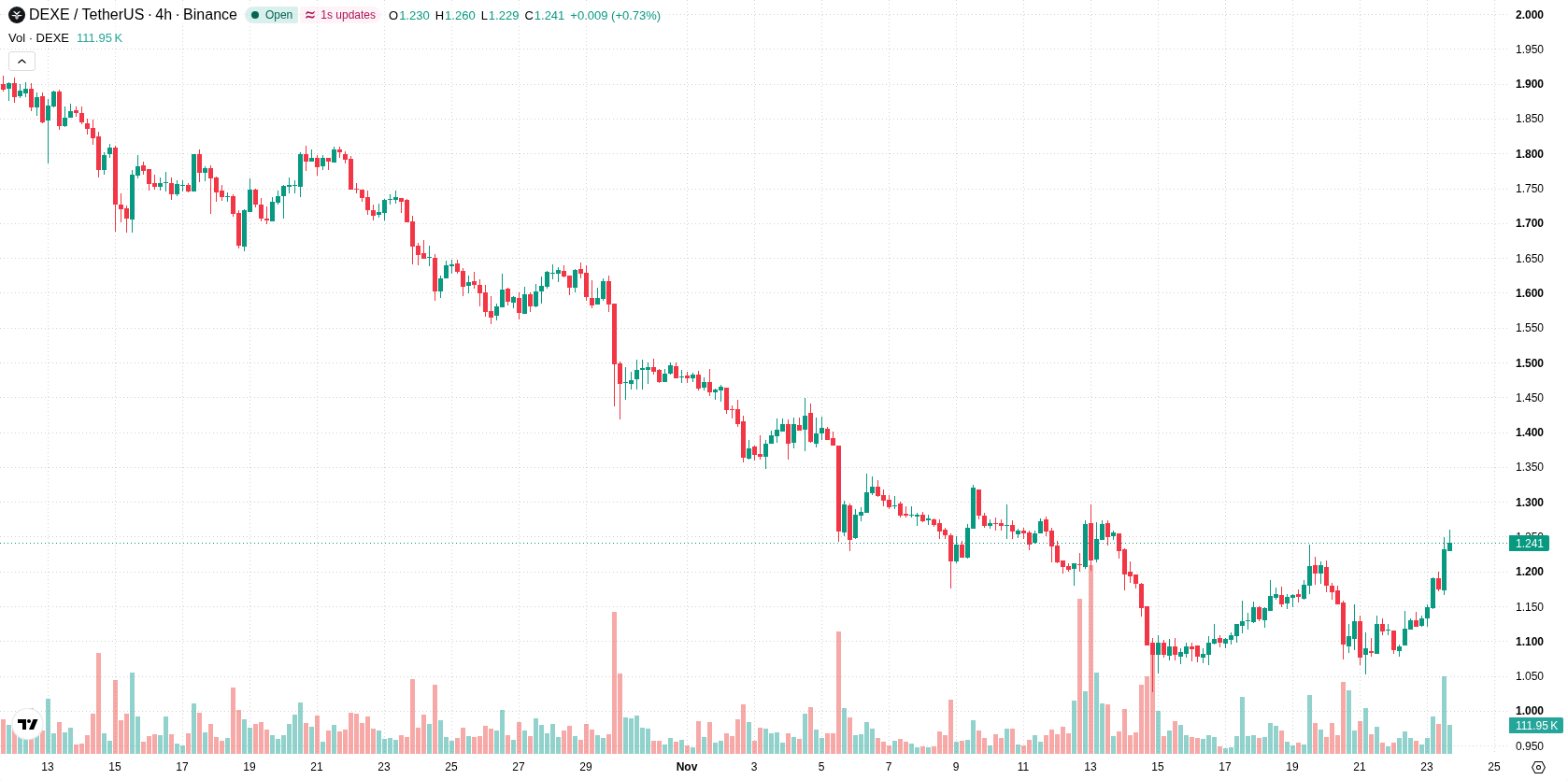
Sustained selling pressure as price tests near-term resistance
DEXE/USD is trading above its 20-day moving average at $1.21, but remains below the 50-day and 200-day averages at $1.52 and $9.15, respectively. This points to short-term stability with persistent medium- and long-term downward pressure. Immediate resistance is visible at $1.34 (Ichimoku Kijun), and support near $1.21. Momentum signals are mostly negative: the Moving Average Convergence Divergence (MACD) and Average Directional Index (ADX) both indicate selling pressure, while the Commodity Channel Index (CCI) and Relative Strength Index (RSI) are each neutral. The Stochastic RSI is also neutral. Bull/Bear Power (BBP) shows that sellers have a slight edge intraday. The pair opened nearly flat and is currently trading at $1.24, up $0.11 or 9.54%, positioned near the session high with intraday volatility at 7.14%. Momentum is mixed relative to the price action, as indicators signal prevailing selling pressure, yet the price is firming towards session highs.
Earlier, analysts noted that DeXe was supported by short-term bullish momentum but faced persistent longer-term technical headwinds. The current session reinforces this outlook, as prevailing selling pressure and resistance at higher averages increase downside risk, making a sustained break above $1.36 a critical trigger for any bullish reversal.






Latest DeXe News




-
 Afghanistan
-
 Albania
-
 Algeria
-
 Angola
-
 Argentina
-
 Armenia
-
 Australia
-
 Austria
-
 Azerbaijan
-
 Bahamas
-
 Bahrain
-
 Bangladesh
-
 Belarus
-
 Belgium
-
 Bolivia
-
 Botswana
-
 Brazil
-
 Brunei
-
 Bulgaria
-
 Cambodia
-
 Cameroon
-
 Canada
-
 Chile
-
 China
-
 Colombia
-
 Congo
-
 Costa Rica
-
 Cote d'Ivoire
-
 Croatia
-
 Cuba
-
 Cyprus
-
 Czechia
-
 DR Congo
-
 Denmark
-
 Dominican Republic
-
 Ecuador
-
 Egypt
-
 El Salvador
-
 Estonia
-
 Eswatini
-
 Ethiopia
-
 Finland
-
 France
-
 Georgia
-
 Germany
-
 Ghana
-
 Greece
-
 Haiti
-
 Hong Kong
-
 Hungary
-
 India
-
 Indonesia
-
 Iran, Islamic republic
-
 Iraq
-
 Ireland
-
 Israel
-
 Italy
-
 Jamaica
-
 Japan
-
 Jordan
-
 Kazakhstan
-
 Kenya
-
 Korea
-
 Kuwait
-
 Kyrgyzstan
-
 Laos
-
 Latvia
-
 Lebanon
-
 Lesotho
-
 Libya
-
 Lithuania
-
 Luxembourg
-
 Madagascar
-
 Malaysia
-
 Malta
-
 Mauritius
-
 Mexico
-
 Moldova
-
 Mongolia
-
 Montenegro
-
 Morocco
-
 Mozambique
-
 Myanmar
-
 Namibia
-
 Nepal
-
 Netherlands
-
 New Zealand
-
 Nigeria
-
 North Macedonia
-
 Norway
-
 Oman
-
 Pakistan
-
 Palestine
-
 Panama
-
 Papua New Guinea
-
 Paraguay
-
 Peru
-
 Philippines
-
 Poland
-
 Portugal
-
 Puerto Rico
-
 Qatar
-
 Reunion
-
 Romania
-
 Rwanda
-
 Saudi Arabia
-
 Serbia
-
 Singapore
-
 Slovakia
-
 Slovenia
-
 Somalia
-
 South Africa
-
 Spain
-
 Sri Lanka
-
 Sweden
-
 Switzerland
-
 Syria
-
 Taiwan
-
 Tajikistan
-
 Tanzania
-
 Thailand
-
 Trinidad and Tobago
-
 Tunisia
-
 Turkey
-
 UAE
-
 Uganda
-
 Ukraine
-
 United Kingdom
-
United States
-
 Uruguay
-
 Uzbekistan
-
 Venezuela
-
 Vietnam
-
 Yemen
-
 Zambia
-
 Zimbabwe
- Forex
- Crypto












