

Stellar climbs while traders track central bank signals and shifts in investor confidence

Stellar (XLM) is trading higher as of November 23, 2026, amid sensitivity to shifts in Federal Reserve interest rate policy and the evolving economic outlook. Liquidity conditions and investor risk appetite remain key channels influencing demand for XLM and other volatile crypto assets. Traders are monitoring Federal Reserve policy signals and potential recession risks for cues on possible changes in demand pressure.
 0.1317
0.1428
Highlights
- Stellar demand reacts to Federal Reserve policy changes, with dovish or stable rates supporting risk appetite in volatile assets.
- Heightened recession fears and tightening moves reduce market liquidity and risk-taking, pressuring XLM demand and pricing.
- XLM trades below key moving averages with bearish technicals, holding support near $0.13 and resistance at $0.1339.
Fed policy and economic outlook shape XLM demand
According to Benzinga Benzinga, Federal Reserve policies—particularly decisions around interest rates—have a direct effect on market liquidity and investor risk appetite, which are important drivers for demand in Stellar (XLM). Economic slowdowns and heightened recession concerns typically lead to reduced risk-taking, dampening activity in volatile assets such as XLM.
This policy-sensitive backdrop means that dovish signals or stable rates from the Fed can spur demand for XLM if risk appetite improves. Conversely, any move toward tightening or an increase in recession risk can quickly result in outflows or hesitation among investors active in volatile cryptocurrencies.
The influence of monetary policy on XLM is conditional, as these macro factors channel through overall liquidity and sentiment rather than directly dictating flows. Accordingly, periods of rate uncertainty often produce heightened sensitivity in XLM price reactions.
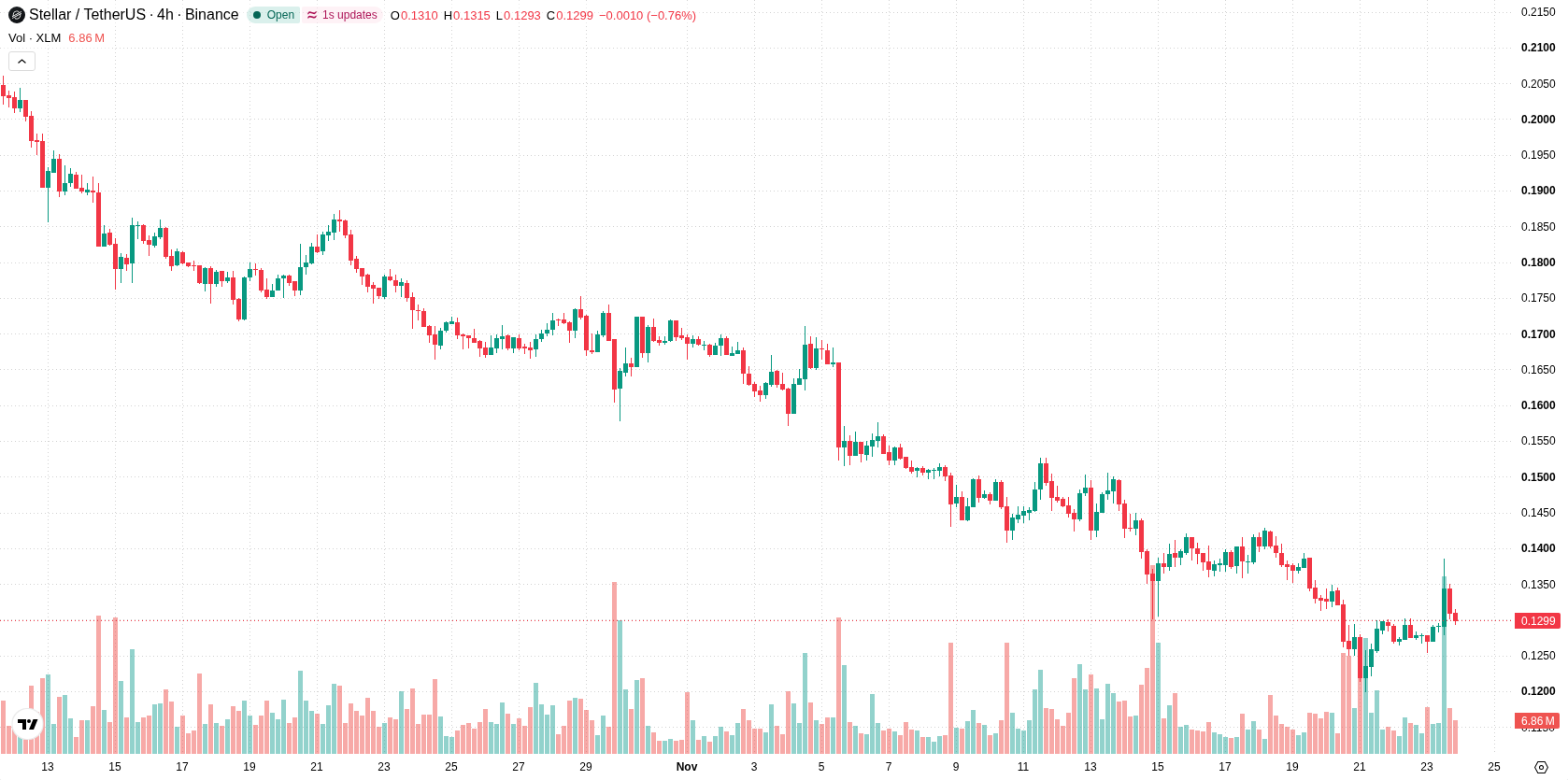
XLM momentum remains mixed under key 4H moving averages
On the 4H chart, XLM is positioned below its primary moving averages, with the H4 SMA-50 at $0.1339 and the H4 SMA-200 at $0.1542, suggesting longer-term downward pressure. However, the asset is holding modestly above the H4 SMA-20 at $0.1279, showing some short-term buying interest in the context of macro-driven swings.
Technical signals are mixed: while the MACD points to a strong sell and the H4 trend remains bearish, the ADX suggests there is still buying momentum in play. The H4 Kijun level at $0.1293 currently serves as nearby support for the asset amid these conflicting signals.
Fed risk and volatility to determine next move for XLM
Looking ahead, the stability of XLM is likely to depend on how the Fed's policy path shapes market liquidity and risk appetite. A move below support around $0.13 could increase downside pressure. Conversely, if XLM rises above resistance at $0.1339, it could indicate renewed short-term strength. Any shift in Fed stance or significant economic data release may quickly alter the risk environment for XLM holders.
Previously it was reported that Stellar’s price trajectory was largely dictated by expectations for macroeconomic growth and shifts in interest rate policy. The current analysis adds nuance by highlighting the direct role of Federal Reserve decisions in shaping market liquidity and risk appetite, emphasizing that the next significant move for XLM will hinge on the Fed's policy signals and upcoming economic data.










-
 Afghanistan
-
 Albania
-
 Algeria
-
 Angola
-
 Argentina
-
 Armenia
-
 Australia
-
 Austria
-
 Azerbaijan
-
 Bahamas
-
 Bahrain
-
 Bangladesh
-
 Belarus
-
 Belgium
-
 Bolivia
-
 Botswana
-
 Brazil
-
 Brunei
-
 Bulgaria
-
 Cambodia
-
 Cameroon
-
 Canada
-
 Chile
-
 China
-
 Colombia
-
 Congo
-
 Costa Rica
-
 Cote d'Ivoire
-
 Croatia
-
 Cuba
-
 Cyprus
-
 Czechia
-
 DR Congo
-
 Denmark
-
 Dominican Republic
-
 Ecuador
-
 Egypt
-
 El Salvador
-
 Estonia
-
 Eswatini
-
 Ethiopia
-
 Finland
-
 France
-
 Georgia
-
 Germany
-
 Ghana
-
 Greece
-
 Haiti
-
 Hong Kong
-
 Hungary
-
 India
-
 Indonesia
-
 Iran, Islamic republic
-
 Iraq
-
 Ireland
-
 Israel
-
 Italy
-
 Jamaica
-
 Japan
-
 Jordan
-
 Kazakhstan
-
 Kenya
-
 Korea
-
 Kuwait
-
 Kyrgyzstan
-
 Laos
-
 Latvia
-
 Lebanon
-
 Lesotho
-
 Libya
-
 Lithuania
-
 Luxembourg
-
 Madagascar
-
 Malaysia
-
 Malta
-
 Mauritius
-
 Mexico
-
 Moldova
-
 Mongolia
-
 Montenegro
-
 Morocco
-
 Mozambique
-
 Myanmar
-
 Namibia
-
 Nepal
-
 Netherlands
-
 New Zealand
-
 Nigeria
-
 North Macedonia
-
 Norway
-
 Oman
-
 Pakistan
-
 Palestine
-
 Panama
-
 Papua New Guinea
-
 Paraguay
-
 Peru
-
 Philippines
-
 Poland
-
 Portugal
-
 Puerto Rico
-
 Qatar
-
 Reunion
-
 Romania
-
 Rwanda
-
 Saudi Arabia
-
 Serbia
-
 Singapore
-
 Slovakia
-
 Slovenia
-
 Somalia
-
 South Africa
-
 Spain
-
 Sri Lanka
-
 Sweden
-
 Switzerland
-
 Syria
-
 Taiwan
-
 Tajikistan
-
 Tanzania
-
 Thailand
-
 Trinidad and Tobago
-
 Tunisia
-
 Turkey
-
 UAE
-
 Uganda
-
 Ukraine
-
 United Kingdom
-
United States
-
 Uruguay
-
 Uzbekistan
-
 Venezuela
-
 Vietnam
-
 Yemen
-
 Zambia
-
 Zimbabwe
- Forex
- Crypto












