

Can XLM stabilize if tokenized asset adoption and network growth continue?

Stellar (XLM) is trading down at $0.1237, showing a 6.99% decline for the session as of November 24, 2026. Recent activity highlights increasing interest in the Stellar network's tokenization capabilities, with traders watching for further ecosystem developments and institutional adoption.
 0.1324
0.1428
Highlights
- Stellar recorded $1.2 billion in net inflows of tokenized real-world assets over the 30 days ending November 24, 2026.
- Increased adoption for asset issuance and settlement could raise medium-term demand for XLM for transactions and network operations.
- XLM trades below major moving averages with technical indicators projecting a continued sell bias unless sustained inflows or network developments occur.
Stellar network leads in tokenized asset inflows amid ecosystem growth
According to Coinpedia, Stellar recorded the highest net inflow among major blockchains, with $1.2 billion in tokenized real-world assets added over the 30 days ending November 24, 2026. This development points to a notable expansion in institutional and user activity on the network, though price action has remained under broader selling pressure.
The sizable inflows into tokenized assets suggest that Stellar’s network is becoming a preferred platform for asset issuance and settlement, as on-chain demand for tokenization drives network usage. Growth in tokenized assets may increase demand for XLM as the native asset for transaction fees and network operations, providing a possible medium-term benefit to its utility and liquidity.
However, as the linkage between ecosystem inflows and XLM’s market price can be indirect, traders remain attentive to potential regulatory shifts or changes in institutional sentiment that could alter the pace of tokenized asset adoption.
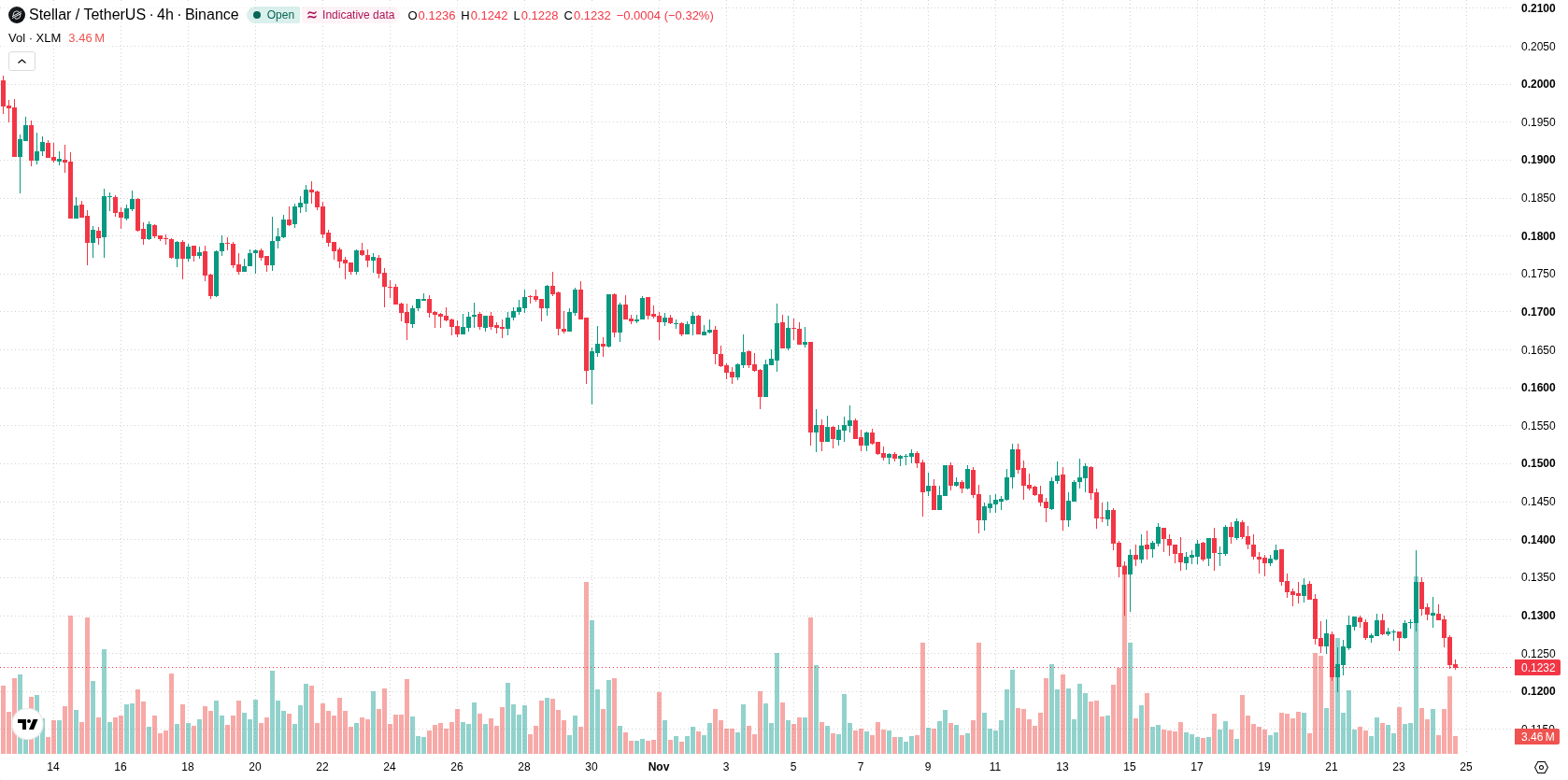
XLM price holds below H4 moving averages as momentum fades
Technical signals on the 4H chart remain aligned with a bearish framework, as XLM continues to trade below the H4 SMA-50 at $0.1327 and the H4 SMA-200 at $0.1528. Short-term momentum has also faded with price action staying under the H4 SMA-20 at $0.1287.
Additional indicators reinforce this cautious stance. The H4 Kijun at $0.1292 serves as a resistance level, while both MACD and ADX project a sell bias, indicating that downward trends persist within the current range.
Further adoption or a break above H4 Kijun needed for reversal
Further institutional adoption or a regulatory catalyst could change the risk environment for Stellar. Stability above the H4 Kijun around $0.13 would be the first sign of possible reversal. Until then, traders may view downside risk as prevailing, unless significant new inflows or network developments occur.
Earlier, analysts noted that Stellar was experiencing persistent weakness despite recent protocol upgrades, with price action under broad selling pressure. The latest data on tokenized asset inflows and ongoing technical weakness support this view, with traders now closely watching for significant institutional developments or regulatory shifts to alter the prevailing risk environment.








-
 Afghanistan
-
 Albania
-
 Algeria
-
 Angola
-
 Argentina
-
 Armenia
-
 Australia
-
 Austria
-
 Azerbaijan
-
 Bahamas
-
 Bahrain
-
 Bangladesh
-
 Belarus
-
 Belgium
-
 Bolivia
-
 Botswana
-
 Brazil
-
 Brunei
-
 Bulgaria
-
 Cambodia
-
 Cameroon
-
 Canada
-
 Chile
-
 China
-
 Colombia
-
 Congo
-
 Costa Rica
-
 Cote d'Ivoire
-
 Croatia
-
 Cuba
-
 Cyprus
-
 Czechia
-
 DR Congo
-
 Denmark
-
 Dominican Republic
-
 Ecuador
-
 Egypt
-
 El Salvador
-
 Estonia
-
 Eswatini
-
 Ethiopia
-
 Finland
-
 France
-
 Georgia
-
 Germany
-
 Ghana
-
 Greece
-
 Haiti
-
 Hong Kong
-
 Hungary
-
 India
-
 Indonesia
-
 Iran, Islamic republic
-
 Iraq
-
 Ireland
-
 Israel
-
 Italy
-
 Jamaica
-
 Japan
-
 Jordan
-
 Kazakhstan
-
 Kenya
-
 Korea
-
 Kuwait
-
 Kyrgyzstan
-
 Laos
-
 Latvia
-
 Lebanon
-
 Lesotho
-
 Libya
-
 Lithuania
-
 Luxembourg
-
 Madagascar
-
 Malaysia
-
 Malta
-
 Mauritius
-
 Mexico
-
 Moldova
-
 Mongolia
-
 Montenegro
-
 Morocco
-
 Mozambique
-
 Myanmar
-
 Namibia
-
 Nepal
-
 Netherlands
-
 New Zealand
-
 Nigeria
-
 North Macedonia
-
 Norway
-
 Oman
-
 Pakistan
-
 Palestine
-
 Panama
-
 Papua New Guinea
-
 Paraguay
-
 Peru
-
 Philippines
-
 Poland
-
 Portugal
-
 Puerto Rico
-
 Qatar
-
 Reunion
-
 Romania
-
 Rwanda
-
 Saudi Arabia
-
 Serbia
-
 Singapore
-
 Slovakia
-
 Slovenia
-
 Somalia
-
 South Africa
-
 Spain
-
 Sri Lanka
-
 Sweden
-
 Switzerland
-
 Syria
-
 Taiwan
-
 Tajikistan
-
 Tanzania
-
 Thailand
-
 Trinidad and Tobago
-
 Tunisia
-
 Turkey
-
 UAE
-
 Uganda
-
 Ukraine
-
 United Kingdom
-
United States
-
 Uruguay
-
 Uzbekistan
-
 Venezuela
-
 Vietnam
-
 Yemen
-
 Zambia
-
 Zimbabwe
- Forex
- Crypto












