
Nvidia stock jumps 2.2% as U.S. Congress drops chip export ban from Defense Bill
As of December 5, Nvidia stock is trading at $183.47, up 2.2% in the past 24 hours. This recovery follows a period of consolidation between $170 and $180, where the stock showed signs of building a base.
Highlights
- Nvidia shares gained 2.2% after U.S. lawmakers removed the GAIN AI Act from the final defense bill, avoiding stricter export rules on AI chips.
- The exclusion eases immediate regulatory risks for Nvidia’s global sales of high-performance processors like the H100 and A100.
- Technical indicators suggest continued bullish momentum, with resistance near $190 and support holding around $175.
The current price places Nvidia firmly above both the 50-day moving average (around $169) and the 200-day moving average (currently near $150), confirming the continuation of its medium-term uptrend. Volume surged to over 167 million shares in Friday’s session, reinforcing bullish sentiment and validating the breakout from near-term support at $175. Immediate resistance sits near $188–190 — a level where the stock paused during November. A confirmed breakout above this band would open the path toward testing the August high of around $210.
Technical indicators are turning increasingly supportive. The Relative Strength Index (RSI) has rebounded to the 60–65 range, suggesting renewed buying strength without being in overbought territory. MACD (Moving Average Convergence Divergence) shows a fresh bullish crossover, adding to positive momentum signals.
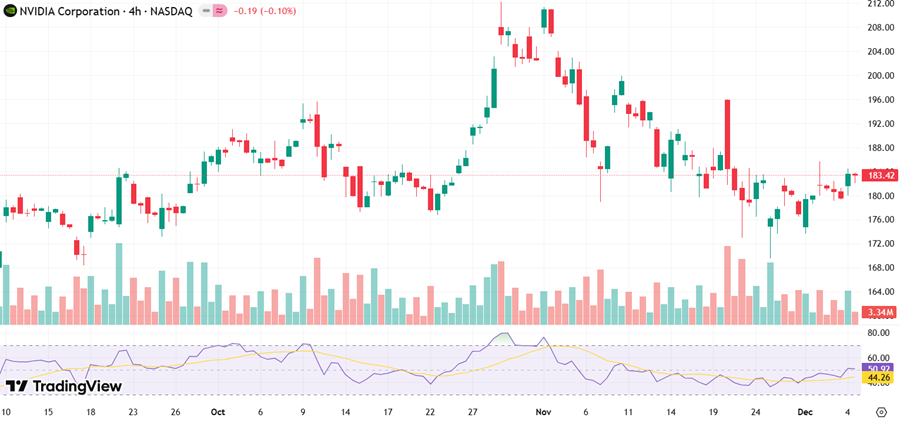
Nvidia stock price dynamics (October 2025 - December 2025). Source: TradingView
Key levels to watch in the near term are support at $175, which has been tested three times in the last two weeks and held firmly, and resistance at $190, which now acts as a decision point for short-term traders. Sustained movement above $190 could accelerate gains toward $200 and beyond, while a failure to hold $175 may expose Nvidia to a correction toward the 50-day average near $169.
Export clause removed from defense bill shifts regulatory risk
The primary driver of Nvidia’s rebound is political: U.S. lawmakers have opted not to include the proposed GAIN AI Act — a provision that would have imposed tighter export controls on high-end AI chips, including Nvidia’s H100 and A100 — in the final version of the National Defense Authorization Act (NDAA).
While the Biden administration originally imposed export restrictions on AI chips in 2022–2023, the current U.S. government appears more cautious about expanding those limits through new legislation. Investors interpreted this shift as a signal that U.S. policy on AI chip exports may remain more flexible and targeted rather than sweeping.
However, not all risks are off the table. U.S. Representative Michael Gallagher introduced separate legislation aimed at imposing chip-tracking requirements and tighter scrutiny of end-user applications — a move that could impact Nvidia’s business in indirect ways. In parallel, geopolitical tensions between Washington and Beijing continue to loom, especially around semiconductor access, IP control, and dual-use technologies.
Eyes on $190–200 as political clouds recede
In the short term, Nvidia’s path of least resistance appears to be upward. If $183–185 holds as the new base, and if regulatory news remains stable, the stock is likely to retest and potentially break through the $190 resistance area within days. A clean move through this zone — supported by high volume and favorable momentum — could push Nvidia to $195–200 before the end of December.
The base case scenario projects a move to $195–200 over the next 2–4 weeks, contingent on continued institutional demand and a stable macro backdrop. The bullish case, involving easing of additional export controls or strong quarterly guidance, places the 3-month target closer to $210–220.
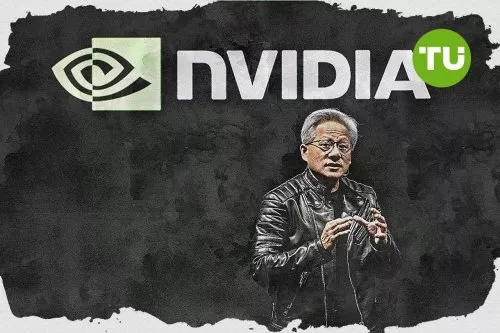
Investor concerns resurfaced after Nvidia CEO Jensen Huang met with President Trump to discuss potential export restrictions on advanced GPUs, including the China-specific H20 model. While Huang expressed support for national security measures, he warned that China may reject the downgraded chips, posing a risk to Nvidia’s international revenue.









-
 Afghanistan
-
 Albania
-
 Algeria
-
 Angola
-
 Argentina
-
 Armenia
-
 Australia
-
 Austria
-
 Azerbaijan
-
 Bahamas
-
 Bahrain
-
 Bangladesh
-
 Belarus
-
 Belgium
-
 Bolivia
-
 Botswana
-
 Brazil
-
 Brunei
-
 Bulgaria
-
 Cambodia
-
 Cameroon
-
 Canada
-
 Chile
Chile
-
 China
China
-
 Colombia
-
 Congo
Congo
-
 Costa Rica
-
 Cote d'Ivoire
-
 Croatia
-
 Cuba
Cuba
-
 Cyprus
-
 Czechia
-
 DR Congo
-
 Denmark
-
 Dominican Republic
-
 Ecuador
-
 Egypt
Egypt
-
 El Salvador
-
 Estonia
-
 Eswatini
-
 Ethiopia
-
 Finland
-
 France
-
 Georgia
-
 Germany
-
 Ghana
Ghana
-
 Greece
-
 Haiti
Haiti
-
 Hong Kong
-
 Hungary
-
 India
India
-
 Indonesia
-
 Iran, Islamic republic
-
 Iraq
Iraq
-
 Ireland
-
 Israel
-
 Italy
Italy
-
 Jamaica
-
 Japan
Japan
-
 Jordan
-
 Kazakhstan
-
 Kenya
Kenya
-
 Korea
Korea
-
 Kuwait
-
 Kyrgyzstan
-
 Laos
Laos
-
 Latvia
-
 Lebanon
-
 Lesotho
-
 Libya
Libya
-
 Lithuania
-
 Luxembourg
-
 Madagascar
-
 Malaysia
-
 Malta
Malta
-
 Mauritius
-
 Mexico
-
 Moldova
-
 Mongolia
-
 Montenegro
-
 Morocco
-
 Mozambique
-
 Myanmar
-
 Namibia
-
 Nepal
Nepal
-
 Netherlands
-
 New Zealand
-
 Nigeria
-
 North Macedonia
-
 Norway
-
 Oman
Oman
-
 Pakistan
-
 Palestine
-
 Panama
-
 Papua New Guinea
-
 Paraguay
-
 Peru
Peru
-
 Philippines
-
 Poland
-
 Portugal
-
 Puerto Rico
-
 Qatar
Qatar
-
 Reunion
-
 Romania
-
 Rwanda
-
 Saudi Arabia
-
 Serbia
-
 Singapore
-
 Slovakia
-
 Slovenia
-
 Somalia
-
 South Africa
-
 Spain
Spain
-
 Sri Lanka
-
 Sweden
-
 Switzerland
-
 Syria
Syria
-
 Taiwan
-
 Tajikistan
-
 Tanzania
-
 Thailand
-
 Trinidad and Tobago
-
 Tunisia
-
 Turkey
-
 UAE
UAE
-
 Uganda
-
 Ukraine
-
 United Kingdom
-
United States
-
 Uruguay
-
 Uzbekistan
-
 Venezuela
-
 Vietnam
-
 Yemen
Yemen
-
 Zambia
-
 Zimbabwe
- Forex
- Crypto











