
Tesla stock climbs above $448 as Musk targets full robotaxi autonomy by year-end
As of December 11, Tesla stock is trading at $448.50, up 0.7% in the past 24 hours, continuing its steady recovery toward the year’s highs. Technically, Tesla (TSLA) is showing sustained bullish behavior, trading above all major moving averages.
Highlights
- Tesla shares gained 0.7% as Elon Musk reaffirmed plans to launch fully autonomous robotaxis in Austin by year-end.
- The stock is approaching key resistance at $460, with strong technical momentum and investor focus on autonomy.
- Analysts remain split, balancing long-term AI potential against short-term execution risks.
The 50-day moving average is currently near $436, and the 200-day moving average is around $240, providing a wide cushion of support that underscores Tesla's long-term uptrend. Shorter-term, the 21-day exponential moving average (EMA) has now crossed above $442, and the stock is holding this level convincingly, suggesting continuation of the current rally.Technical indicators reinforce this bullish outlook. Relative Strength Index (RSI) readings have been oscillating in the 65–70 range, suggesting strong momentum without entering severely overbought territory. The MACD (Moving Average Convergence Divergence) continues to show a bullish crossover, with widening histograms that indicate rising buying pressure. Bollinger Bands are expanding, signaling increasing volatility and the potential for a significant directional move.
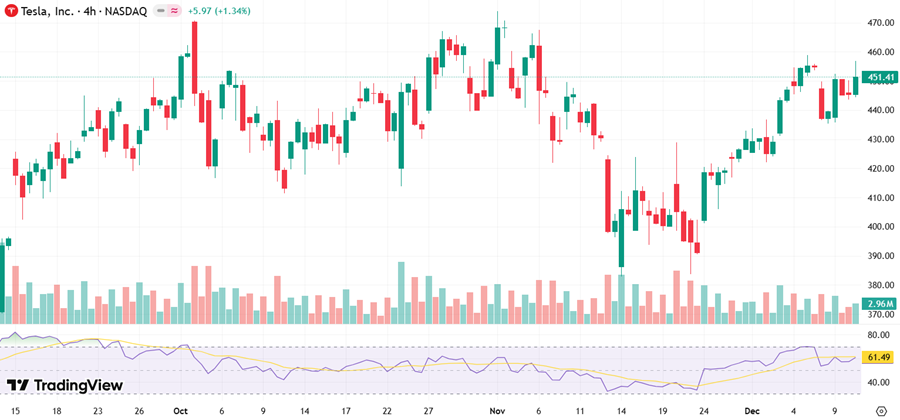
Tesla stock price dynamics (October 2025 - December 2025). Source: TradingView
Key support is identified at $435–$440, which coincides with the 50-day moving average and the recent consolidation zone. Below that, the next level is $420, though no immediate downside threat appears on the chart. On the upside, resistance remains near $458–$460, a zone that has capped the last two rallies. A decisive breakout above this level would likely attract momentum traders and algorithmic flows, opening a path toward $470–$480.
Robotaxi headlines fuel speculation, but risks remain
Investor attention has sharpened following CEO Elon Musk’s renewed pledge to launch fully autonomous robotaxis in the coming weeks. In a recent announcement, Musk stated that Tesla would begin removing safety drivers from supervised Full Self-Driving (FSD) vehicles in Austin, Texas, within three weeks, with the goal of operating fully unsupervised robotaxis before the end of 2025. This represents a significant step in Tesla’s AI and autonomy roadmap and has contributed to recent bullish sentiment.
The rollout will begin with Model Ys equipped with Tesla's latest FSD Beta version. However, the rollout scale remains small, and full regulatory approval is still uncertain. Tesla's approach—relying solely on cameras without lidar or radar—remains controversial, particularly as most competitors favor sensor fusion systems to ensure safety and reliability.Analyst reactions are mixed. Deutsche Bank recently reiterated Tesla as a "Top Pick for 2026," setting a $470 price target, citing long-term upside in autonomy, Dojo supercomputing, and AI monetization. However, Morgan Stanley took a more cautious stance, downgrading the stock to “Hold” while still acknowledging upside risk if FSD succeeds commercially.
Breakout or pause: $460 level key as robotaxi rollout looms
Bullish investors are watching the $460 breakout level closely. If Tesla confirms unsupervised robotaxi testing in Austin without regulatory or safety backlash, the stock is likely to extend its rally toward $470–$480 in the short term. Strong trading volumes and favorable technicals would support this move, especially if paired with broader tech sector strength.
In a more neutral base-case scenario, TSLA could consolidate in the $435–$460 range, with range-bound action as investors await tangible data on robotaxi expansion, FSD safety metrics, or holiday delivery figures. This would allow technical indicators to reset and create a springboard for a more sustainable rally in Q1 2026.
Tesla's Full Self-Driving software has shown a major breakthrough, according to a new report by Piper Sandler. Version 14.1.x improved its “miles to critical disengagement” metric from 441 miles to over 9,200 — a 20-fold increase in autonomous performance.





Latest Tesla News







-
 Afghanistan
-
 Albania
-
 Algeria
-
 Angola
-
 Argentina
-
 Armenia
-
 Australia
-
 Austria
-
 Azerbaijan
-
 Bahamas
-
 Bahrain
-
 Bangladesh
-
 Belarus
-
 Belgium
-
 Bolivia
-
 Botswana
-
 Brazil
-
 Brunei
-
 Bulgaria
-
 Cambodia
-
 Cameroon
-
 Canada
-
 Chile
Chile
-
 China
China
-
 Colombia
-
 Congo
Congo
-
 Costa Rica
-
 Cote d'Ivoire
-
 Croatia
-
 Cuba
Cuba
-
 Cyprus
-
 Czechia
-
 DR Congo
-
 Denmark
-
 Dominican Republic
-
 Ecuador
-
 Egypt
Egypt
-
 El Salvador
-
 Estonia
-
 Eswatini
-
 Ethiopia
-
 Finland
-
 France
-
 Georgia
-
 Germany
-
 Ghana
Ghana
-
 Greece
-
 Haiti
Haiti
-
 Hong Kong
-
 Hungary
-
 India
India
-
 Indonesia
-
 Iran, Islamic republic
-
 Iraq
Iraq
-
 Ireland
-
 Israel
-
 Italy
Italy
-
 Jamaica
-
 Japan
Japan
-
 Jordan
-
 Kazakhstan
-
 Kenya
Kenya
-
 Korea
Korea
-
 Kuwait
-
 Kyrgyzstan
-
 Laos
Laos
-
 Latvia
-
 Lebanon
-
 Lesotho
-
 Libya
Libya
-
 Lithuania
-
 Luxembourg
-
 Madagascar
-
 Malaysia
-
 Malta
Malta
-
 Mauritius
-
 Mexico
-
 Moldova
-
 Mongolia
-
 Montenegro
-
 Morocco
-
 Mozambique
-
 Myanmar
-
 Namibia
-
 Nepal
Nepal
-
 Netherlands
-
 New Zealand
-
 Nigeria
-
 North Macedonia
-
 Norway
-
 Oman
Oman
-
 Pakistan
-
 Palestine
-
 Panama
-
 Papua New Guinea
-
 Paraguay
-
 Peru
Peru
-
 Philippines
-
 Poland
-
 Portugal
-
 Puerto Rico
-
 Qatar
Qatar
-
 Reunion
-
 Romania
-
 Rwanda
-
 Saudi Arabia
-
 Serbia
-
 Singapore
-
 Slovakia
-
 Slovenia
-
 Somalia
-
 South Africa
-
 Spain
Spain
-
 Sri Lanka
-
 Sweden
-
 Switzerland
-
 Syria
Syria
-
 Taiwan
-
 Tajikistan
-
 Tanzania
-
 Thailand
-
 Trinidad and Tobago
-
 Tunisia
-
 Turkey
-
 UAE
UAE
-
 Uganda
-
 Ukraine
-
 United Kingdom
-
United States
-
 Uruguay
-
 Uzbekistan
-
 Venezuela
-
 Vietnam
-
 Yemen
Yemen
-
 Zambia
-
 Zimbabwe
- Forex
- Crypto











