
Nikkei 225 holds near 50,500 as investors lock in gains
The Nikkei 225 is trading near the 50,500 level on Monday after pulling back from recent highs, as year-end positioning and thinning liquidity begin to influence market behavior. Monday’s decline erased the prior session’s gains, signaling a more cautious tone among investors rather than a breakdown in the broader trend.
Highlights
- Nikkei pulls back from recent highs as holiday liquidity thins and positioning turns cautious
- Broader uptrend remains intact with price holding above key moving averages
- Geopolitical risk and Fed uncertainty drive short-term hesitation, not structural weakness
The retreat follows several sessions of subdued trading, suggesting that investors are locking in gains and reducing exposure into the year-end period. While volatility has increased modestly, the underlying structure continues to point toward consolidation at elevated levels rather than the start of a deeper corrective phase. After one of its strongest multi-month rallies in modern history, the index appears to be entering a consolidation phase, with price action reflecting digestion rather than distribution.
Daily trend remains resilient despite consolidation
The daily chart reinforces the view that the broader uptrend remains intact. The Nikkei continues to trade comfortably above its rising 20, 50, 100, and 200-day EMAs, which remain stacked in bullish alignment. The 20-day EMA near 50,150 has begun to flatten, a typical signal of consolidation following a strong advance rather than trend exhaustion.
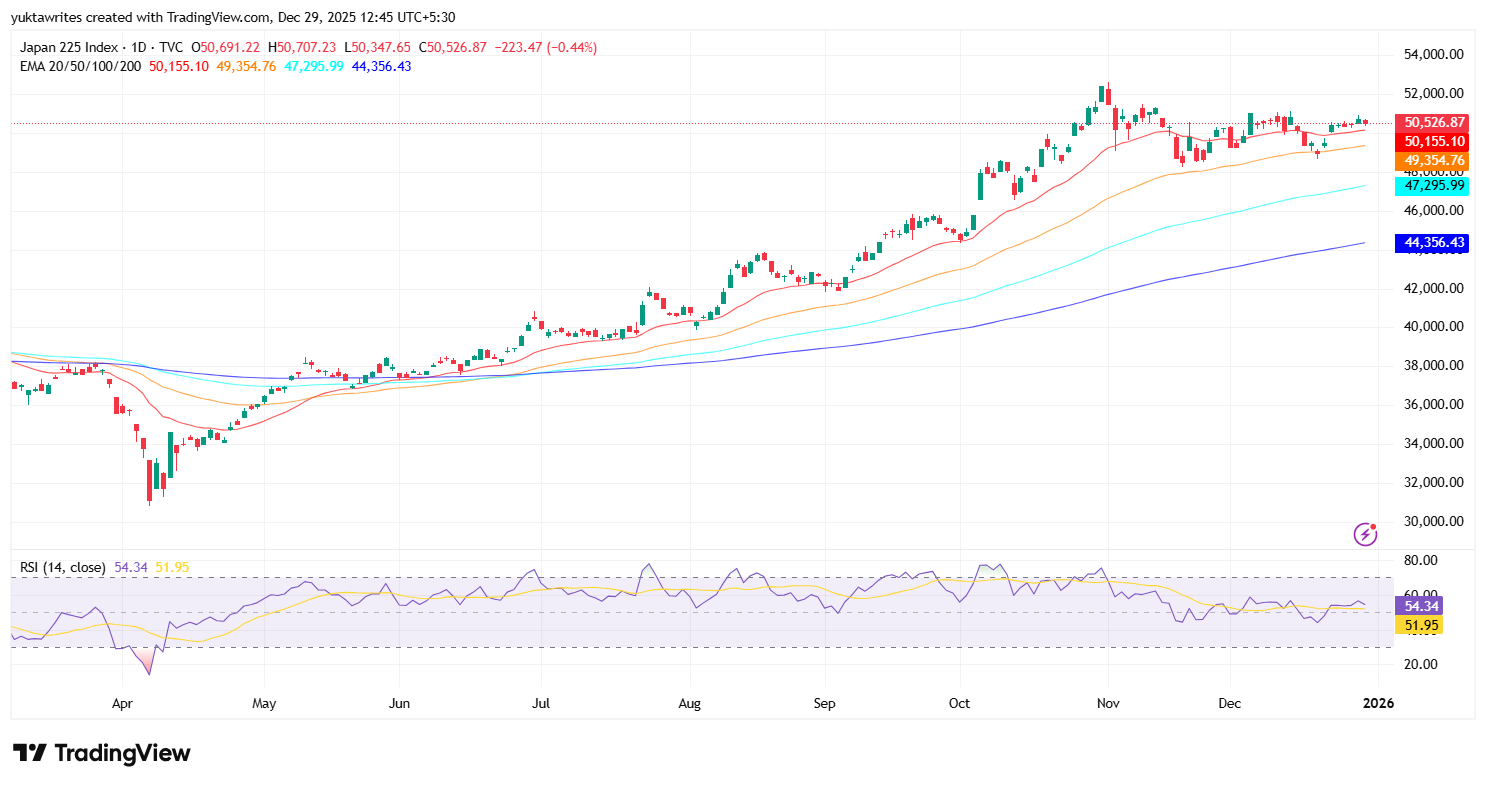
Nikkei 225 price dynamics (Source: TradingView)
Daily RSI is holding around the mid-50s, reflecting neutral momentum after months of sustained upside. This reading suggests that the market has worked off overbought conditions through time rather than price, a hallmark of healthy trends. Unless the index breaks decisively below the 20-day EMA, the medium-term bullish structure remains firmly in place.
From a technical perspective, the 50,000 level continues to act as a key psychological and structural support. A sustained move below this area would expose the 49,500 region, where the rising 50-day EMA provides stronger medium-term support. On the upside, the 50,800-51,000 band remains the immediate resistance zone. A clean close above that area would likely signal renewed momentum and open the door to fresh record highs.
Short-term momentum cools as traders reduce exposure
On the 30-minute chart, the Nikkei shows a clear loss of short-term momentum after failing to sustain its push toward the 51,000 area. Price has slipped back below its intraday Supertrend, with Parabolic SAR resistance now tracking above the index. This technical shift reflects near-term pressure as traders trim positions ahead of the holiday period and respond to thinner market conditions.
Importantly, the pullback has remained orderly. Price continues to hold above the 50,300-50,400 zone, which has emerged as a short-term equilibrium area over recent sessions. The absence of sharp downside acceleration suggests that selling has been driven more by profit-taking and risk management than by a change in conviction. As long as this area holds, the near-term structure favors consolidation rather than continuation lower.
Macro and geopolitical factors shape near-term sentiment
The recent pullback has been influenced by a convergence of macro and geopolitical factors. Sentiment turned cautious after China launched large-scale military drills around Taiwan as part of its “Justice Mission 2025” exercise, injecting fresh uncertainty into regional markets. While the drills did not trigger widespread risk-off behavior, they prompted investors to pare exposure in extended positions.
At the same time, markets are positioning ahead of the release of minutes from the U.S. Federal Reserve’s latest policy meeting. Although the Fed cut rates earlier this month, officials signaled a more measured easing path, projecting only one additional cut next year. This guidance has tempered risk appetite, particularly in markets that have already priced in significant optimism.
Sector performance underscores the tactical nature of the move. Technology and industrial heavyweights such as Advantest, Daikin Industries, Japan Tobacco, and NEC led the decline. However, the broader Topix index managed to post a modest gain, indicating rotation within the market rather than a broad-based exit from Japanese equities.
As discussed in earlier coverage, the Nikkei’s rally in 2025 has been driven by a combination of improving corporate earnings, easing trade headwinds, supportive fiscal policy, and Japan’s relatively accommodative real interest rate environment. The index is up roughly 28% for the year and is on track for a third consecutive annual gain.
Against that backdrop, the current pause appears to be a natural digestion phase rather than a loss of confidence. As long as key support levels hold and global conditions remain broadly constructive, the Nikkei’s longer-term bullish narrative remains intact heading into 2026.


Latest Nikkei 225 News







-
 Afghanistan
-
 Albania
-
 Algeria
-
 Angola
-
 Argentina
-
 Armenia
-
 Australia
-
 Austria
-
 Azerbaijan
-
 Bahamas
-
 Bahrain
-
 Bangladesh
-
 Belarus
-
 Belgium
-
 Bolivia
-
 Botswana
-
 Brazil
-
 Brunei
-
 Bulgaria
-
 Cambodia
-
 Cameroon
-
 Canada
-
 Chile
Chile
-
 China
China
-
 Colombia
-
 Congo
Congo
-
 Costa Rica
-
 Cote d'Ivoire
-
 Croatia
-
 Cuba
Cuba
-
 Cyprus
-
 Czechia
-
 DR Congo
-
 Denmark
-
 Dominican Republic
-
 Ecuador
-
 Egypt
Egypt
-
 El Salvador
-
 Estonia
-
 Eswatini
-
 Ethiopia
-
 Finland
-
 France
-
 Georgia
-
 Germany
-
 Ghana
Ghana
-
 Greece
-
 Haiti
Haiti
-
 Hong Kong
-
 Hungary
-
 India
India
-
 Indonesia
-
 Iran, Islamic republic
-
 Iraq
Iraq
-
 Ireland
-
 Israel
-
 Italy
Italy
-
 Jamaica
-
 Japan
Japan
-
 Jordan
-
 Kazakhstan
-
 Kenya
Kenya
-
 Korea
Korea
-
 Kuwait
-
 Kyrgyzstan
-
 Laos
Laos
-
 Latvia
-
 Lebanon
-
 Lesotho
-
 Libya
Libya
-
 Lithuania
-
 Luxembourg
-
 Madagascar
-
 Malaysia
-
 Malta
Malta
-
 Mauritius
-
 Mexico
-
 Moldova
-
 Mongolia
-
 Montenegro
-
 Morocco
-
 Mozambique
-
 Myanmar
-
 Namibia
-
 Nepal
Nepal
-
 Netherlands
-
 New Zealand
-
 Nigeria
-
 North Macedonia
-
 Norway
-
 Oman
Oman
-
 Pakistan
-
 Palestine
-
 Panama
-
 Papua New Guinea
-
 Paraguay
-
 Peru
Peru
-
 Philippines
-
 Poland
-
 Portugal
-
 Puerto Rico
-
 Qatar
Qatar
-
 Reunion
-
 Romania
-
 Rwanda
-
 Saudi Arabia
-
 Serbia
-
 Singapore
-
 Slovakia
-
 Slovenia
-
 Somalia
-
 South Africa
-
 Spain
Spain
-
 Sri Lanka
-
 Sweden
-
 Switzerland
-
 Syria
Syria
-
 Taiwan
-
 Tajikistan
-
 Tanzania
-
 Thailand
-
 Trinidad and Tobago
-
 Tunisia
-
 Turkey
-
 UAE
UAE
-
 Uganda
-
 Ukraine
-
 United Kingdom
-
United States
-
 Uruguay
-
 Uzbekistan
-
 Venezuela
-
 Vietnam
-
 Yemen
Yemen
-
 Zambia
-
 Zimbabwe
- Forex
- Crypto











