

Nikkei 225 slips below 52,000 as China export restrictions raise geopolitical risk
The Nikkei 225 rolled over on Wednesday, snapping a brief two-day rebound as profit-taking collided with fresh geopolitical tension in Asia. Japan’s benchmark index closed down 1.06% at 51,962, while the broader Topix index fell 0.77% to 3,511, underscoring a shift from momentum-driven buying to more cautious positioning.
Highlights
- Nikkei closes at 51,962 as China export controls hit defense and industrial stocks
- Index holds above key trend support despite sharp sector-level selling
- Geopolitics re-emerge as a risk factor after December’s momentum rally
China’s announcement of export controls on military-use goods bound for Japan became the immediate catalyst, cutting across some of the Nikkei’s strongest-performing sectors and reminding investors that geopolitical risk is no longer a background variable.
Uptrend holds but momentum cools
From a technical perspective, the broader trend remains intact despite the pullback. On the daily chart, the Nikkei continues to trade comfortably above its rising 20-day and 50-day moving averages, clustered around the 50,600 and 49,700 region. That band now defines near-term trend support. As long as price remains above it, Wednesday’s decline reads as consolidation rather than a breakdown.
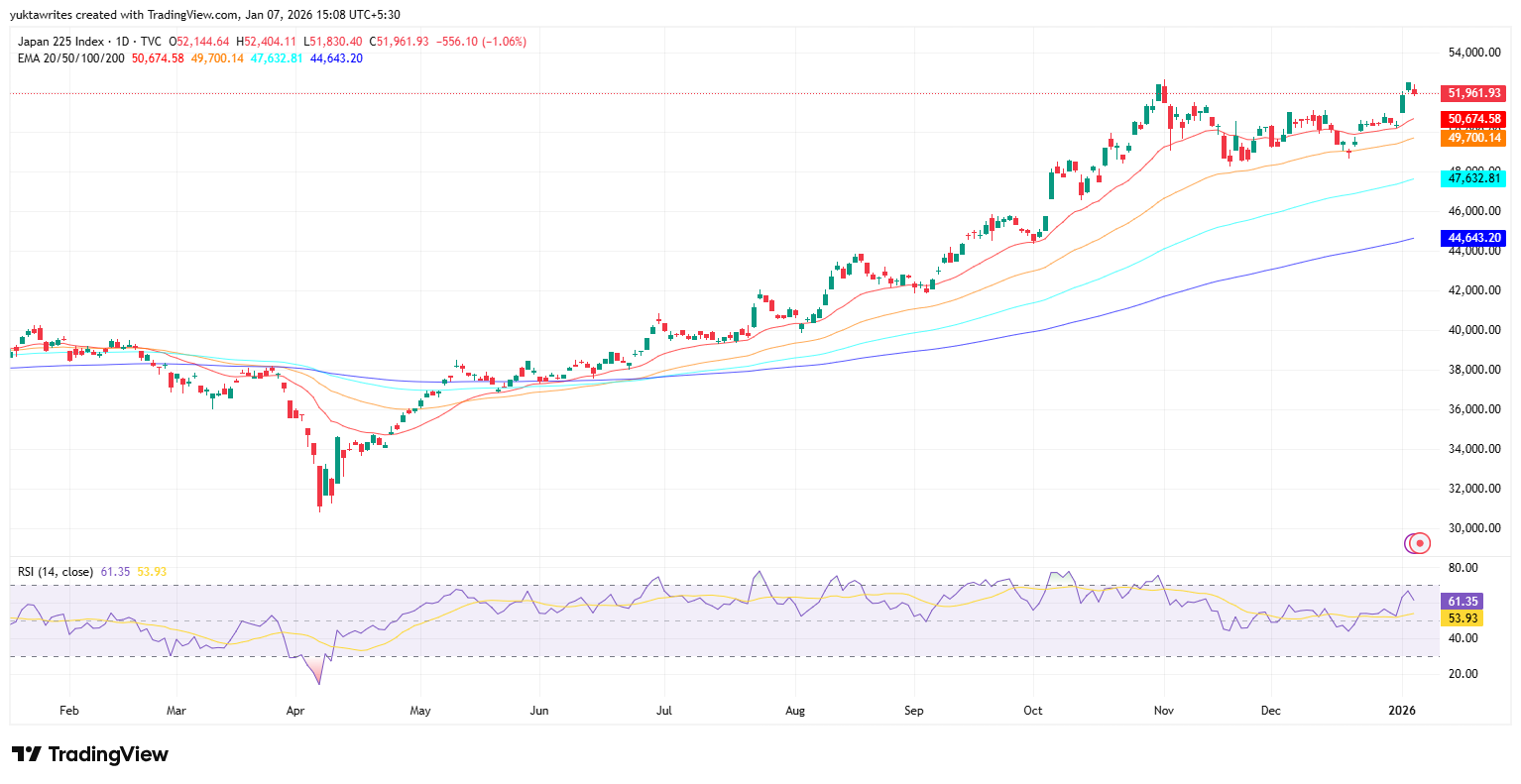
Nikkei 225 price dynamics (Source: TradingView)
The longer-term picture remains firmly bullish. The 100-day EMA near 47,600 and the 200-day around 44,600 sit far below current levels, highlighting how extended the rally has been over the past year. That distance, however, also explains why the market is becoming more sensitive to negative catalysts. When positioning is crowded, it takes less news to trigger profit-taking.
Momentum indicators reflect that balance. Daily RSI has eased back toward the low-60s after spending much of December in overbought territory. This cooling relieves upside pressure without damaging the underlying structure. In practical terms, the market has stopped accelerating, but it has not yet rolled over into a bearish phase.
Intraday price action adds further clarity. On the 30-minute chart, the Nikkei was rejected cleanly from the 52,300-52,500 zone, where short-term Supertrend flipped lower and sellers took control. Price slid toward 51,900 before stabilizing above intraday support near 51,700. That level now serves as a key line for short-term traders. Holding above it keeps the index in a range-to-higher posture. A decisive break below would open room toward 51,200 and potentially the psychological 51,000 mark.
Sector pressure exposes geopolitical sensitivity
The character of Wednesday’s decline was driven less by broad macro weakness and more by sector-specific pressure. Defense and industrial stocks bore the brunt of selling after China confirmed restrictions on exports of electronics, sensors, aerospace components, and shipping-related technology destined for Japan.
Mitsubishi Heavy Industries fell 2.3%, Kawasaki Heavy Industries dropped 2.1%, and several exporters tied to defense and advanced manufacturing followed lower. This matters for index dynamics. The Nikkei’s rally over the past year has leaned heavily on Japan’s industrial leverage, defense spending expectations, and its role in global supply chains. Any disruption to that narrative feeds quickly into index risk premia.
Selling was not confined to one corner of the market. Large-cap leaders including Sony Group, Toyota Motor, and SoftBank Group all closed lower, signaling broad profit-taking rather than simple rotation. Tokyo Electric Power’s 7.3% slide added to the defensive tone. Corporate headlines offered little offset. Hisamitsu Pharmaceutical’s decision to go private in a roughly 390 billion yen transaction drew attention but was not large enough to support the broader market.
Macro fundamentals remain supportive but increasingly fragile. Japan continues to benefit from strong nominal growth, corporate governance reforms, and steady foreign inflows. At the same time, geopolitical risk in Asia has shifted from abstract concern to actionable variable. Trade controls, supply-chain restrictions, and regional security tensions now carry direct implications for earnings visibility.
Clear levels define the next move
From a bullish standpoint, the roadmap remains straightforward. If the Nikkei holds above 51,700 and reclaims the 52,300 area with volume, momentum could re-accelerate toward the prior highs near 53,000 and potentially the 54,000 zone marked on the daily chart. The broader trend still favors buying pullbacks rather than selling rallies.
The bearish case becomes relevant only if deeper support gives way. A sustained break below the 50-day average near 49,700 would signal that this is no longer a routine pause. That would expose the index to a retracement toward 48,000, where the 100-day EMA sits, and could prompt faster de-risking from trend followers who have ridden the rally for months.
For short-term traders, discipline matters. Respecting levels rather than reacting to headlines has been the most effective approach. Momentum traders should wait for confirmation, either a reclaim of resistance to re-enter longs or a clean loss of support to press shorts.
For longer-term investors, the message is measured rather than alarmist. The Nikkei has absorbed pullbacks before as long as its structural story remained intact. That story is still alive, but the margin for error has narrowed.
Previously discussed, the Nikkei’s powerful December rally left positioning crowded and volatility compressed, increasing sensitivity to negative catalysts. As long as long-term averages continue to rise, pullbacks have remained corrective. The key question now is whether geopolitics merely resets momentum or begins to challenge the structural thesis behind Japan’s equity outperformance.





Latest Nikkei 225 News






-
 Afghanistan
-
 Albania
-
 Algeria
-
 Angola
-
 Argentina
-
 Armenia
-
 Australia
-
 Austria
-
 Azerbaijan
-
 Bahamas
-
 Bahrain
-
 Bangladesh
-
 Belarus
-
 Belgium
-
 Bolivia
-
 Botswana
-
 Brazil
-
 Brunei
-
 Bulgaria
-
 Cambodia
-
 Cameroon
-
 Canada
-
 Chile
Chile
-
 China
China
-
 Colombia
-
 Congo
Congo
-
 Costa Rica
-
 Cote d'Ivoire
-
 Croatia
-
 Cuba
Cuba
-
 Cyprus
-
 Czechia
-
 DR Congo
-
 Denmark
-
 Dominican Republic
-
 Ecuador
-
 Egypt
Egypt
-
 El Salvador
-
 Estonia
-
 Eswatini
-
 Ethiopia
-
 Finland
-
 France
-
 Georgia
-
 Germany
-
 Ghana
Ghana
-
 Greece
-
 Haiti
Haiti
-
 Hong Kong
-
 Hungary
-
 India
India
-
 Indonesia
-
 Iran, Islamic republic
-
 Iraq
Iraq
-
 Ireland
-
 Israel
-
 Italy
Italy
-
 Jamaica
-
 Japan
Japan
-
 Jordan
-
 Kazakhstan
-
 Kenya
Kenya
-
 Korea
Korea
-
 Kuwait
-
 Kyrgyzstan
-
 Laos
Laos
-
 Latvia
-
 Lebanon
-
 Lesotho
-
 Libya
Libya
-
 Lithuania
-
 Luxembourg
-
 Madagascar
-
 Malaysia
-
 Malta
Malta
-
 Mauritius
-
 Mexico
-
 Moldova
-
 Mongolia
-
 Montenegro
-
 Morocco
-
 Mozambique
-
 Myanmar
-
 Namibia
-
 Nepal
Nepal
-
 Netherlands
-
 New Zealand
-
 Nigeria
-
 North Macedonia
-
 Norway
-
 Oman
Oman
-
 Pakistan
-
 Palestine
-
 Panama
-
 Papua New Guinea
-
 Paraguay
-
 Peru
Peru
-
 Philippines
-
 Poland
-
 Portugal
-
 Puerto Rico
-
 Qatar
Qatar
-
 Reunion
-
 Romania
-
 Rwanda
-
 Saudi Arabia
-
 Serbia
-
 Singapore
-
 Slovakia
-
 Slovenia
-
 Somalia
-
 South Africa
-
 Spain
Spain
-
 Sri Lanka
-
 Sweden
-
 Switzerland
-
 Syria
Syria
-
 Taiwan
-
 Tajikistan
-
 Tanzania
-
 Thailand
-
 Trinidad and Tobago
-
 Tunisia
-
 Turkey
-
 UAE
UAE
-
 Uganda
-
 Ukraine
-
 United Kingdom
-
United States
-
 Uruguay
-
 Uzbekistan
-
 Venezuela
-
 Vietnam
-
 Yemen
Yemen
-
 Zambia
-
 Zimbabwe
- Forex
- Crypto












