
Nvidia stock stabilizes at $185 as China curbs imports of H200 AI chip

As of January 14, Nvidia stock is trading at $185.80, up 0.5% in the past 24 hours. The stock remains range-bound, underperforming major indices as it struggles with resistance despite holding key support.
Highlights
- Nvidia closed at $185.80, up 0.5%, but remains below key resistance levels.
- China has quietly restricted imports of Nvidia’s H200 AI chips, adding uncertainty to future sales.
- Technical indicators suggest a neutral to slightly bearish short-term outlook unless momentum improves.
Currently, Nvidia trades below its 50-day moving average, suggesting limited near-term bullish momentum. The failure to reclaim the $190–$195 resistance zone reflects investor caution amid regulatory pressures and elevated valuations. The RSI (Relative Strength Index) is hovering around neutral levels, neither overbought nor oversold, but the flattening MACD line indicates reduced upward pressure. Momentum has faded since the stock peaked near $212, with institutional flows appearing more cautious.
Support is currently anchored at $170, a level that previously served as a springboard for rallies and aligns with a demand zone based on historical volume. A break below this level could open the way toward $150, coinciding with the 200-day moving average and critical long-term support. On the upside, immediate resistance is seen near $190, with stronger rejection expected around $212 unless a major catalyst re-energizes sentiment. The technical picture is neutral to slightly bearish in the short term, unless Nvidia can reclaim its 50-day moving average with volume.
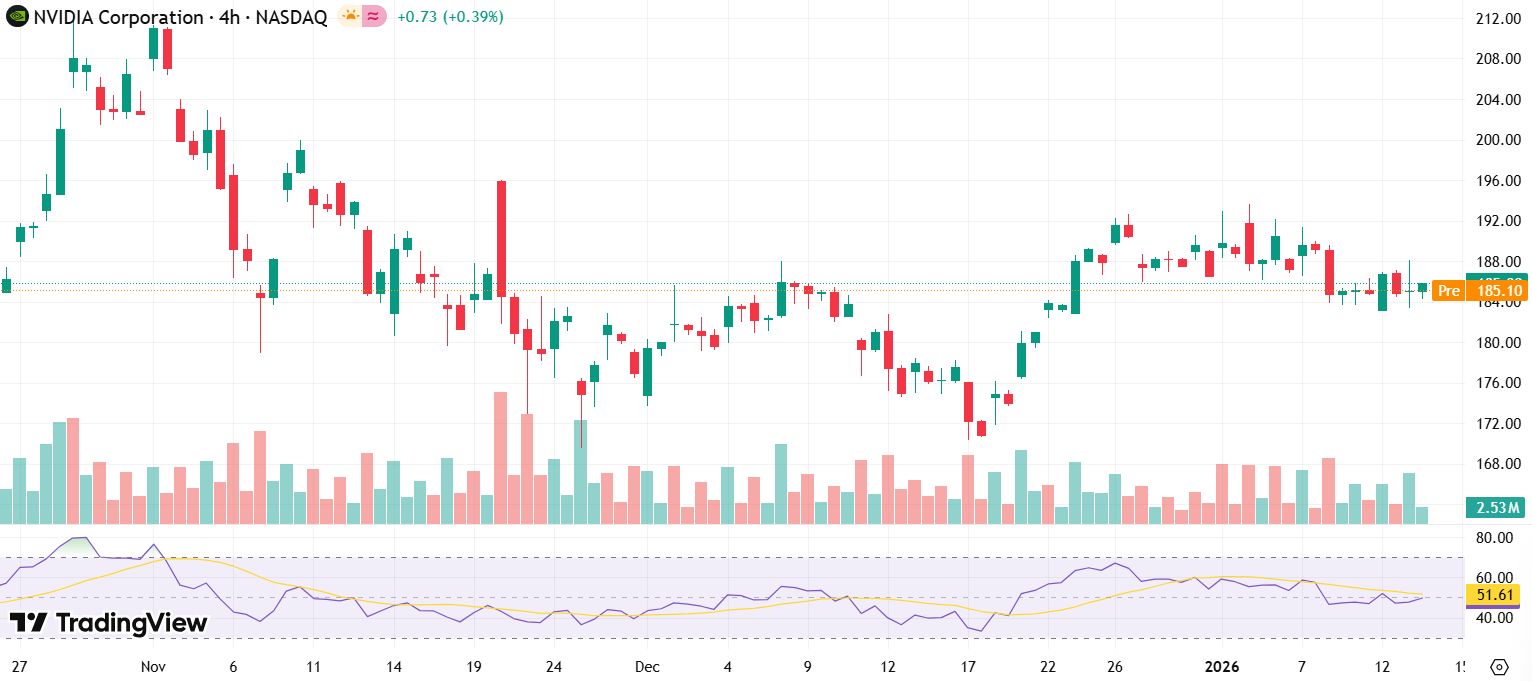
Nvidia stock price dynamics (November 2025 - January 2025). Source: TradingView.
Despite the recent stagnation, Nvidia maintains a strong longer-term uptrend, with the stock still trading well above its 100-day and 200-day moving averages. This broader technical structure suggests that while near-term momentum is lacking, the underlying bullish trend remains intact. Institutional investors may view current levels as a consolidation phase rather than a breakdown, especially given Nvidia’s dominant position in AI infrastructure. However, any uptick in volume without price follow-through could signal distribution rather than accumulation, reinforcing the need for a clear breakout above the 50-day average to confirm renewed upward momentum.
China’s chip restrictions and geopolitical uncertainty weigh on sentiment
Nvidia’s upside remains clouded by the latest developments from China. Chinese authorities have quietly restricted the import and sale of Nvidia’s high-end H200 AI chips. The policy allows sales only under “special circumstances,” such as university or research use, a vague designation that severely limits commercial distribution. Industry insiders noted that customs agents were instructed not to permit shipments of H200 chips, effectively enforcing an unofficial ban.
This move follows earlier U.S. decisions to grant Nvidia conditional export licenses to China with caveats—products must not be used for military purposes, must undergo third-party testing, and are subject to quantity restrictions. The U.S. had hoped these mitigations would allow limited sales of Nvidia’s advanced chips while protecting national security interests. However, the Chinese counter-response appears aimed at suppressing demand on the receiving end, keeping Nvidia locked out of one of the largest AI chip markets globally.
The geopolitical backdrop remains fragile. Chinese tech companies reportedly placed substantial advance orders for Nvidia chips in Q4 2025, anticipating regulatory relief. Instead, they now face delivery blockages, undermining procurement strategies and casting doubt on projected sales volumes for Nvidia in Asia. Investors had hoped for a partial China rebound in 2026, but that now appears delayed or downgraded.
Price range to hold pending policy clarity
In the short term, Nvidia is likely to remain range-bound between $170 and $195, with limited catalysts before its February earnings release. The base case scenario assumes no further deterioration in U.S.-China tech policy and stable macro conditions. If Nvidia signals strong Q4 revenue driven by U.S. and European AI cloud demand, the stock may push toward $200, retesting recent highs.
A bullish breakout scenario would require policy clarity from Beijing or indications that China’s enforcement is less restrictive in practice than it appears on paper. A breakthrough above $195 could target $212, with $220 as an extension if macro conditions align.
DA Davidson reaffirmed its Buy rating on Nvidia after CES, highlighting its leadership in AI computing. The firm sees Nvidia as the key winner in the upcoming hardware refresh cycle fueled by growing AI infrastructure demand.








-
 Afghanistan
-
 Albania
-
 Algeria
-
 Angola
-
 Argentina
-
 Armenia
-
 Australia
-
 Austria
-
 Azerbaijan
-
 Bahamas
-
 Bahrain
-
 Bangladesh
-
 Belarus
-
 Belgium
-
 Bolivia
-
 Botswana
-
 Brazil
-
 Brunei
-
 Bulgaria
-
 Cambodia
-
 Cameroon
-
 Canada
-
 Chile
Chile
-
 China
China
-
 Colombia
-
 Congo
Congo
-
 Costa Rica
-
 Cote d'Ivoire
-
 Croatia
-
 Cuba
Cuba
-
 Cyprus
-
 Czechia
-
 DR Congo
-
 Denmark
-
 Dominican Republic
-
 Ecuador
-
 Egypt
Egypt
-
 El Salvador
-
 Estonia
-
 Eswatini
-
 Ethiopia
-
 Finland
-
 France
-
 Georgia
-
 Germany
-
 Ghana
Ghana
-
 Greece
-
 Haiti
Haiti
-
 Hong Kong
-
 Hungary
-
 India
India
-
 Indonesia
-
 Iran, Islamic republic
-
 Iraq
Iraq
-
 Ireland
-
 Israel
-
 Italy
Italy
-
 Jamaica
-
 Japan
Japan
-
 Jordan
-
 Kazakhstan
-
 Kenya
Kenya
-
 Korea
Korea
-
 Kuwait
-
 Kyrgyzstan
-
 Laos
Laos
-
 Latvia
-
 Lebanon
-
 Lesotho
-
 Libya
Libya
-
 Lithuania
-
 Luxembourg
-
 Madagascar
-
 Malaysia
-
 Malta
Malta
-
 Mauritius
-
 Mexico
-
 Moldova
-
 Mongolia
-
 Montenegro
-
 Morocco
-
 Mozambique
-
 Myanmar
-
 Namibia
-
 Nepal
Nepal
-
 Netherlands
-
 New Zealand
-
 Nigeria
-
 North Macedonia
-
 Norway
-
 Oman
Oman
-
 Pakistan
-
 Palestine
-
 Panama
-
 Papua New Guinea
-
 Paraguay
-
 Peru
Peru
-
 Philippines
-
 Poland
-
 Portugal
-
 Puerto Rico
-
 Qatar
Qatar
-
 Reunion
-
 Romania
-
 Rwanda
-
 Saudi Arabia
-
 Serbia
-
 Singapore
-
 Slovakia
-
 Slovenia
-
 Somalia
-
 South Africa
-
 Spain
Spain
-
 Sri Lanka
-
 Sweden
-
 Switzerland
-
 Syria
Syria
-
 Taiwan
-
 Tajikistan
-
 Tanzania
-
 Thailand
-
 Trinidad and Tobago
-
 Tunisia
-
 Turkey
-
 UAE
UAE
-
 Uganda
-
 Ukraine
-
 United Kingdom
-
United States
-
 Uruguay
-
 Uzbekistan
-
 Venezuela
-
 Vietnam
-
 Yemen
Yemen
-
 Zambia
-
 Zimbabwe
- Forex
- Crypto











