
Nikkei 225 eases from 53,584 highs as global risk cools and investors lock in gains

The Nikkei 225 pulled back from record territory on Monday, closing near 53,584 as global risk sentiment softened and investors took profits after an extended rally. The move reflects caution rather than stress, with geopolitical headlines and near-term policy uncertainty in Japan prompting a pause after weeks of strong upside momentum.
Highlights
- Nikkei closes near 53,584 after retreating from record highs.
- Index remains well above key moving averages, keeping the primary trend bullish.
- Tariff threats and BoJ uncertainty drive profit-taking, not capitulation.
The pullback comes as markets reassess risk following fresh U.S. tariff threats toward European countries and ahead of the Bank of Japan’s upcoming policy decision. While heavyweight stocks that led the rally saw the most pressure, there is little evidence of forced selling or broad-based risk aversion.
Uptrend intact as consolidation replaces momentum
On the daily chart, the Nikkei’s broader structure remains firmly bullish. Price continues to trade well above all major EMAs, underscoring the strength of the longer-term trend. The 20-day EMA near 52,039 has begun to flatten after weeks of upside acceleration, signaling a slowdown in momentum rather than a reversal. The 50-day EMA around 50,577 continues to slope higher beneath price, providing a deeper layer of trend support.
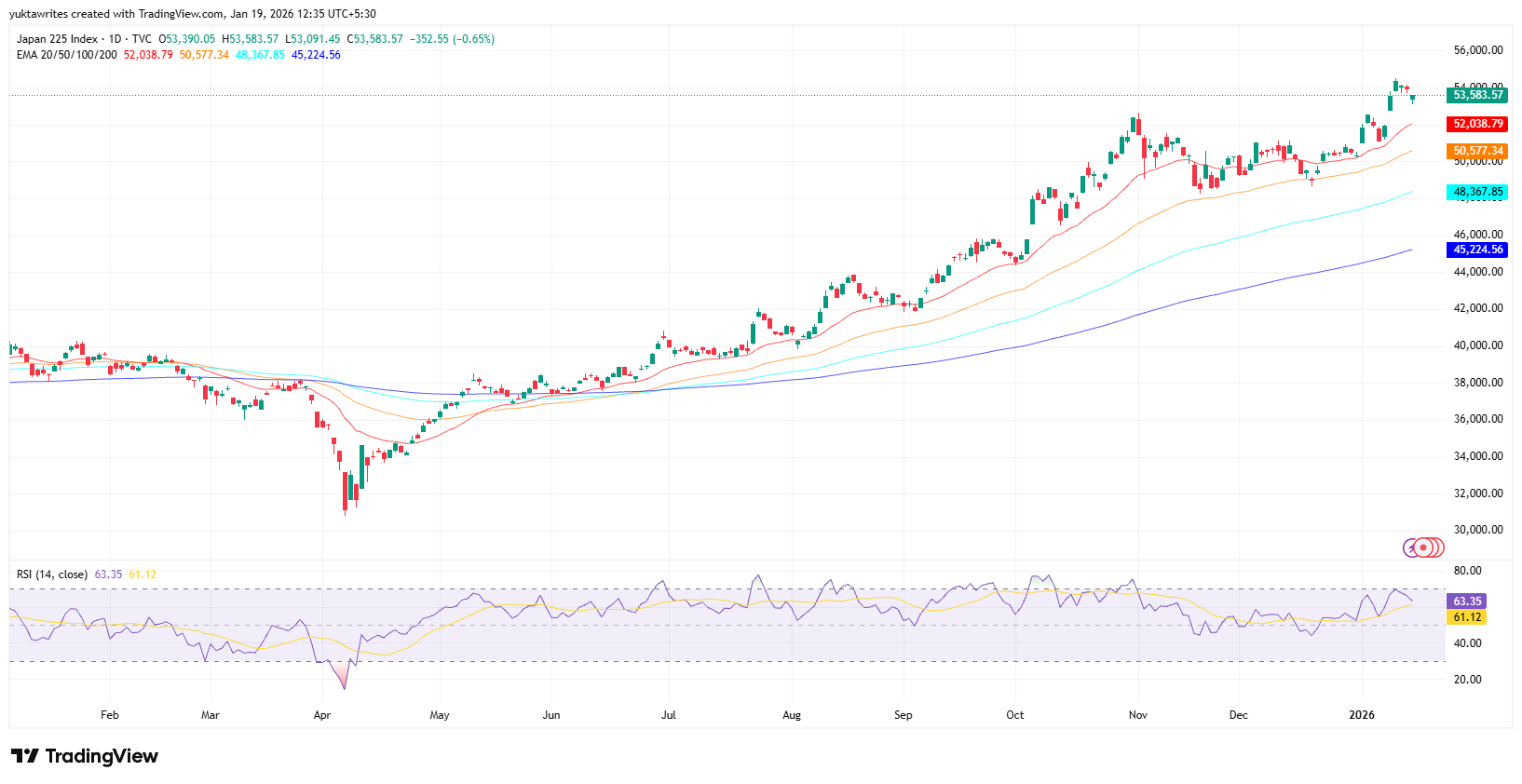
NIKKEI 225 index dynamics (Source: TradingView)
Further below, the 100-day EMA near 48,368 and the 200-day EMA around 45,225 highlight how far the index has traveled from its longer-term base. This distance reflects the intensity of the rally that carried Japanese equities to record levels. Importantly, the current pullback is unfolding from strength, not weakness, and remains well contained within the rising trend channel.
Momentum indicators echo this message. Daily RSI has eased back into the low-to-mid 60s after cooling from overbought territory. That shift signals digestion rather than distribution. Buyers are no longer chasing prices aggressively, but sellers have also failed to impose downside pressure. As long as RSI remains comfortably above 55, the pullback fits the profile of a healthy consolidation phase within an ongoing uptrend.
Shorter-term price action shows where the market is making decisions. On the 30-minute chart, the Nikkei has transitioned into a defined range following the sharp rally earlier this month. Supertrend has shifted to neutral-to-bearish, and Parabolic SAR is sitting close to price, reflecting indecision rather than aggressive selling. The 53,100-53,300 zone has emerged as near-term support, while 53,900-54,200 has capped rebound attempts. A clear break on either side of this band is likely to set the tone for the next short-term move.
Tariffs and policy uncertainty temper risk appetite
Fundamentals have provided the catalyst for consolidation. Global risk sentiment cooled after President Donald Trump threatened new tariffs on European nations, raising concerns about potential retaliation and renewed trade friction. While Japan is not the direct target, its export-heavy equity market remains sensitive to shifts in global trade expectations.
Domestically, investors are positioning cautiously ahead of the Bank of Japan’s policy meeting. Rates are widely expected to remain unchanged, but guidance around the timing and pace of future normalization will be closely watched. After months of speculation, any nuance in messaging could influence currency moves and equity positioning, particularly in sectors tied to domestic demand and financial conditions.
Political uncertainty has added another layer of hesitation. Talk of a possible snap election has resurfaced, injecting short-term noise even as expectations of expansionary fiscal policy continue to underpin the medium-term outlook. For now, these factors have encouraged profit-taking rather than wholesale de-risking.
Market outlook
From a tradeability standpoint, the Nikkei remains a buy-on-dips market while key supports hold. As long as price stays above the 20-day EMA near 52,000, the bias remains constructive. A deeper retracement toward the 50-day EMA around 50,500 would still be considered corrective within the broader uptrend, offering potential opportunities for longer-term buyers. Only a sustained break below 50,000 would signal a more meaningful shift in structure and warrant a reassessment of the bullish thesis.
Previously, we noted that the Nikkei’s advance had become increasingly momentum-driven and vulnerable to pauses as macro headlines resurfaced. The current pullback aligns with that view. With the primary trend intact and selling pressure contained, the index appears to be consolidating gains rather than rolling over, positioning it to resume its upward trajectory once global risk sentiment stabilizes.





Latest Nikkei 225 News







-
 Afghanistan
-
 Albania
-
 Algeria
-
 Angola
-
 Argentina
-
 Armenia
-
 Australia
-
 Austria
-
 Azerbaijan
-
 Bahamas
-
 Bahrain
-
 Bangladesh
-
 Belarus
-
 Belgium
-
 Bolivia
-
 Botswana
-
 Brazil
-
 Brunei
-
 Bulgaria
-
 Cambodia
-
 Cameroon
-
 Canada
-
 Chile
Chile
-
 China
China
-
 Colombia
-
 Congo
Congo
-
 Costa Rica
-
 Cote d'Ivoire
-
 Croatia
-
 Cuba
Cuba
-
 Cyprus
-
 Czechia
-
 DR Congo
-
 Denmark
-
 Dominican Republic
-
 Ecuador
-
 Egypt
Egypt
-
 El Salvador
-
 Estonia
-
 Eswatini
-
 Ethiopia
-
 Finland
-
 France
-
 Georgia
-
 Germany
-
 Ghana
Ghana
-
 Greece
-
 Haiti
Haiti
-
 Hong Kong
-
 Hungary
-
 India
India
-
 Indonesia
-
 Iran, Islamic republic
-
 Iraq
Iraq
-
 Ireland
-
 Israel
-
 Italy
Italy
-
 Jamaica
-
 Japan
Japan
-
 Jordan
-
 Kazakhstan
-
 Kenya
Kenya
-
 Korea
Korea
-
 Kuwait
-
 Kyrgyzstan
-
 Laos
Laos
-
 Latvia
-
 Lebanon
-
 Lesotho
-
 Libya
Libya
-
 Lithuania
-
 Luxembourg
-
 Madagascar
-
 Malaysia
-
 Malta
Malta
-
 Mauritius
-
 Mexico
-
 Moldova
-
 Mongolia
-
 Montenegro
-
 Morocco
-
 Mozambique
-
 Myanmar
-
 Namibia
-
 Nepal
Nepal
-
 Netherlands
-
 New Zealand
-
 Nigeria
-
 North Macedonia
-
 Norway
-
 Oman
Oman
-
 Pakistan
-
 Palestine
-
 Panama
-
 Papua New Guinea
-
 Paraguay
-
 Peru
Peru
-
 Philippines
-
 Poland
-
 Portugal
-
 Puerto Rico
-
 Qatar
Qatar
-
 Reunion
-
 Romania
-
 Rwanda
-
 Saudi Arabia
-
 Serbia
-
 Singapore
-
 Slovakia
-
 Slovenia
-
 Somalia
-
 South Africa
-
 Spain
Spain
-
 Sri Lanka
-
 Sweden
-
 Switzerland
-
 Syria
Syria
-
 Taiwan
-
 Tajikistan
-
 Tanzania
-
 Thailand
-
 Trinidad and Tobago
-
 Tunisia
-
 Turkey
-
 UAE
UAE
-
 Uganda
-
 Ukraine
-
 United Kingdom
-
United States
-
 Uruguay
-
 Uzbekistan
-
 Venezuela
-
 Vietnam
-
 Yemen
Yemen
-
 Zambia
-
 Zimbabwe
- Forex
- Crypto











