
WTI crude oil price forecast: Surge to $66 as Iran tensions revive geopolitical premium

WTI crude oil climbed 1.74% to $66.06 per barrel, extending the prior session’s more than 4% rally, the strongest single-day advance since late October. The rebound marks a sharp reversal from recent consolidation and underscores how quickly geopolitical risk can override concerns about oversupply.
Highlights
- WTI rises 1.74% to $66.06 after a 4% surge in the previous session.
- Price breaks above key moving averages, signaling bullish momentum.
- U.S.-Iran tensions escalate, reviving fears of Strait of Hormuz disruption.
The latest gains come as tensions between the U.S. and Iran intensify, injecting a renewed risk premium into global energy markets. Traders who had focused on rising inventories and surplus projections are now recalibrating positions amid the prospect of supply disruptions in the Middle East.
Technical breakout shifts short-term momentum
From a chart perspective, crude oil has staged a decisive breakout. Prices have moved above the 50-day EMA at $63.17, the 100-day EMA at $61.53, the 200-day EMA at $62.68 and the longer 200-day MA at $61.25. That cluster, which had acted as resistance for weeks, now sits firmly below the market.
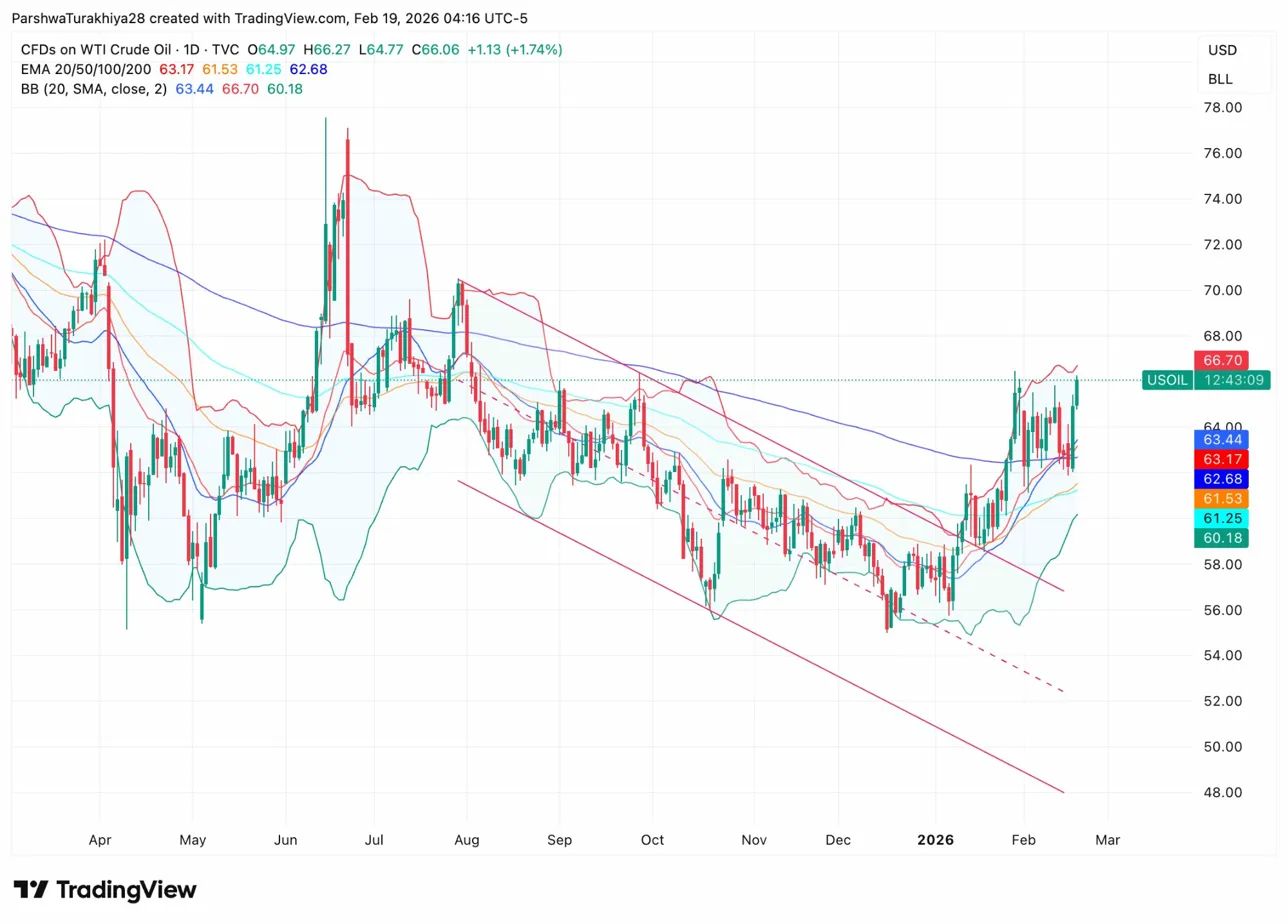
USOIL price dynamics (Source: TradingView)
Bollinger Bands show a middle line at $63.44 and an upper band near $66.7, placing crude close to the top of its recent range. The recovery follows a pullback to the $61–$62 zone after February’s rally from December lows near $55 to a high around $67.
Momentum indicators have turned higher, confirming the shift in sentiment. Immediate resistance lies near $66.70 and then $67–$68, the February peak. A sustained break above those levels could open the path toward $70. On the downside, the $63–$64 area now represents first support, with stronger backing at $61–$62.
Geopolitical risks overshadow inventory concerns
The fundamental backdrop has also turned more supportive. Reports indicate that U.S. military planning regarding Iran could involve a prolonged campaign if diplomacy fails. Israel has publicly advocated tougher measures, while U.S. officials have warned that military options remain on the table.
Although Iran has described talks as having reached “general agreement” on guiding principles, senior U.S. officials say key red lines remain unresolved. The uncertainty has renewed fears that crude flows through the Strait of Hormuz, a corridor that handles roughly one-fifth of global oil shipments, could be disrupted.
Inventory data offered modest reassurance. The American Petroleum Institute reported a 0.61 million barrel decline in U.S. crude stocks last week, a stark contrast to the previous week’s 13.4 million barrel build. While small, the draw suggests that the recent surge in inventories may be moderating.
As previously discussed, WTI had struggled to hold above $65 earlier this year as oversupply projections weighed on sentiment. The latest move shows how quickly geopolitical catalysts can alter the narrative, at least in the short term.


Latest WTI News






-
 Afghanistan
-
 Albania
-
 Algeria
-
 Angola
-
 Argentina
-
 Armenia
-
 Australia
-
 Austria
-
 Azerbaijan
-
 Bahamas
-
 Bahrain
-
 Bangladesh
-
 Belarus
-
 Belgium
-
 Bolivia
-
 Botswana
-
 Brazil
-
 Brunei
-
 Bulgaria
-
 Cambodia
-
 Cameroon
-
 Canada
-
 Chile
Chile
-
 China
China
-
 Colombia
-
 Congo
Congo
-
 Costa Rica
-
 Cote d'Ivoire
-
 Croatia
-
 Cuba
Cuba
-
 Cyprus
-
 Czechia
-
 DR Congo
-
 Denmark
-
 Dominican Republic
-
 Ecuador
-
 Egypt
Egypt
-
 El Salvador
-
 Estonia
-
 Eswatini
-
 Ethiopia
-
 Finland
-
 France
-
 Georgia
-
 Germany
-
 Ghana
Ghana
-
 Greece
-
 Haiti
Haiti
-
 Hong Kong
-
 Hungary
-
 India
India
-
 Indonesia
-
 Iran, Islamic republic
-
 Iraq
Iraq
-
 Ireland
-
 Israel
-
 Italy
Italy
-
 Jamaica
-
 Japan
Japan
-
 Jordan
-
 Kazakhstan
-
 Kenya
Kenya
-
 Korea
Korea
-
 Kuwait
-
 Kyrgyzstan
-
 Laos
Laos
-
 Latvia
-
 Lebanon
-
 Lesotho
-
 Libya
Libya
-
 Lithuania
-
 Luxembourg
-
 Madagascar
-
 Malaysia
-
 Malta
Malta
-
 Mauritius
-
 Mexico
-
 Moldova
-
 Mongolia
-
 Montenegro
-
 Morocco
-
 Mozambique
-
 Myanmar
-
 Namibia
-
 Nepal
Nepal
-
 Netherlands
-
 New Zealand
-
 Nigeria
-
 North Macedonia
-
 Norway
-
 Oman
Oman
-
 Pakistan
-
 Palestine
-
 Panama
-
 Papua New Guinea
-
 Paraguay
-
 Peru
Peru
-
 Philippines
-
 Poland
-
 Portugal
-
 Puerto Rico
-
 Qatar
Qatar
-
 Reunion
-
 Romania
-
 Rwanda
-
 Saudi Arabia
-
 Serbia
-
 Singapore
-
 Slovakia
-
 Slovenia
-
 Somalia
-
 South Africa
-
 Spain
Spain
-
 Sri Lanka
-
 Sweden
-
 Switzerland
-
 Syria
Syria
-
 Taiwan
-
 Tajikistan
-
 Tanzania
-
 Thailand
-
 Trinidad and Tobago
-
 Tunisia
-
 Turkey
-
 UAE
UAE
-
 Uganda
-
 Ukraine
-
 United Kingdom
-
United States
-
 Uruguay
-
 Uzbekistan
-
 Venezuela
-
 Vietnam
-
 Yemen
Yemen
-
 Zambia
-
 Zimbabwe
- Forex
- Crypto











