
Chevron stock forecast for 2030: Venezuela ramp and Guyana scale support $350 case

Chevron is up about 19% this year while crude oil is in the mid-$60s. This difference between stock performance and oil prices shows the market now views CVX less as a commodity play and more as a growth story in production.
Highlights
- CVX is pressing against $185-187 resistance in an ascending triangle, with all EMAs aligned bullishly below price.
- Price forecasts for 2030 range from $280 to $350 if Venezuela ramps, Guyana scales further, and cost reductions hit the $3-4B target.
- Chevron raised its dividend for the 39th straight year to $7.12 per share and repurchased $3 billion in stock during Q4.
The company reported record output in 2025, completed the Hess acquisition for access to Guyana, and remains the only major U.S. operator in post-Maduro Venezuela. On February 23, Chevron also signed preliminary agreements to potentially acquire Iraq's West Qurna 2 oilfield from Russia's Lukoil, a field producing around 480,000 barrels per day.
The CVX price is trading above all major moving averages, with the 20 EMA at $177.8, the 50 at $168.3, the 100 at $161.0, and the 200 at $154.8. The bullish stacking confirms strong upside momentum. An ascending triangle has formed with rising higher lows meeting flat resistance near $185-187.
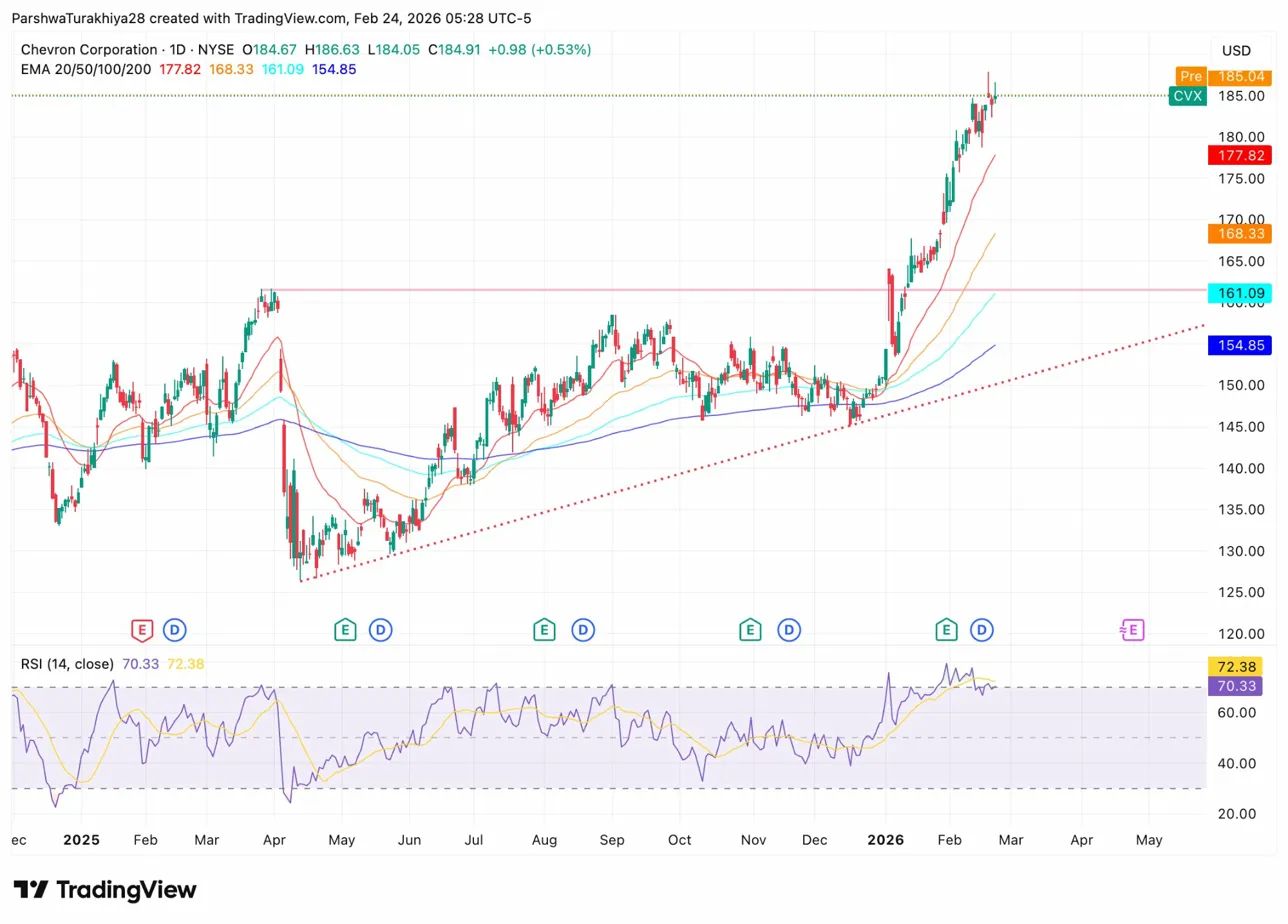
CVX price dynamics (Source: TradingView)
RSI sits around 70-72, strong but approaching overbought with no bearish divergence visible. A daily close above $187 would confirm the breakout and open the $190-195 zone. Failure to clear resistance and a drop below $177 shifts the picture to short-term consolidation toward $168-170.
Chevron 2030 outlook depends on production growth and Venezuela execution
Chevron hit record production in 2025. Worldwide output rose 12%, U.S. output rose 16%, and adjusted free cash flow grew over 35% even as oil prices fell 15%. Cost cuts delivered $1.5 billion in savings last year, with a $3-4 billion target by the end of 2026.
With the Hess acquisition, the company has secured a 30% stake in Guyana’s Stabroek Block, along with an additional net production of 286,000 barrels per day in the fourth quarter. This has strengthened the company’s upstream profile and enhanced its long-term production capacity.
Management expects to generate approximately $10 billion in free cash flow from legacy operations in 2026, while Hess is projected to contribute an additional $2.5 billion. Overall, the company’s free cash flow position is expected to remain significantly strong.
Venezuela remains the biggest long-term variable. Chevron never left and can double its liftings almost immediately, with a 50% production increase within 18-24 months. No other major has that access.
Beyond that, the company expanded into Israel with the Leviathan gas decision, won exploration rights in Libya after a decade-long absence, signed offshore leases in Greece, and finished a $47 billion expansion at Kazakhstan's Tengiz. No single country risk can meaningfully damage cash flow with that spread.
If oil averages $65-75 through the decade and production reaches 4.5-5 million barrels of oil equivalent per day, free cash flow around $25-30 billion annually supports a $280-350 share price by 2030. Crude staying below $55 or a failed Venezuela ramp brings that closer to $220-260.
What investors should monitor
U.S. Treasury decisions on expanding Chevron's Venezuela license will set the pace for production growth there. Tengiz should be back at full capacity after the January fire and confirmation matters for international earnings. The April OPEC+ decision on unwinding production cuts could pressure crude if supply opens up. Iran tensions carry a $4-7 per barrel risk premium that could disappear with diplomacy or spike with escalation. Chevron's sub-$50 breakeven cushions either outcome. Next earnings land April 24, 2026.
Recently we discussed that Chevron’s strong 2025 production, rising free cash flow, and Guyana exposure support the long-term bull case, while resistance at $185–187 forms a key technical trigger ahead of the April OPEC+ decision and Q1 earnings on April 24.











-
 Afghanistan
-
 Albania
-
 Algeria
-
 Angola
-
 Argentina
-
 Armenia
-
 Australia
-
 Austria
-
 Azerbaijan
-
 Bahamas
-
 Bahrain
-
 Bangladesh
-
 Belarus
-
 Belgium
-
 Bolivia
-
 Botswana
-
 Brazil
-
 Brunei
-
 Bulgaria
-
 Cambodia
-
 Cameroon
-
 Canada
-
 Chile
Chile
-
 China
China
-
 Colombia
-
 Congo
Congo
-
 Costa Rica
-
 Cote d'Ivoire
-
 Croatia
-
 Cuba
Cuba
-
 Cyprus
-
 Czechia
-
 DR Congo
-
 Denmark
-
 Dominican Republic
-
 Ecuador
-
 Egypt
Egypt
-
 El Salvador
-
 Estonia
-
 Eswatini
-
 Ethiopia
-
 Finland
-
 France
-
 Georgia
-
 Germany
-
 Ghana
Ghana
-
 Greece
-
 Haiti
Haiti
-
 Hong Kong
-
 Hungary
-
 India
India
-
 Indonesia
-
 Iran, Islamic republic
-
 Iraq
Iraq
-
 Ireland
-
 Israel
-
 Italy
Italy
-
 Jamaica
-
 Japan
Japan
-
 Jordan
-
 Kazakhstan
-
 Kenya
Kenya
-
 Korea
Korea
-
 Kuwait
-
 Kyrgyzstan
-
 Laos
Laos
-
 Latvia
-
 Lebanon
-
 Lesotho
-
 Libya
Libya
-
 Lithuania
-
 Luxembourg
-
 Madagascar
-
 Malaysia
-
 Malta
Malta
-
 Mauritius
-
 Mexico
-
 Moldova
-
 Mongolia
-
 Montenegro
-
 Morocco
-
 Mozambique
-
 Myanmar
-
 Namibia
-
 Nepal
Nepal
-
 Netherlands
-
 New Zealand
-
 Nigeria
-
 North Macedonia
-
 Norway
-
 Oman
Oman
-
 Pakistan
-
 Palestine
-
 Panama
-
 Papua New Guinea
-
 Paraguay
-
 Peru
Peru
-
 Philippines
-
 Poland
-
 Portugal
-
 Puerto Rico
-
 Qatar
Qatar
-
 Reunion
-
 Romania
-
 Rwanda
-
 Saudi Arabia
-
 Serbia
-
 Singapore
-
 Slovakia
-
 Slovenia
-
 Somalia
-
 South Africa
-
 Spain
Spain
-
 Sri Lanka
-
 Sweden
-
 Switzerland
-
 Syria
Syria
-
 Taiwan
-
 Tajikistan
-
 Tanzania
-
 Thailand
-
 Trinidad and Tobago
-
 Tunisia
-
 Turkey
-
 UAE
UAE
-
 Uganda
-
 Ukraine
-
 United Kingdom
-
United States
-
 Uruguay
-
 Uzbekistan
-
 Venezuela
-
 Vietnam
-
 Yemen
Yemen
-
 Zambia
-
 Zimbabwe
- Forex
- Crypto











