
Goldman Sachs stock forecast for 2030: AI integration and M&A cycle support $1,400 target
Goldman Sachs expects a strong outlook for 2030, fueled by progress in AI and a solid M&A cycle that supports a valuation of $1,400. As the firm approaches mid-2026, it shows strong earnings growth and better revenue stability, having reported a net revenue of $58.28 billion and net earnings of $17.18 billion for 2025.
Highlights
- Goldman Sachs delivered $58.28 billion in 2025 revenue, with EPS rising to $51.32 and return on equity at 15%.
- Investment banking generated $41.5 billion in revenue, positioning firm to benefit from a potential record M&A cycle.
- AI deployment, $576 billion in alternatives assets, and improving operating leverage support long-term valuation case toward $1,400 by 2030.
The diluted EPS increased to $51.32 from $40.54 the previous year, with a return on equity of 15%. Additionally, in Q4, profits rose by 12% year-over-year to $4.62 billion, exceeding consensus expectations. The firm has seen its fee-based revenue doubling since 2019, transitioning from a trading-heavy model to a more balanced platform.
M&A momentum drives earnings leverage
Management anticipates that deal-making activity will strengthen through 2026, with global M&A potentially reaching record levels. Investment banking remains Goldman’s most profitable sector, with Global Banking & Markets generating $41.5 billion in revenue in 2025.
If advisory volumes increase, earnings could grow faster than revenue due to operating leverage, and a sustained M&A cycle would likely enhance forward estimates and maintain stability in multiples.
AI integration supports margin expansion
Goldman Sachs is also integrating autonomous AI agents into trade accounting and client onboarding processes. Internal tests have shown great improvements in processing speed and productivity.
The management's goal is to manage headcount growth while scaling revenue. The efficiency ratio is currently around 64%, and even slight improvements could lead to substantial pre-tax income. A combination of structural cost discipline and revenue growth enhances long-term earnings visibility.
Analyst Anton Kharitonov noted, “GS is no longer just a beneficiary of deal cycles. It is building a machine where advisory strength, asset gathering, and AI-driven cost control reinforce each other. If M&A surprises to the upside, earnings growth could outpace what the current multiple implies.”
GS technical structure and valuation outlook
Goldman Sachs price today trades near $902 after retreating from highs around $1,000. Price sits between 50-day EMA near $906 and 100-day EMA near $864. Ascending trendline from 2024 lows holds near $880–900 and remains critical support.
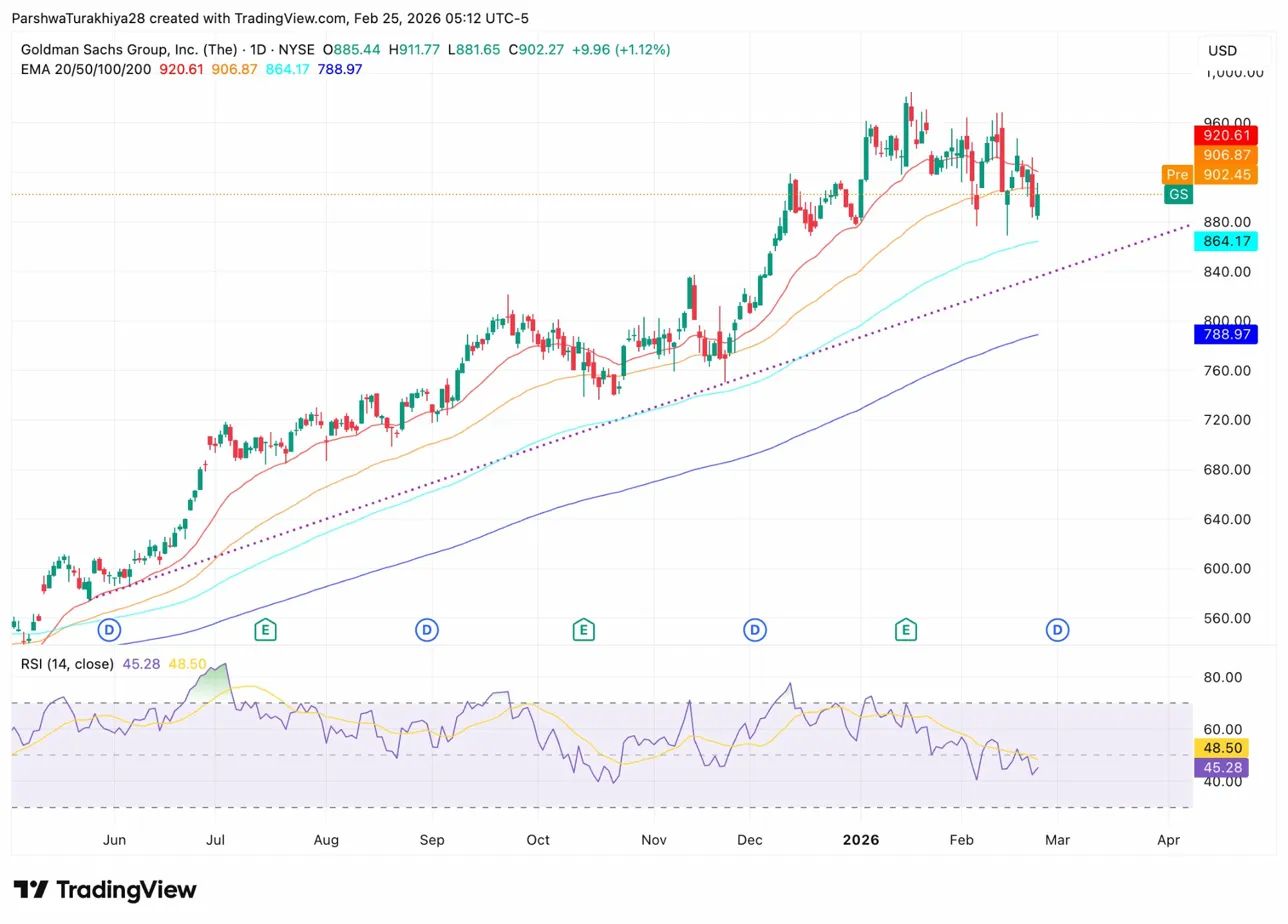
GS price dynamics (Source: TradingView)
If that structure holds and advisory revenue accelerates, earnings could compound toward $80–90 per share by 2030. Applying a 16–18x multiple supports a valuation range of $1,280–1,620. A balanced base case centers near $1,400 by 2030.
As discussed earlier, Goldman’s trajectory depends primarily on advisory revenue acceleration and operating leverage from AI integration. The next earnings cycle will clarify whether deal momentum matches management expectations.


Latest Goldman Sachs News




-
 Afghanistan
-
 Albania
-
 Algeria
-
 Angola
-
 Argentina
-
 Armenia
-
 Australia
-
 Austria
-
 Azerbaijan
-
 Bahamas
-
 Bahrain
-
 Bangladesh
-
 Belarus
-
 Belgium
-
 Bolivia
-
 Botswana
-
 Brazil
-
 Brunei
-
 Bulgaria
-
 Cambodia
-
 Cameroon
-
 Canada
-
 Chile
Chile
-
 China
China
-
 Colombia
-
 Congo
Congo
-
 Costa Rica
-
 Cote d'Ivoire
-
 Croatia
-
 Cuba
Cuba
-
 Cyprus
-
 Czechia
-
 DR Congo
-
 Denmark
-
 Dominican Republic
-
 Ecuador
-
 Egypt
Egypt
-
 El Salvador
-
 Estonia
-
 Eswatini
-
 Ethiopia
-
 Finland
-
 France
-
 Georgia
-
 Germany
-
 Ghana
Ghana
-
 Greece
-
 Haiti
Haiti
-
 Hong Kong
-
 Hungary
-
 India
India
-
 Indonesia
-
 Iran, Islamic republic
-
 Iraq
Iraq
-
 Ireland
-
 Israel
-
 Italy
Italy
-
 Jamaica
-
 Japan
Japan
-
 Jordan
-
 Kazakhstan
-
 Kenya
Kenya
-
 Korea
Korea
-
 Kuwait
-
 Kyrgyzstan
-
 Laos
Laos
-
 Latvia
-
 Lebanon
-
 Lesotho
-
 Libya
Libya
-
 Lithuania
-
 Luxembourg
-
 Madagascar
-
 Malaysia
-
 Malta
Malta
-
 Mauritius
-
 Mexico
-
 Moldova
-
 Mongolia
-
 Montenegro
-
 Morocco
-
 Mozambique
-
 Myanmar
-
 Namibia
-
 Nepal
Nepal
-
 Netherlands
-
 New Zealand
-
 Nigeria
-
 North Macedonia
-
 Norway
-
 Oman
Oman
-
 Pakistan
-
 Palestine
-
 Panama
-
 Papua New Guinea
-
 Paraguay
-
 Peru
Peru
-
 Philippines
-
 Poland
-
 Portugal
-
 Puerto Rico
-
 Qatar
Qatar
-
 Reunion
-
 Romania
-
 Rwanda
-
 Saudi Arabia
-
 Serbia
-
 Singapore
-
 Slovakia
-
 Slovenia
-
 Somalia
-
 South Africa
-
 Spain
Spain
-
 Sri Lanka
-
 Sweden
-
 Switzerland
-
 Syria
Syria
-
 Taiwan
-
 Tajikistan
-
 Tanzania
-
 Thailand
-
 Trinidad and Tobago
-
 Tunisia
-
 Turkey
-
 UAE
UAE
-
 Uganda
-
 Ukraine
-
 United Kingdom
-
United States
-
 Uruguay
-
 Uzbekistan
-
 Venezuela
-
 Vietnam
-
 Yemen
Yemen
-
 Zambia
-
 Zimbabwe
- Forex
- Crypto











