

Alphabet (GOOGL) shares have been correcting in recent weeks after a strong rally earlier this year. The main reason is growing market concern over the scale of Google’s spending on artificial intelligence.
The company is prepared to invest up to $180–190 billion in 2026 on AI infrastructure, data centers, and TPU chips—significantly above analysts’ expectations. Investors are increasingly asking how quickly these investments will translate into profits, rather than just revenue growth.
Additional pressure followed the Google I/O conference. Despite the launch of Gemini 3.5, AI agents, and major updates to search, the market reaction was muted—shares fell by around 2% after the presentation. Wall Street is increasingly viewing Google’s strategy as “defensive”: the company is trying to protect its Search, Android, YouTube, and Cloud ecosystem from pressure by OpenAI and Microsoft, rather than demonstrating a breakthrough technological leap.
At the same time, the fundamentals remain strong
Despite the pullback, Alphabet’s operating performance remains robust. Google Cloud continues to grow at an accelerated pace due to demand for AI services, and Gemini is already integrated across nearly all of the company’s key products. Management notes that demand for AI computing currently exceeds Google’s internal capacity. This is a rare situation where the company’s challenge is not a lack of customers, but a shortage of infrastructure.
The market is now debating not whether Google will monetize AI, but how long it will take. Some analysts view the current decline as a temporary reaction to rising CAPEX, especially given Alphabet’s dominance in advertising, cloud, and the mobile ecosystem. Others, however, are concerned that AI-powered search could gradually erode the high-margin model of traditional Search, which has been Google’s core profit engine for decades.
Key risk: antitrust pressure and Search transformation
Another factor weighing on the stock is increasing regulatory pressure from the U.S. and the EU. The appeal process in the antitrust case regarding Google’s search monopoly is ongoing. U.S. authorities are seeking stricter measures, including the potential separation of Chrome and limitations on exclusive agreements with Apple. For the market, this is no longer an abstract legal risk, but a factor that could reshape Alphabet’s business structure in the coming years.
Overall, GOOGL is currently in a repricing phase: the market acknowledges that Google remains one of the world’s leading AI players, but is simultaneously demanding proof that its massive investments will be efficient. In the short term, this creates pressure on the stock, but strategically, Alphabet remains one of the strongest global AI platforms.
Near-term outlook
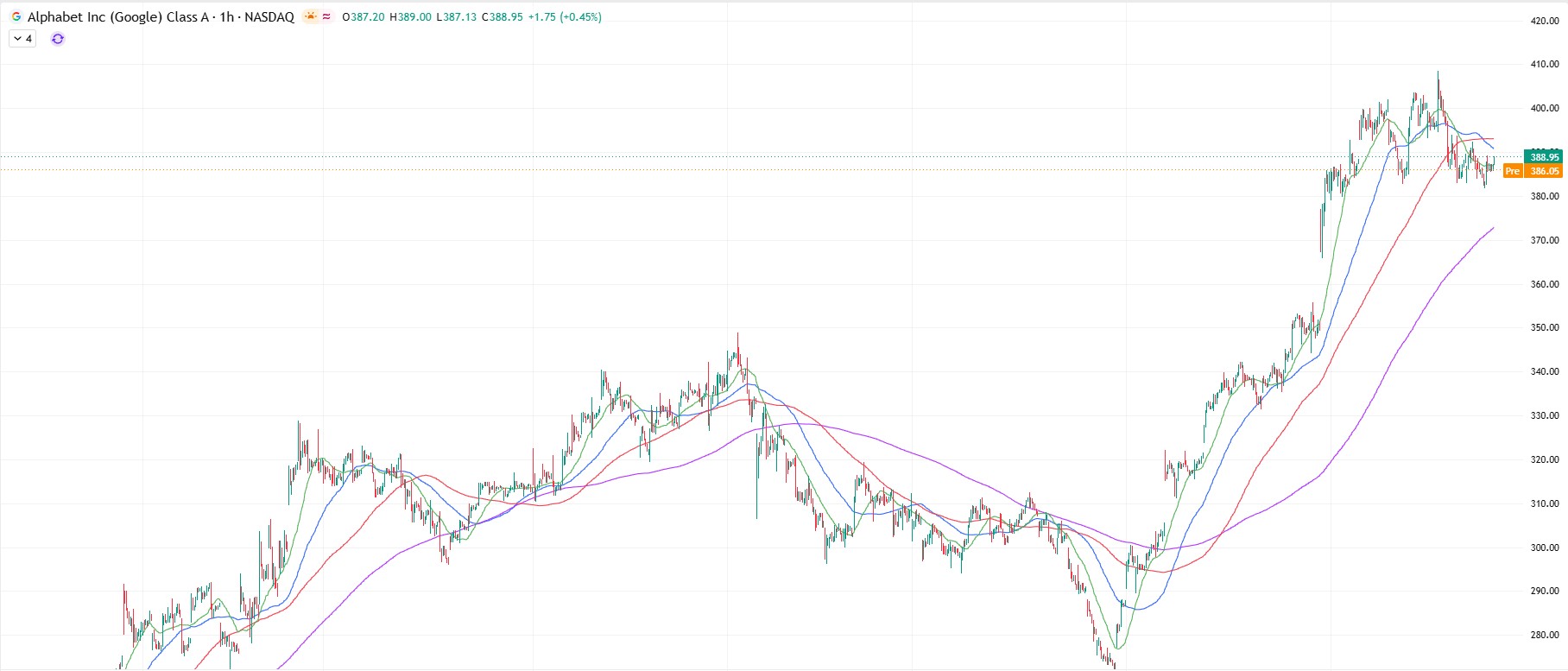
After bulls failed to break resistance near the $410 level, Apple (AAPL) shares pulled back toward support around $385. As the long-term trend remains intact, as previously noted in Alphabet declines as traders take profits on long positions, demand from this level could support a move back toward the $400–410 resistance range. A break below support would likely lead to a decline toward $375–370.


Latest Google News






-
 Afghanistan
-
 Albania
-
 Algeria
-
 Angola
-
 Argentina
-
 Armenia
-
 Australia
-
 Austria
-
 Azerbaijan
-
 Bahamas
-
 Bahrain
-
 Bangladesh
-
 Belarus
-
 Belgium
-
 Bolivia
-
 Botswana
-
 Brazil
-
 Brunei
-
 Bulgaria
-
 Cambodia
-
 Cameroon
-
 Canada
-
 Chile
Chile
-
 China
China
-
 Colombia
-
 Congo
Congo
-
 Costa Rica
-
 Cote d'Ivoire
-
 Croatia
-
 Cuba
Cuba
-
 Cyprus
-
 Czechia
-
 DR Congo
-
 Denmark
-
 Dominican Republic
-
 Ecuador
-
 Egypt
Egypt
-
 El Salvador
-
 Estonia
-
 Eswatini
-
 Ethiopia
-
 Finland
-
 France
-
 Georgia
-
 Germany
-
 Ghana
Ghana
-
 Greece
-
 Haiti
Haiti
-
 Hong Kong
-
 Hungary
-
 India
India
-
 Indonesia
-
 Iran, Islamic republic
-
 Iraq
Iraq
-
 Ireland
-
 Israel
-
 Italy
Italy
-
 Jamaica
-
 Japan
Japan
-
 Jordan
-
 Kazakhstan
-
 Kenya
Kenya
-
 Korea
Korea
-
 Kuwait
-
 Kyrgyzstan
-
 Laos
Laos
-
 Latvia
-
 Lebanon
-
 Lesotho
-
 Libya
Libya
-
 Lithuania
-
 Luxembourg
-
 Madagascar
-
 Malaysia
-
 Malta
Malta
-
 Mauritius
-
 Mexico
-
 Moldova
-
 Mongolia
-
 Montenegro
-
 Morocco
-
 Mozambique
-
 Myanmar
-
 Namibia
-
 Nepal
Nepal
-
 Netherlands
-
 New Zealand
-
 Nigeria
-
 North Macedonia
-
 Norway
-
 Oman
Oman
-
 Pakistan
-
 Palestine
-
 Panama
-
 Papua New Guinea
-
 Paraguay
-
 Peru
Peru
-
 Philippines
-
 Poland
-
 Portugal
-
 Puerto Rico
-
 Qatar
Qatar
-
 Reunion
-
 Romania
-
 Rwanda
-
 Saudi Arabia
-
 Serbia
-
 Singapore
-
 Slovakia
-
 Slovenia
-
 Somalia
-
 South Africa
-
 Spain
Spain
-
 Sri Lanka
-
 Sweden
-
 Switzerland
-
 Syria
Syria
-
 Taiwan
-
 Tajikistan
-
 Tanzania
-
 Thailand
-
 Trinidad and Tobago
-
 Tunisia
-
 Turkey
-
 UAE
UAE
-
 Uganda
-
 Ukraine
-
 United Kingdom
-
United States
-
 Uruguay
-
 Uzbekistan
-
 Venezuela
-
 Vietnam
-
 Yemen
Yemen
-
 Zambia
-
 Zimbabwe
- Forex
- Crypto











