

Microsoft continues to aggressively expand its AI business. Following Build 2026, the company unveiled its own reasoning models, new Copilot agents, and additional Azure AI tools, reinforcing its strategy of reducing reliance on OpenAI while building a broader proprietary AI ecosystem.
At the same time, Microsoft is accelerating enterprise adoption of Copilot, while demand for GitHub Copilot and AI-powered cloud services remains strong.
Infrastructure demand remains robust
One of the most notable developments in recent weeks has been Microsoft's decision to temporarily leverage AWS infrastructure to support growing GitHub workloads. While unusual for one of Amazon's biggest competitors, the move highlights the scale of AI-related demand and the ongoing shortage of computing capacity across the industry. For long-term investors, this remains a positive signal for the continued growth trajectory of Azure and Microsoft's broader AI portfolio.
Chart points to a continuing downtrend
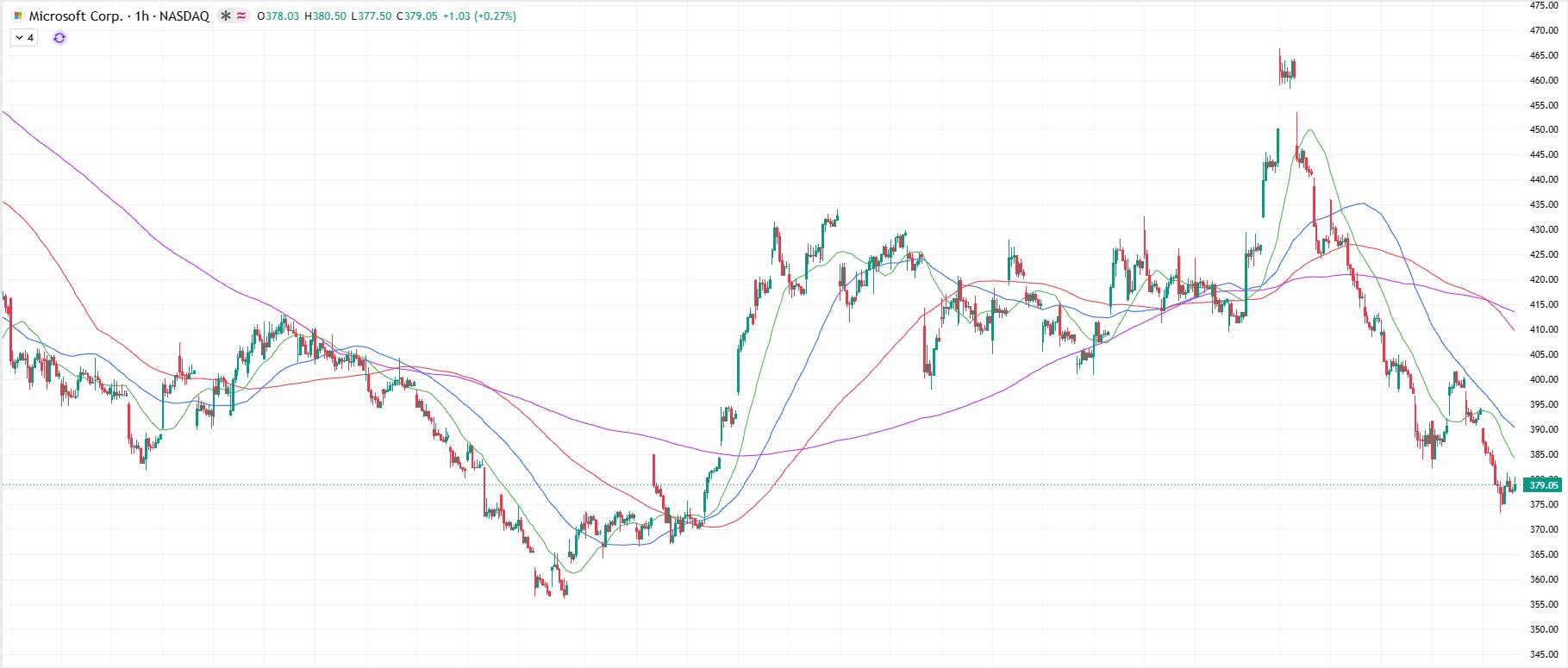
Despite positive fundamental developments, the technical picture remains weak. On the hourly chart, MSFT is trading around $379 after a sharp decline from a recent high near $465. The stock remains below all major moving averages, while the 20-, 50-, 100-, and 200-period averages are aligned in a classic bearish formation. Recent recovery attempts have been met with renewed selling pressure, suggesting that sellers continue to dominate price action and that sustainable buying demand has yet to emerge.
The nearest support zone is located between $370 and $375, where the stock recently established a local low. A break below this area could open the door to a move toward the $360–355 range. To improve the technical outlook, bulls would need to reclaim $390 and then secure a sustained move above the $400–405 resistance zone. Until that happens, any rebounds are likely to be viewed as corrective moves within a broader downtrend rather than the beginning of a new bullish phase.
What could drive the stock next?
For the market, the key question remains the pace at which Microsoft's massive AI investments can be translated into revenue growth. Management continues to express confidence in the long-term potential of Azure and Copilot, but investors increasingly want to see tangible financial results rather than additional product announcements.
In the near term, as highlighted in Microsoft balances AI investment with investor expectations, the stock's direction will largely depend on the performance of the cloud business and AI-related revenue growth. From a technical perspective, however, MSFT remains under pressure and still requires clear confirmation of a trend reversal before sentiment can materially improve.


Latest Microsoft News






-
 Afghanistan
-
 Albania
-
 Algeria
-
 Angola
-
 Argentina
-
 Armenia
-
 Australia
-
 Austria
-
 Azerbaijan
-
 Bahamas
-
 Bahrain
-
 Bangladesh
-
 Belarus
-
 Belgium
-
 Bolivia
-
 Botswana
-
 Brazil
-
 Brunei
-
 Bulgaria
-
 Cambodia
-
 Cameroon
-
 Canada
-
 Chile
Chile
-
 China
China
-
 Colombia
-
 Congo
Congo
-
 Costa Rica
-
 Cote d'Ivoire
-
 Croatia
-
 Cuba
Cuba
-
 Cyprus
-
 Czechia
-
 DR Congo
-
 Denmark
-
 Dominican Republic
-
 Ecuador
-
 Egypt
Egypt
-
 El Salvador
-
 Estonia
-
 Eswatini
-
 Ethiopia
-
 Finland
-
 France
-
 Georgia
-
 Germany
-
 Ghana
Ghana
-
 Greece
-
 Haiti
Haiti
-
 Hong Kong
-
 Hungary
-
 India
India
-
 Indonesia
-
 Iran, Islamic republic
-
 Iraq
Iraq
-
 Ireland
-
 Israel
-
 Italy
Italy
-
 Jamaica
-
 Japan
Japan
-
 Jordan
-
 Kazakhstan
-
 Kenya
Kenya
-
 Korea
Korea
-
 Kuwait
-
 Kyrgyzstan
-
 Laos
Laos
-
 Latvia
-
 Lebanon
-
 Lesotho
-
 Libya
Libya
-
 Lithuania
-
 Luxembourg
-
 Madagascar
-
 Malaysia
-
 Malta
Malta
-
 Mauritius
-
 Mexico
-
 Moldova
-
 Mongolia
-
 Montenegro
-
 Morocco
-
 Mozambique
-
 Myanmar
-
 Namibia
-
 Nepal
Nepal
-
 Netherlands
-
 New Zealand
-
 Nigeria
-
 North Macedonia
-
 Norway
-
 Oman
Oman
-
 Pakistan
-
 Palestine
-
 Panama
-
 Papua New Guinea
-
 Paraguay
-
 Peru
Peru
-
 Philippines
-
 Poland
-
 Portugal
-
 Puerto Rico
-
 Qatar
Qatar
-
 Reunion
-
 Romania
-
 Rwanda
-
 Saudi Arabia
-
 Serbia
-
 Singapore
-
 Slovakia
-
 Slovenia
-
 Somalia
-
 South Africa
-
 Spain
Spain
-
 Sri Lanka
-
 Sweden
-
 Switzerland
-
 Syria
Syria
-
 Taiwan
-
 Tajikistan
-
 Tanzania
-
 Thailand
-
 Trinidad and Tobago
-
 Tunisia
-
 Turkey
-
 UAE
UAE
-
 Uganda
-
 Ukraine
-
 United Kingdom
-
United States
-
 Uruguay
-
 Uzbekistan
-
 Venezuela
-
 Vietnam
-
 Yemen
Yemen
-
 Zambia
-
 Zimbabwe
- Forex
- Crypto











