
LVMH shares gain 2.5% as Armani deal speculation boosts luxury stocks

As of September 15, LVMH stock is trading at €503.2, up 2.5% in the past 24 hours, as investors react to renewed M&A momentum in the luxury sector following revelations about Giorgio Armani’s succession plan.
Highlights
- LVMH shares rose 2.5% after Giorgio Armani’s will revealed plans for a partial sale of his fashion house, with LVMH named among preferred buyers.
- The potential acquisition could strengthen LVMH’s position in formal menswear and diversify its fashion portfolio.
- Market reaction reflects optimism about strategic consolidation despite broader luxury sector headwinds.
Recent technical action shows a potential short-term floor forming around the €490–€500 zone. This area corresponds with the lower range of the stock’s multi-month descending channel and aligns with valuation multiples reflecting current earnings per share and margin compression. RSI indicators are beginning to trend upwards from oversold levels, suggesting accumulation is underway. However, the 200-day simple moving average (currently around €555) remains a key resistance point.
On fundamentals, LVMH’s revenue over the trailing twelve months is €84.7 billion, down from €86.15 billion in 2023. Operating income in 2024 clocked in at €18.9 billion, while net income attributable to shareholders stood at €12.55 billion. The key Fashion & Leather Goods division — which includes brands like Louis Vuitton, Dior, Fendi and Celine — reported an organic sales decline of 9% in Q2 2025, marking the steepest drop in five years.
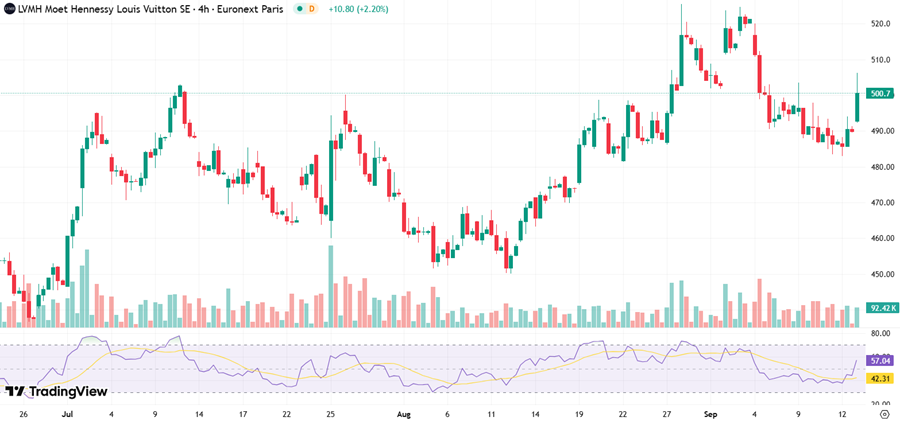
LVMH stock price dynamics (July 2025 - September 2025). Source: TradingView
Other segments are showing mixed performance: Wines & Spirits continue to weaken due to slower demand in China and the U.S., while Watches & Jewelry remains volatile. Perfumes & Cosmetics, on the other hand, has shown moderate growth, driven by Christian Dior Parfums and strong demand in the Middle East. At current levels, LVMH is trading at a forward P/E ratio of approximately 21x — a discount compared to its five-year average — but reflective of broader concerns over luxury demand and operating margin erosion.
Armani succession plan reshapes M&A landscape
Market sentiment around LVMH turned sharply positive following reports that Giorgio Armani’s will outlines a staged sale of the privately held fashion house. The plan calls for a 15% stake to be sold within 18 months, with the possibility of increasing that to 30–54.9% over five years. The named preferred buyers include LVMH, L’Oréal, and EssilorLuxottica. Investors view this as a rare chance to acquire a legacy luxury brand that has remained fiercely independent for over four decades.
For LVMH, this represents a significant strategic opportunity. Armani’s portfolio — which includes Giorgio Armani, Emporio Armani, Armani Exchange, and Armani Privé — would complement LVMH’s existing brand architecture. While Louis Vuitton and Dior cater to aspirational luxury, Armani could serve to strengthen LVMH’s footprint in tailored menswear and formal fashion, areas where the group has historically underperformed. The move could also allow LVMH to re-enter segments like high-end business attire and eveningwear, which are experiencing a modest resurgence post-COVID.
There are also potential cost and operational synergies. Armani’s global presence, especially in Europe and Asia, would integrate well with LVMH’s robust retail infrastructure. In addition, LVMH’s capabilities in marketing, e-commerce, and vertical integration could help Armani accelerate growth and improve profitability. A successful integration could elevate Armani's positioning to match or exceed peers like Zegna or Brunello Cucinelli in the premium menswear space.
Price scenarios hinge on Armani deal terms and luxury cycle
Looking ahead, LVMH’s stock performance over the next 6–12 months will depend heavily on two key factors: first, the structure and size of any potential Armani acquisition; and second, the pace of recovery in the broader luxury demand cycle, particularly in core markets like China and the United States. Both elements will shape investor expectations around revenue growth, margin resilience, and long-term brand positioning. With macro uncertainty still weighing on global consumer spending, the timing and execution of any strategic move will be critical.
In a base-case scenario, where LVMH acquires only a minority stake (15–30%) in Armani with manageable integration costs, the market could reward the company with a modest valuation uplift. This could push the stock back toward the €530–€550 range, a 5–10% upside from current levels, especially if organic sales stabilize in Q4 2025. Such an outcome would also provide LVMH with strategic optionality, allowing the group to deepen its stake gradually depending on market conditions and Armani’s performance.
Investor sentiment toward LVMH improved after HSBC upgraded the stock to "Buy" with a €727 target, citing recovering demand in the U.S. and China. Analyst Erwan Rambourg noted that while conditions remain mixed, stabilization signals the beginning of a potential recovery.









-
 Afghanistan
-
 Albania
-
 Algeria
-
 Angola
-
 Argentina
-
 Armenia
-
 Australia
-
 Austria
-
 Azerbaijan
-
 Bahamas
-
 Bahrain
-
 Bangladesh
-
 Belarus
-
 Belgium
-
 Bolivia
-
 Botswana
-
 Brazil
-
 Brunei
-
 Bulgaria
-
 Cambodia
-
 Cameroon
-
 Canada
-
 Chile
Chile
-
 China
China
-
 Colombia
-
 Congo
Congo
-
 Costa Rica
-
 Cote d'Ivoire
-
 Croatia
-
 Cuba
Cuba
-
 Cyprus
-
 Czechia
-
 DR Congo
-
 Denmark
-
 Dominican Republic
-
 Ecuador
-
 Egypt
Egypt
-
 El Salvador
-
 Estonia
-
 Eswatini
-
 Ethiopia
-
 Finland
-
 France
-
 Georgia
-
 Germany
-
 Ghana
Ghana
-
 Greece
-
 Haiti
Haiti
-
 Hong Kong
-
 Hungary
-
 India
India
-
 Indonesia
-
 Iran, Islamic republic
-
 Iraq
Iraq
-
 Ireland
-
 Israel
-
 Italy
Italy
-
 Jamaica
-
 Japan
Japan
-
 Jordan
-
 Kazakhstan
-
 Kenya
Kenya
-
 Korea
Korea
-
 Kuwait
-
 Kyrgyzstan
-
 Laos
Laos
-
 Latvia
-
 Lebanon
-
 Lesotho
-
 Libya
Libya
-
 Lithuania
-
 Luxembourg
-
 Madagascar
-
 Malaysia
-
 Malta
Malta
-
 Mauritius
-
 Mexico
-
 Moldova
-
 Mongolia
-
 Montenegro
-
 Morocco
-
 Mozambique
-
 Myanmar
-
 Namibia
-
 Nepal
Nepal
-
 Netherlands
-
 New Zealand
-
 Nigeria
-
 North Macedonia
-
 Norway
-
 Oman
Oman
-
 Pakistan
-
 Palestine
-
 Panama
-
 Papua New Guinea
-
 Paraguay
-
 Peru
Peru
-
 Philippines
-
 Poland
-
 Portugal
-
 Puerto Rico
-
 Qatar
Qatar
-
 Reunion
-
 Romania
-
 Rwanda
-
 Saudi Arabia
-
 Serbia
-
 Singapore
-
 Slovakia
-
 Slovenia
-
 Somalia
-
 South Africa
-
 Spain
Spain
-
 Sri Lanka
-
 Sweden
-
 Switzerland
-
 Syria
Syria
-
 Taiwan
-
 Tajikistan
-
 Tanzania
-
 Thailand
-
 Trinidad and Tobago
-
 Tunisia
-
 Turkey
-
 UAE
UAE
-
 Uganda
-
 Ukraine
-
 United Kingdom
-
United States
-
 Uruguay
-
 Uzbekistan
-
 Venezuela
-
 Vietnam
-
 Yemen
Yemen
-
 Zambia
-
 Zimbabwe
- Forex
- Crypto











