
Natural gas breaks out as Europe reliance on U.S. LNG deepens and storage levels drop
Natural gas futures surged to $3.43 per MMBtu on October 6, 2025, climbing more than 3% intraday as renewed supply concerns and rising European LNG demand pushed prices higher. With EU gas reserves now at their lowest level since 2021 and winter imports set to accelerate, the market’s structural tightness is becoming increasingly evident, driving volatility across global gas benchmarks.
Highlights
- Natural gas rises over 3% to $3.43 as EU storage drops to 82.75% capacity.
- U.S. LNG exports expected to supply 70% of Europe’s gas needs by 2029.
- Breakout above $3.50 could lift prices toward $3.80–4.00 into winter.
On the daily chart, natural gas has confirmed a breakout from a long-term descending wedge pattern, marking a potential reversal from months of bearish consolidation.
Initial support sits between $3.23 and $3.20 near the 100-day exponential moving average (EMA), while deeper demand rests around $3.11–3.15. The critical floor remains at $2.85–2.90, where multiple rebounds have occurred over the past year. Resistance is positioned at $3.50–3.55, with a breakout above that level likely opening the path toward $3.80–4.00, a zone that capped gains earlier in 2025.
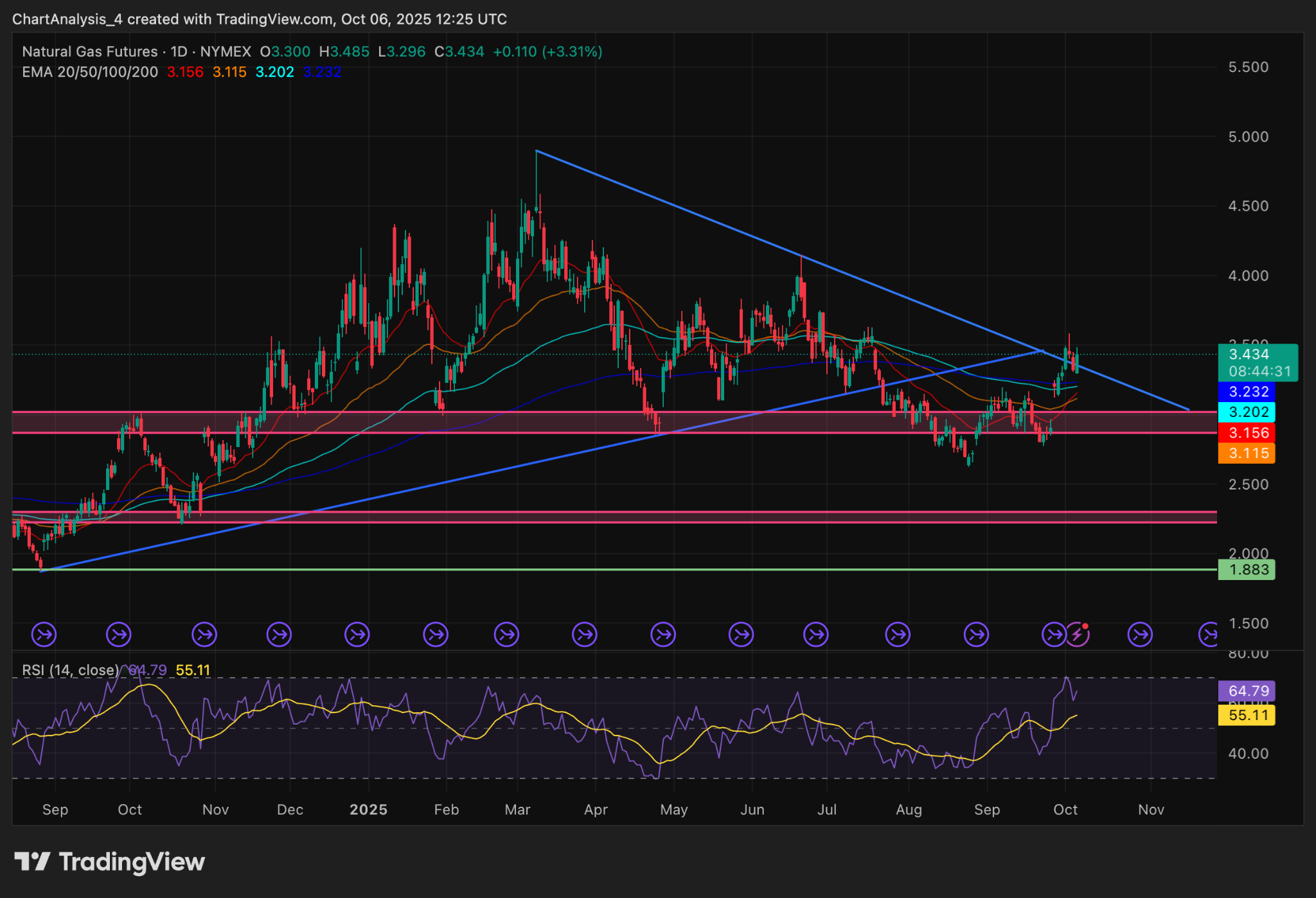
NG price dynamics (Source: TradingView)
Momentum indicators show improving sentiment. The RSI stands at 64.79, indicating healthy buying pressure without signaling overbought conditions. Meanwhile, the clustering of the 20-, 50-, and 100-day EMAs and their upward tilt reinforce the view that bullish momentum is strengthening after an extended accumulation phase.
Fundamentals support the breakout
Europe’s growing dependence on liquefied natural gas remains the dominant driver. EU LNG imports are projected to rise to 820 cargoes in 2025, up from 660 in 2024, with U.S. exports expected to supply roughly 70% of Europe’s needs by 2029. The continent’s gas storage levels have fallen to 82.75% of capacity as of October 4, down from 94.32% a year earlier, the lowest reading in four years. Analysts warn that inventories could drop below 30% by March 2026, which would mark a seven-year low.
This decline in reserves, combined with weaker pipeline flows from Russia and Algeria, has intensified reliance on U.S. LNG. The shift increases Europe’s exposure to spot market volatility, especially as competition for cargoes with Asian buyers escalates ahead of winter.U.S. fundamentals also play a role. Rising domestic production and growing export capacity are keeping shipments robust, but with U.S. storage levels tightening, domestic prices may face additional upward pressure if winter demand spikes. The interlink between U.S. and European gas balances has turned natural gas into a globally synchronized market, where regional shocks can ripple quickly across continents.
Geopolitical factors add another layer of risk. Reduced pipeline flows from Norway and continued supply disruptions from North Africa have amplified Europe’s dependence on seaborne LNG. Any logistical or political disruption could translate in sudden price surges, particularly given the limited buffer in European storage.
NG outlook
Natural gas has entered a new bullish phase following its breakout above long-term resistance. If prices hold above the $3.20–3.15 range, momentum could drive a retest of $3.55 and potentially $3.80–4.00 into the peak winter months. However, the market remains highly sensitive to weather forecasts, LNG shipment schedules, and policy decisions around gas reserves.
In the medium term, the broader picture favors higher prices as low storage, structural demand from Europe, and growing U.S. export commitments combine to sustain upward pressure. Short-term pullbacks are possible, but likely to be met with strong buying interest above $3.15.
In prior analyses, natural gas was seen struggling within a prolonged consolidation range. The latest breakout above $3.20 confirms the transition from that accumulation phase into a trend expansion, reinforcing the bullish narrative heading into the winter heating season.





Latest Natural Gas News









-
 Afghanistan
-
 Albania
-
 Algeria
-
 Angola
-
 Argentina
-
 Armenia
-
 Australia
-
 Austria
-
 Azerbaijan
-
 Bahamas
-
 Bahrain
-
 Bangladesh
-
 Belarus
-
 Belgium
-
 Bolivia
-
 Botswana
-
 Brazil
-
 Brunei
-
 Bulgaria
-
 Cambodia
-
 Cameroon
-
 Canada
-
 Chile
Chile
-
 China
China
-
 Colombia
-
 Congo
Congo
-
 Costa Rica
-
 Cote d'Ivoire
-
 Croatia
-
 Cuba
Cuba
-
 Cyprus
-
 Czechia
-
 DR Congo
-
 Denmark
-
 Dominican Republic
-
 Ecuador
-
 Egypt
Egypt
-
 El Salvador
-
 Estonia
-
 Eswatini
-
 Ethiopia
-
 Finland
-
 France
-
 Georgia
-
 Germany
-
 Ghana
Ghana
-
 Greece
-
 Haiti
Haiti
-
 Hong Kong
-
 Hungary
-
 India
India
-
 Indonesia
-
 Iran, Islamic republic
-
 Iraq
Iraq
-
 Ireland
-
 Israel
-
 Italy
Italy
-
 Jamaica
-
 Japan
Japan
-
 Jordan
-
 Kazakhstan
-
 Kenya
Kenya
-
 Korea
Korea
-
 Kuwait
-
 Kyrgyzstan
-
 Laos
Laos
-
 Latvia
-
 Lebanon
-
 Lesotho
-
 Libya
Libya
-
 Lithuania
-
 Luxembourg
-
 Madagascar
-
 Malaysia
-
 Malta
Malta
-
 Mauritius
-
 Mexico
-
 Moldova
-
 Mongolia
-
 Montenegro
-
 Morocco
-
 Mozambique
-
 Myanmar
-
 Namibia
-
 Nepal
Nepal
-
 Netherlands
-
 New Zealand
-
 Nigeria
-
 North Macedonia
-
 Norway
-
 Oman
Oman
-
 Pakistan
-
 Palestine
-
 Panama
-
 Papua New Guinea
-
 Paraguay
-
 Peru
Peru
-
 Philippines
-
 Poland
-
 Portugal
-
 Puerto Rico
-
 Qatar
Qatar
-
 Reunion
-
 Romania
-
 Rwanda
-
 Saudi Arabia
-
 Serbia
-
 Singapore
-
 Slovakia
-
 Slovenia
-
 Somalia
-
 South Africa
-
 Spain
Spain
-
 Sri Lanka
-
 Sweden
-
 Switzerland
-
 Syria
Syria
-
 Taiwan
-
 Tajikistan
-
 Tanzania
-
 Thailand
-
 Trinidad and Tobago
-
 Tunisia
-
 Turkey
-
 UAE
UAE
-
 Uganda
-
 Ukraine
-
 United Kingdom
-
United States
-
 Uruguay
-
 Uzbekistan
-
 Venezuela
-
 Vietnam
-
 Yemen
Yemen
-
 Zambia
-
 Zimbabwe
- Forex
- Crypto











