
Natural gas steadies near $3.39 as cold weather and geopolitical risks lift demand outlook
Natural gas prices held around $3.39 on Tuesday, extending their rebound from late September lows near $3.10. The rally has been fueled by colder weather forecasts across Europe, rising geopolitical tensions affecting supply, and expectations of stronger winter demand.
Highlights
- Natural gas trades near $3.39, extending recovery from late September lows.
- Colder weather and Russia-Ukraine tensions boost near-term demand outlook.
- Resistance at $3.60 remains key as traders eye a potential breakout toward $4.
However, the broader market remains delicately balanced, with healthy storage levels and fluctuating LNG flows keeping volatility high.
Technical breakout and support levels
The recent uptrend in natural gas follows a decisive breakout from a descending trendline that had capped gains since early summer. This move above the $3.20–$3.23 zone coincided with prices reclaiming key moving averages, notably the 20-day EMA at $3.17 and the 50-day EMA at $3.20. The breakout initially carried prices as high as $3.60 before resistance triggered mild profit-taking.
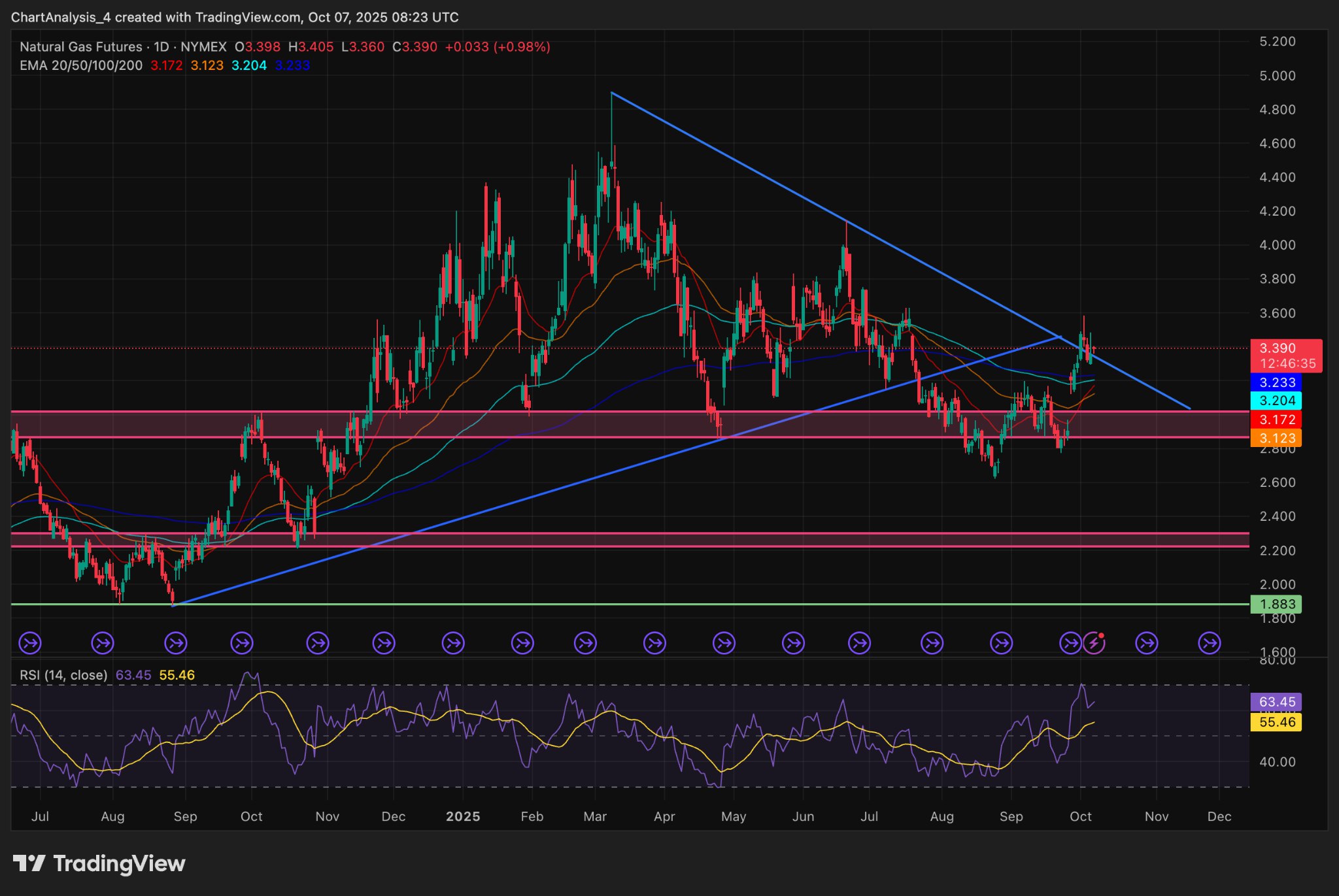
NG price dynamics (Source: TradingView)
From a structural standpoint, the recovery remains intact as long as natural gas holds above $3.20. Support is clustered between $3.12 and $3.17, while deeper backing lies near $2.80–$2.90 — a zone that repeatedly attracted buyers over the summer months. On the upside, the $3.60–$3.70 band remains a crucial barrier, and a sustained breakout above that could open the door to a move toward $4, especially if winter heating demand intensifies.
Momentum indicators lean cautiously bullish. The relative strength index sits near 63, confirming improving sentiment but not yet at overbought levels. The steady climb in RSI since mid-September suggests that bulls are regaining control, though the lack of follow-through beyond $3.60 points to continued hesitation among traders.
European demand and supply outlook
The European gas market remains a central driver of global sentiment. Benchmark futures in Europe climbed to a six-week high of €33.5 per megawatt-hour as forecasts pointed to colder temperatures in France and Germany. At the same time, Russia’s latest wave of attacks on Ukraine’s energy infrastructure has intensified concerns over winter supply stability.
Still, Europe’s storage situation remains relatively comfortable, with current levels at 82.8% of capacity — the lowest in four years but still sufficient to cushion short-term disruptions. This has tempered panic-driven buying despite rising geopolitical risk. Analysts note that the next several weeks will be critical, as sustained cold weather could sharply increase withdrawal rates, tightening inventories heading into December.
The EU’s growing reliance on liquefied natural gas imports has also reshaped market dynamics. LNG now accounts for roughly half of Europe’s total gas consumption, up from just 10% a decade ago. The United States supplies nearly 60% of these LNG imports, making European prices increasingly sensitive to U.S. export policy and global LNG competition, particularly from Asia. This structural shift has embedded greater volatility in gas pricing, as disruptions or surges in demand from other regions can quickly ripple through the European market.
Outlook
Natural gas appears to be stabilizing after reclaiming the $3.20 support area, with momentum tilted modestly in favor of further gains. Short-term resistance at $3.60 remains the key barrier to watch; a breakout above this threshold could accelerate the move toward $4 as winter heating demand intensifies and geopolitical uncertainty persists. Conversely, a drop back below $3.20 would risk invalidating the breakout, potentially sending prices back toward the $2.90 area.
With weather patterns turning colder and geopolitical tensions mounting, the coming weeks could prove pivotal for the market’s next direction. While strong European storage levels are acting as a buffer, the global LNG supply chain remains highly exposed to disruptions — ensuring that volatility will stay a defining feature of natural gas pricing through the winter.
Earlier forecasts emphasized that natural gas would turn bullish once prices broke above $3.20, driven by tightening weather conditions and LNG dynamics. The current rebound confirms that scenario, with the focus now shifting to whether prices can sustain momentum through the $3.60 resistance zone.





Latest Natural Gas News








-
 Afghanistan
-
 Albania
-
 Algeria
-
 Angola
-
 Argentina
-
 Armenia
-
 Australia
-
 Austria
-
 Azerbaijan
-
 Bahamas
-
 Bahrain
-
 Bangladesh
-
 Belarus
-
 Belgium
-
 Bolivia
-
 Botswana
-
 Brazil
-
 Brunei
-
 Bulgaria
-
 Cambodia
-
 Cameroon
-
 Canada
-
 Chile
Chile
-
 China
China
-
 Colombia
-
 Congo
Congo
-
 Costa Rica
-
 Cote d'Ivoire
-
 Croatia
-
 Cuba
Cuba
-
 Cyprus
-
 Czechia
-
 DR Congo
-
 Denmark
-
 Dominican Republic
-
 Ecuador
-
 Egypt
Egypt
-
 El Salvador
-
 Estonia
-
 Eswatini
-
 Ethiopia
-
 Finland
-
 France
-
 Georgia
-
 Germany
-
 Ghana
Ghana
-
 Greece
-
 Haiti
Haiti
-
 Hong Kong
-
 Hungary
-
 India
India
-
 Indonesia
-
 Iran, Islamic republic
-
 Iraq
Iraq
-
 Ireland
-
 Israel
-
 Italy
Italy
-
 Jamaica
-
 Japan
Japan
-
 Jordan
-
 Kazakhstan
-
 Kenya
Kenya
-
 Korea
Korea
-
 Kuwait
-
 Kyrgyzstan
-
 Laos
Laos
-
 Latvia
-
 Lebanon
-
 Lesotho
-
 Libya
Libya
-
 Lithuania
-
 Luxembourg
-
 Madagascar
-
 Malaysia
-
 Malta
Malta
-
 Mauritius
-
 Mexico
-
 Moldova
-
 Mongolia
-
 Montenegro
-
 Morocco
-
 Mozambique
-
 Myanmar
-
 Namibia
-
 Nepal
Nepal
-
 Netherlands
-
 New Zealand
-
 Nigeria
-
 North Macedonia
-
 Norway
-
 Oman
Oman
-
 Pakistan
-
 Palestine
-
 Panama
-
 Papua New Guinea
-
 Paraguay
-
 Peru
Peru
-
 Philippines
-
 Poland
-
 Portugal
-
 Puerto Rico
-
 Qatar
Qatar
-
 Reunion
-
 Romania
-
 Rwanda
-
 Saudi Arabia
-
 Serbia
-
 Singapore
-
 Slovakia
-
 Slovenia
-
 Somalia
-
 South Africa
-
 Spain
Spain
-
 Sri Lanka
-
 Sweden
-
 Switzerland
-
 Syria
Syria
-
 Taiwan
-
 Tajikistan
-
 Tanzania
-
 Thailand
-
 Trinidad and Tobago
-
 Tunisia
-
 Turkey
-
 UAE
UAE
-
 Uganda
-
 Ukraine
-
 United Kingdom
-
United States
-
 Uruguay
-
 Uzbekistan
-
 Venezuela
-
 Vietnam
-
 Yemen
Yemen
-
 Zambia
-
 Zimbabwe
- Forex
- Crypto











