
Microsoft slips toward $487 as technical pressure outweighs new Saudi cloud partnership

Microsoft shares closed near $487 on Wednesday, extending a steady multi-session decline as the stock continues to unwind from its early-November peak. The weakness came even as the company announced a memorandum of understanding with Saudi Arabia’s Public Investment Fund and SITE to explore sovereign-cloud services in the kingdom.
Highlights
- Microsoft slides toward $487 despite new cloud collaboration with Saudi Arabia’s PIF and SITE.
- Stock trades below key EMAs as the technical structure shifts into a corrective phase.
- Momentum turns bearish with price approaching the 200-day EMA near $479.
While the strategic partnership signals continued expansion of Microsoft’s global cloud footprint, the market’s response has been muted. Technical pressures, broader Nasdaq softness, and renewed scrutiny of high-multiple tech names remain the dominant forces guiding price action.
Technical structure weakens as Microsoft tests major support
The daily chart shows clear signs of deterioration. Microsoft has broken below both the 20-day and 50-day EMAs, with each now sloping downward and acting as dynamic overhead resistance. Attempts to rebound into these zones last week were met with aggressive selling, confirming a shift in control from buyers to sellers.
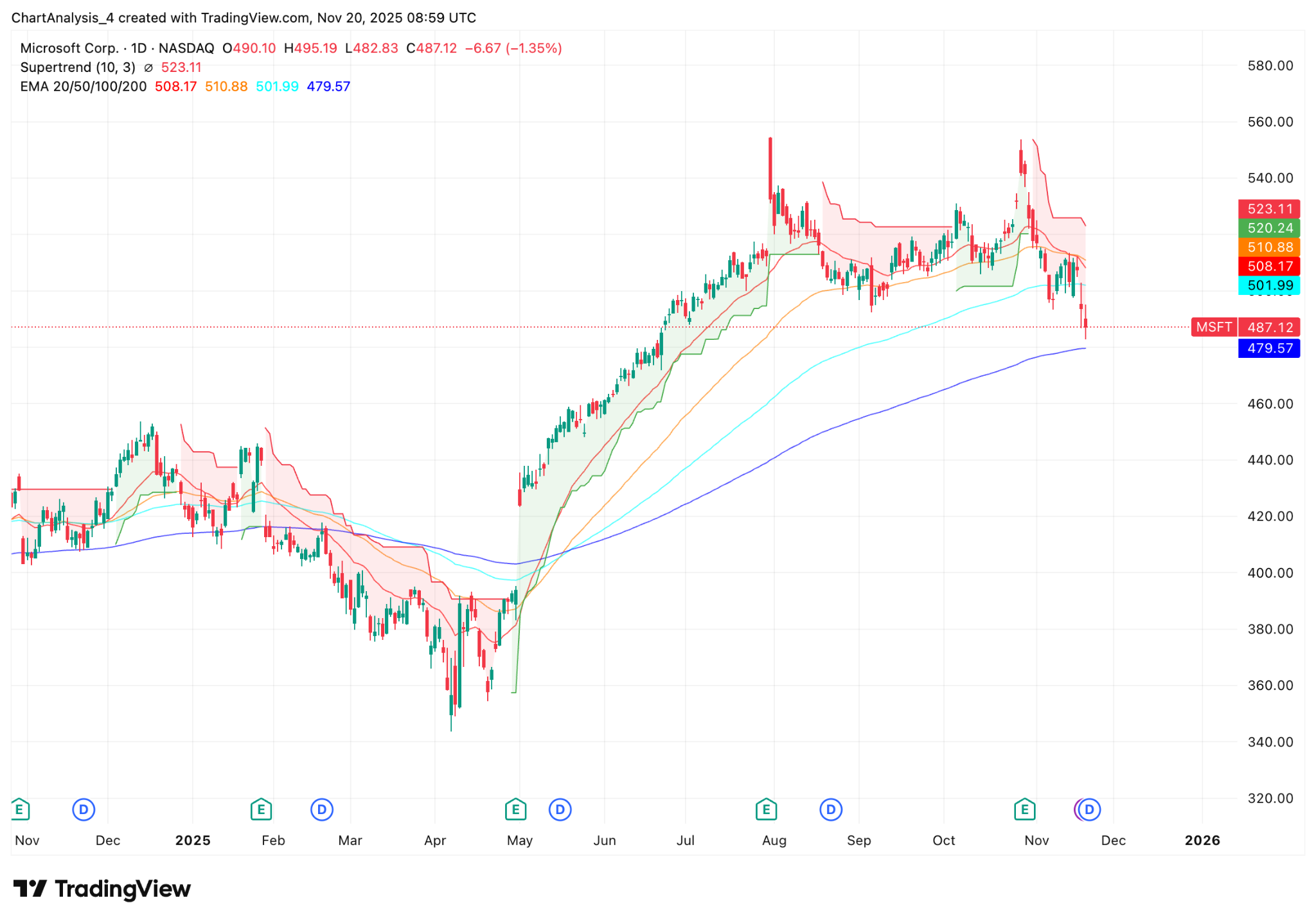
Microsoft stock price dynamics (Source: TradingView)
The Supertrend indicator flipped bearish earlier in November and has remained firmly above price ever since, reinforcing the sustained momentum shift. The stock is now drifting toward the 200-day EMA around $479, a level not tested since April’s breakout. As one of the most reliable long-term support references, it represents a critical battleground for bulls attempting to halt the decline.
The broader pattern shows a controlled sequence of lower highs and lower lows developing since the $550–$560 region. This structured retreat, rather than a sharp unwind, signals that distribution is occurring gradually. Slow, steady pressure often allows a downtrend to grind further before a true stabilization attempt materializes.
If Microsoft breaks decisively below the 200-day EMA, the next notable support sits near $465, a consolidation zone from the summer that previously acted as a platform for buying interest.
Momentum indicators show a market still under distribution
Momentum metrics reinforce the caution. RSI has slipped into the low-to-mid range after failing to hold above the 50 level earlier this month. Without bullish divergence, there is little evidence that the downtrend is tiring. Volume levels remain subdued compared to the stock's major inflection points, a sign that selling is steady but not capitulatory.
Short-term price action mirrors the broader trend. On the 30-minute chart, Microsoft continues to trade beneath the Supertrend and intraday EMAs, with every push toward the $596–$600 region rejected quickly. The DMI indicator shows the negative directional index firmly above the positive index, confirming that sellers continue to dominate intraday flows.
Bulls need a reclaim of the 50-day EMA and a Supertrend reversal before the technical tone can shift meaningfully. Without those developments, the stock remains exposed to further downside, with the 200-day EMA serving as the immediate line of defense.
Strategic Saudi cloud partnership overshadowed by market tone
Fundamentally, Microsoft’s announcement in Saudi Arabia highlights its accelerating push into sovereign-cloud infrastructure. The proposed collaboration with the Public Investment Fund and SITE aims to develop localized cloud services designed to meet national data-sovereignty requirements—an area of rising demand among governments and regulated industries.
Under more stable technical conditions, such an agreement would likely have offered support. Sovereign-cloud expansion presents a long runway for future revenue and strengthens Microsoft’s competitive position against hyperscale rivals. But current market sentiment has overshadowed even strategically meaningful developments, as high-growth tech undergoes repricing amid rising rate expectations and broader Nasdaq cooling.
Macro headwinds remain a secondary but persistent factor. The rotation out of high-multiple tech has pressured leading names across the index, and Microsoft’s decline reflects not just company-specific positioning but also sector-wide caution.
In earlier analysis, we noted that Microsoft’s failure to hold the 20-day EMA risked exposing the stock to a deeper test of the 50-day and eventually the 200-day EMA. The current decline confirms that scenario, with price now approaching the long-term average highlighted as the key pivot for trend stability.





Latest Microsoft News









-
 Afghanistan
-
 Albania
-
 Algeria
-
 Angola
-
 Argentina
-
 Armenia
-
 Australia
-
 Austria
-
 Azerbaijan
-
 Bahamas
-
 Bahrain
-
 Bangladesh
-
 Belarus
-
 Belgium
-
 Bolivia
-
 Botswana
-
 Brazil
-
 Brunei
-
 Bulgaria
-
 Cambodia
-
 Cameroon
-
 Canada
-
 Chile
Chile
-
 China
China
-
 Colombia
-
 Congo
Congo
-
 Costa Rica
-
 Cote d'Ivoire
-
 Croatia
-
 Cuba
Cuba
-
 Cyprus
-
 Czechia
-
 DR Congo
-
 Denmark
-
 Dominican Republic
-
 Ecuador
-
 Egypt
Egypt
-
 El Salvador
-
 Estonia
-
 Eswatini
-
 Ethiopia
-
 Finland
-
 France
-
 Georgia
-
 Germany
-
 Ghana
Ghana
-
 Greece
-
 Haiti
Haiti
-
 Hong Kong
-
 Hungary
-
 India
India
-
 Indonesia
-
 Iran, Islamic republic
-
 Iraq
Iraq
-
 Ireland
-
 Israel
-
 Italy
Italy
-
 Jamaica
-
 Japan
Japan
-
 Jordan
-
 Kazakhstan
-
 Kenya
Kenya
-
 Korea
Korea
-
 Kuwait
-
 Kyrgyzstan
-
 Laos
Laos
-
 Latvia
-
 Lebanon
-
 Lesotho
-
 Libya
Libya
-
 Lithuania
-
 Luxembourg
-
 Madagascar
-
 Malaysia
-
 Malta
Malta
-
 Mauritius
-
 Mexico
-
 Moldova
-
 Mongolia
-
 Montenegro
-
 Morocco
-
 Mozambique
-
 Myanmar
-
 Namibia
-
 Nepal
Nepal
-
 Netherlands
-
 New Zealand
-
 Nigeria
-
 North Macedonia
-
 Norway
-
 Oman
Oman
-
 Pakistan
-
 Palestine
-
 Panama
-
 Papua New Guinea
-
 Paraguay
-
 Peru
Peru
-
 Philippines
-
 Poland
-
 Portugal
-
 Puerto Rico
-
 Qatar
Qatar
-
 Reunion
-
 Romania
-
 Rwanda
-
 Saudi Arabia
-
 Serbia
-
 Singapore
-
 Slovakia
-
 Slovenia
-
 Somalia
-
 South Africa
-
 Spain
Spain
-
 Sri Lanka
-
 Sweden
-
 Switzerland
-
 Syria
Syria
-
 Taiwan
-
 Tajikistan
-
 Tanzania
-
 Thailand
-
 Trinidad and Tobago
-
 Tunisia
-
 Turkey
-
 UAE
UAE
-
 Uganda
-
 Ukraine
-
 United Kingdom
-
United States
-
 Uruguay
-
 Uzbekistan
-
 Venezuela
-
 Vietnam
-
 Yemen
Yemen
-
 Zambia
-
 Zimbabwe
- Forex
- Crypto











