
Microsoft trades near $472 as AI monetization concerns fuel renewed selling pressure

Microsoft trades near $472 after another sharp decline, extending a multi-week slide that has pulled the stock back to levels last seen in late spring. The downturn comes as investors reassess the commercial strength of Microsoft’s AI products, raising questions about how quickly the company can convert its technical lead into meaningful enterprise adoption.
Highlights
- Microsoft falls toward $472 as technical pressure builds.
- Copilot adoption concerns weigh on enterprise sentiment.
- Support at $470 and $450 will define the next move.
The stock’s chart shows a decisive shift in momentum. Microsoft has broken below all major EMAs, with the 20-day, 50-day, 100-day and 200-day stacked above price in a fully bearish formation. This alignment, rare during the stock’s multi-year rally, signals that sellers now dominate the intermediate trend.
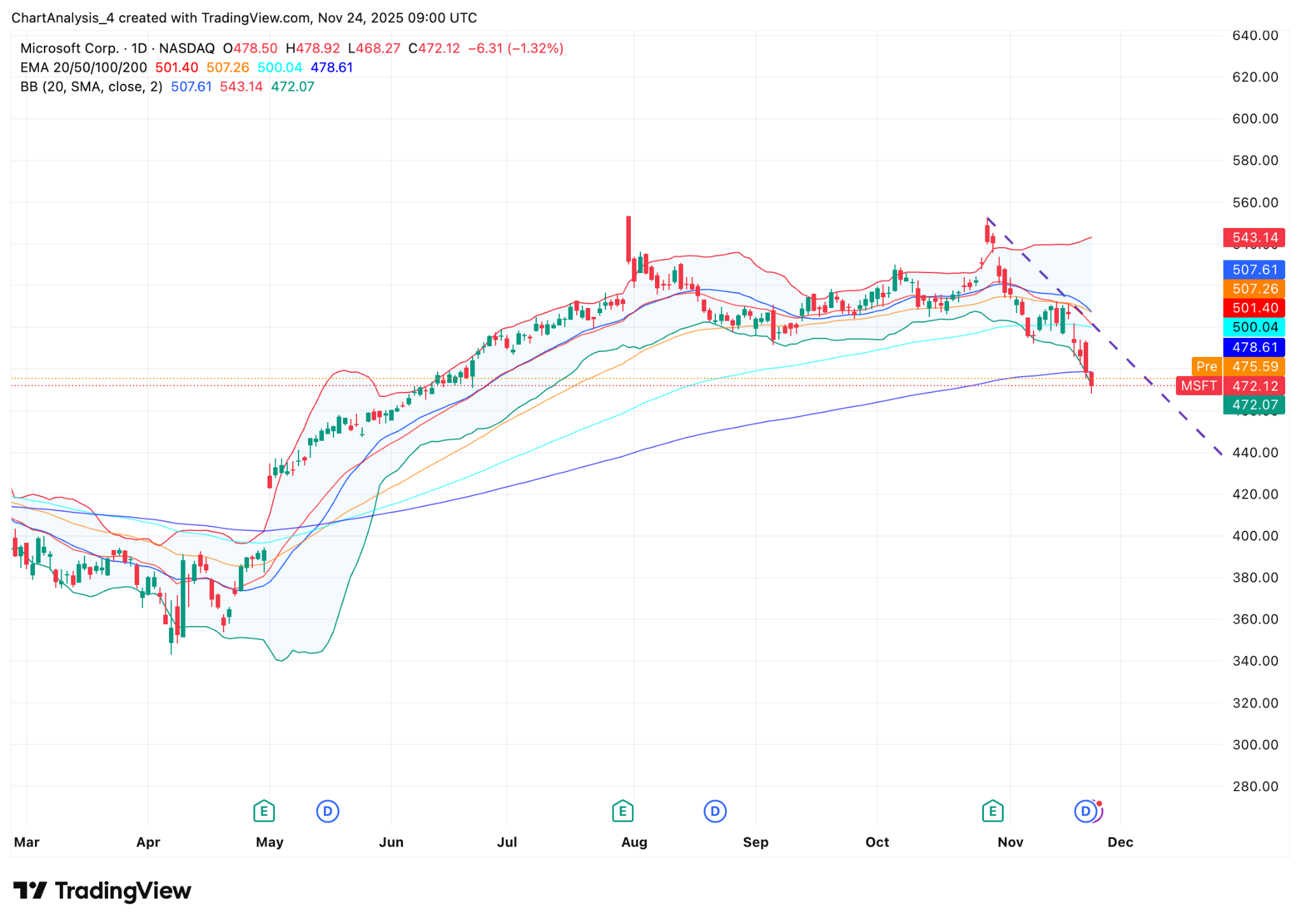
Microsoft stock price dynamics (Source: TradingView)
A steep descending trendline from the November high has capped every rebound attempt, and price continues to close beneath the lower Bollinger Band. The market has shown no sign of capitulation; instead, the decline reflects orderly but persistent distribution. Only a sustained close above $500 would break this structure and mark the first signal of stabilization.
The $470 zone has emerged as the first meaningful support, aligning with a consolidation shelf from March and the lower volatility envelope. Buyers have responded here over the past two sessions, but the bounce remains shallow. A deeper support band sits near $450, the same region where Microsoft’s summer rally began forming. If sellers break $470, the path toward $450 and even $430 opens quickly.
AI monetization questions reshape the narrative
Microsoft’s technical weakness is unfolding against a challenging backdrop for its AI business. At the Ignite conference, several CIOs and consulting partners questioned whether Copilot delivers enough value to justify its $30-per-user monthly cost. Many organizations indicated that large-scale rollouts remain unlikely until productivity gains become clearer or the pricing becomes more flexible.
The commentary marks an important change. During the early cloud era, Microsoft enjoyed largely effortless enterprise demand. But in the AI agent race, the company now competes not only with Google’s Gemini but also with leaner third-party tools promising faster iteration cycles or lower integration costs.
Some enterprises have pushed for steep discounts, prompting Microsoft to scale back concessions. Others are experimenting with alternative agents that fit specific workflows more efficiently. As one long-time partner summarized, “This time Microsoft has to sell, not just deliver.”
This hesitation does not negate Microsoft’s broader strength. Azure remains the fastest-growing major cloud platform, and partnerships such as Anthropic continue to build out its AI ecosystem. Many enterprise buyers at Ignite also acknowledged that Copilot is still the natural long-term choice once data cleanup and workflow alignment improve. But the uneven pace of adoption is proving to be a headwind at a moment when investors expected rapid monetization.
Key levels will determine whether the slide becomes a reset
The next phase hinges on the technical reaction around $470. If the level holds and the stock rebounds toward $500, Microsoft may begin forming a base that resets expectations without breaking the long-term uptrend. A move above $500 would also mark the first break of the descending trendline.
If sellers push the stock below $470, the correction likely extends toward $450 and then $430. While those levels would represent a steeper repricing, they remain consistent with historical pullbacks that preceded fresh waves of institutional accumulation.
For now, Microsoft stands at a strategic crossroads. Technical pressure, AI adoption skepticism and a more competitive enterprise environment have converged at the same moment. But the company’s scale, cloud footprint and embedded productivity ecosystem remain unmatched, leaving open the possibility that this decline becomes a recalibration rather than a structural reversal.
In earlier analysis, we highlighted that Microsoft’s momentum would fracture if price slipped beneath the EMA cluster and failed to reclaim the 20-day line. That breakdown has now occurred, placing heightened importance on the $470 floor and confirming seller control unless the stock can close back above $500.





Latest Microsoft News








-
 Afghanistan
-
 Albania
-
 Algeria
-
 Angola
-
 Argentina
-
 Armenia
-
 Australia
-
 Austria
-
 Azerbaijan
-
 Bahamas
-
 Bahrain
-
 Bangladesh
-
 Belarus
-
 Belgium
-
 Bolivia
-
 Botswana
-
 Brazil
-
 Brunei
-
 Bulgaria
-
 Cambodia
-
 Cameroon
-
 Canada
-
 Chile
Chile
-
 China
China
-
 Colombia
-
 Congo
Congo
-
 Costa Rica
-
 Cote d'Ivoire
-
 Croatia
-
 Cuba
Cuba
-
 Cyprus
-
 Czechia
-
 DR Congo
-
 Denmark
-
 Dominican Republic
-
 Ecuador
-
 Egypt
Egypt
-
 El Salvador
-
 Estonia
-
 Eswatini
-
 Ethiopia
-
 Finland
-
 France
-
 Georgia
-
 Germany
-
 Ghana
Ghana
-
 Greece
-
 Haiti
Haiti
-
 Hong Kong
-
 Hungary
-
 India
India
-
 Indonesia
-
 Iran, Islamic republic
-
 Iraq
Iraq
-
 Ireland
-
 Israel
-
 Italy
Italy
-
 Jamaica
-
 Japan
Japan
-
 Jordan
-
 Kazakhstan
-
 Kenya
Kenya
-
 Korea
Korea
-
 Kuwait
-
 Kyrgyzstan
-
 Laos
Laos
-
 Latvia
-
 Lebanon
-
 Lesotho
-
 Libya
Libya
-
 Lithuania
-
 Luxembourg
-
 Madagascar
-
 Malaysia
-
 Malta
Malta
-
 Mauritius
-
 Mexico
-
 Moldova
-
 Mongolia
-
 Montenegro
-
 Morocco
-
 Mozambique
-
 Myanmar
-
 Namibia
-
 Nepal
Nepal
-
 Netherlands
-
 New Zealand
-
 Nigeria
-
 North Macedonia
-
 Norway
-
 Oman
Oman
-
 Pakistan
-
 Palestine
-
 Panama
-
 Papua New Guinea
-
 Paraguay
-
 Peru
Peru
-
 Philippines
-
 Poland
-
 Portugal
-
 Puerto Rico
-
 Qatar
Qatar
-
 Reunion
-
 Romania
-
 Rwanda
-
 Saudi Arabia
-
 Serbia
-
 Singapore
-
 Slovakia
-
 Slovenia
-
 Somalia
-
 South Africa
-
 Spain
Spain
-
 Sri Lanka
-
 Sweden
-
 Switzerland
-
 Syria
Syria
-
 Taiwan
-
 Tajikistan
-
 Tanzania
-
 Thailand
-
 Trinidad and Tobago
-
 Tunisia
-
 Turkey
-
 UAE
UAE
-
 Uganda
-
 Ukraine
-
 United Kingdom
-
United States
-
 Uruguay
-
 Uzbekistan
-
 Venezuela
-
 Vietnam
-
 Yemen
Yemen
-
 Zambia
-
 Zimbabwe
- Forex
- Crypto











