

Can WISeSat.Space Holdings $10M investment outflow pressure SEALSQ stock?

SEALSQ (LAES) stock is trading at $2.74, down 5.52% on the day. The price sits below its key short-term averages but holds near its medium-term trend levels.
 2.11
2.50
2.11
2.50
Highlights
- SEALSQ Corp will commit $10 million to WISeSat.Space Holdings Corp as part of a planned de-SPAC transaction.
- This capital commitment creates an immediate liquidity impact for SEALSQ and may alter its capital structure and ownership after deal closure.
- Short- and long-term bearish pressure persists in LAES/USD, with technical indicators mostly negative and price expected to fluctuate between $2.52 and $2.96 over the next 2 to 3 days.
Liquidity outflow and timeline uncertainty from $10 million de-SPAC deal
SEALSQ Corp has entered into a subscription agreement to commit $10 million to WISeSat.Space Holdings Corp as part of a planned de-SPAC transaction, according to Tipranks. This significant capital commitment implies an immediate outflow impacting SEALSQ's liquidity and could result in changes to its capital structure and ownership once the deal closes. The extension of the transaction timeline adds further uncertainty around timing and execution, which may constrain near-term strategic options for SEALSQ.
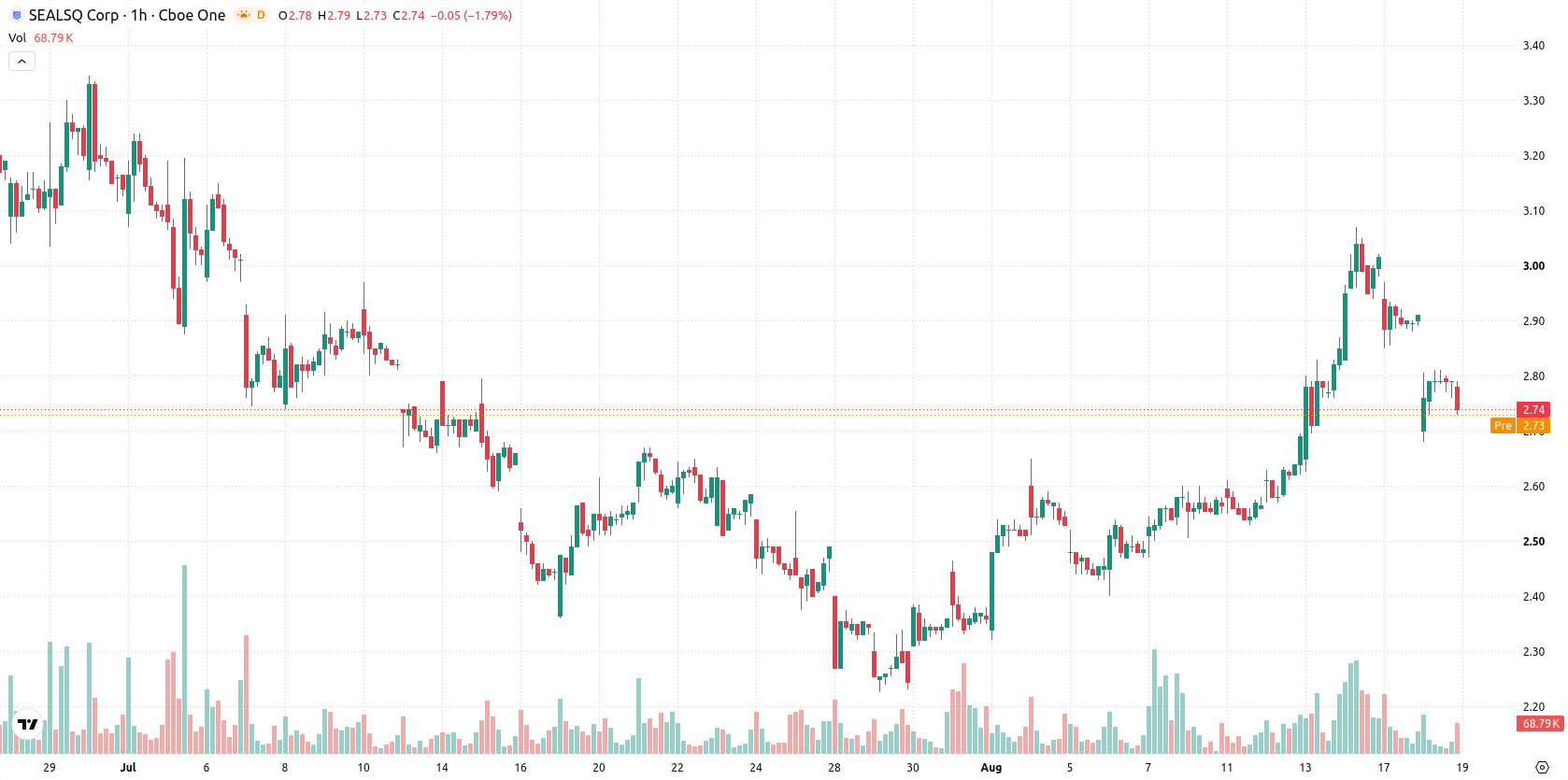
Seller momentum dominates with oversold signals and resistance at Kijun
On the hourly chart, LAES traded below the MA-20 at $2.89 but remained slightly above the MA-50 at $2.74, with the daily chart showing price below the MA-200 at $3.58. The Ichimoku Kijun is at $2.88, currently acting as immediate resistance. Momentum signals are mostly negative: ADX indicates a sell bias, and MACD is neutral. Both RSI at 41.33 and CCI are in oversold territory, while Stochastic RSI is also oversold. Bull/Bear Power reflects seller dominance in the intraday session, and the Awesome Oscillator supports the prevailing downtrend.
Downside bias as volatility band guides short-term scenarios
Over the next two to three trading days, LAES is expected to fluctuate within the $2.52 to $2.96 volatility band relative to current levels. There is a 67% probability of further downside and a 33% chance of recovery. A baseline scenario sees price drifting sideways in this range; a move above the $2.88 Kijun resistance could push price towards the upper bound, while a break below $2.52 would likely prompt additional declines.
Earlier, analysts noted that SEALSQ was facing persistent downside pressure amid mixed technical signals and pivotal support levels. The current developments add a new layer of complexity, as the company's $10 million commitment and the extended transaction timeline introduce additional liquidity and execution risks that heighten the importance of monitoring volatility around the $2.52 to $2.96 trading range in the near term.










-
 Afghanistan
-
 Albania
-
 Algeria
-
 Angola
-
 Argentina
-
 Armenia
-
 Australia
-
 Austria
-
 Azerbaijan
-
 Bahamas
-
 Bahrain
-
 Bangladesh
-
 Belarus
-
 Belgium
-
 Bolivia
-
 Botswana
-
 Brazil
-
 Brunei
-
 Bulgaria
-
 Cambodia
-
 Cameroon
-
 Canada
-
 Chile
Chile
-
 China
China
-
 Colombia
-
 Congo
Congo
-
 Costa Rica
-
 Cote d'Ivoire
-
 Croatia
-
 Cuba
Cuba
-
 Cyprus
-
 Czechia
-
 DR Congo
-
 Denmark
-
 Dominican Republic
-
 Ecuador
-
 Egypt
Egypt
-
 El Salvador
-
 Estonia
-
 Eswatini
-
 Ethiopia
-
 Finland
-
 France
-
 Georgia
-
 Germany
-
 Ghana
Ghana
-
 Greece
-
 Haiti
Haiti
-
 Hong Kong
-
 Hungary
-
 India
India
-
 Indonesia
-
 Iran, Islamic republic
-
 Iraq
Iraq
-
 Ireland
-
 Israel
-
 Italy
Italy
-
 Jamaica
-
 Japan
Japan
-
 Jordan
-
 Kazakhstan
-
 Kenya
Kenya
-
 Korea
Korea
-
 Kuwait
-
 Kyrgyzstan
-
 Laos
Laos
-
 Latvia
-
 Lebanon
-
 Lesotho
-
 Libya
Libya
-
 Lithuania
-
 Luxembourg
-
 Madagascar
-
 Malaysia
-
 Malta
Malta
-
 Mauritius
-
 Mexico
-
 Moldova
-
 Mongolia
-
 Montenegro
-
 Morocco
-
 Mozambique
-
 Myanmar
-
 Namibia
-
 Nepal
Nepal
-
 Netherlands
-
 New Zealand
-
 Nigeria
-
 North Macedonia
-
 Norway
-
 Oman
Oman
-
 Pakistan
-
 Palestine
-
 Panama
-
 Papua New Guinea
-
 Paraguay
-
 Peru
Peru
-
 Philippines
-
 Poland
-
 Portugal
-
 Puerto Rico
-
 Qatar
Qatar
-
 Reunion
-
 Romania
-
 Rwanda
-
 Saudi Arabia
-
 Serbia
-
 Singapore
-
 Slovakia
-
 Slovenia
-
 Somalia
-
 South Africa
-
 Spain
Spain
-
 Sri Lanka
-
 Sweden
-
 Switzerland
-
 Syria
Syria
-
 Taiwan
-
 Tajikistan
-
 Tanzania
-
 Thailand
-
 Trinidad and Tobago
-
 Tunisia
-
 Turkey
-
 UAE
UAE
-
 Uganda
-
 Ukraine
-
 United Kingdom
-
United States
-
 Uruguay
-
 Uzbekistan
-
 Venezuela
-
 Vietnam
-
 Yemen
Yemen
-
 Zambia
-
 Zimbabwe
- Forex
- Crypto












