

Ultralife shares technical analysis: Support test at $5.51 in focus

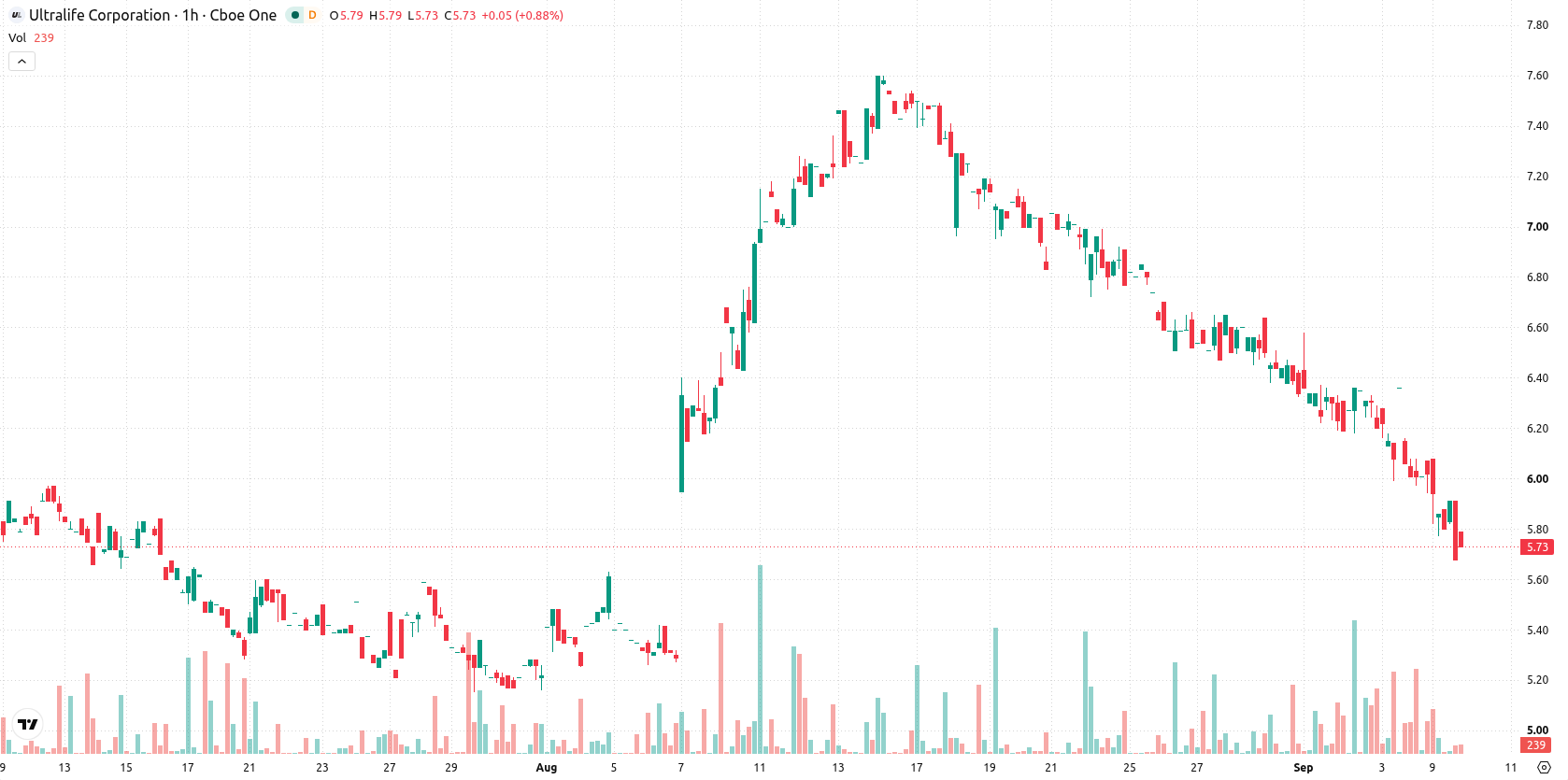
Ultralife (ULBI) stock is trading at $5.72, down 3.7% for the session. The price has declined on the day and is holding below its key moving averages.
 15.80
15.80
Highlights
- ULBI/USD is trading below key moving averages on both short and long timeframes, confirming a sustained bearish trend.
- Momentum indicators collectively show weakness, with oversold conditions and sellers dominating intraday price action.
- Expected range for the next 2 to 3 days is $5.51 to $5.99, with high probability of further downside if support breaks.
Weak momentum signals as technical barriers cap upside
On the technical front, ULBI is trading below the MA-20 and MA-50 on the H1 chart and remains under the MA-200 on the daily chart. The Ichimoku Kijun at $6.15 is serving as immediate resistance. Momentum indicators present weak signals: MACD is flashing Sell, while ADX is Neutral, indicating no dominant trend. RSI stands at 36.89, which aligns with selling pressure, and CCI is Oversold. Stochastic RSI is Neutral, pointing to possible near-term exhaustion, while Bull/Bear Power confirms sellers are in control intraday. The Awesome Oscillator registers as Neutral, not confirming any strong directional bias.
Downside bias prevails as scenarios favor further weakness
Over the next 2–3 trading days, price action for ULBI is expected within a band from immediate support at $5.51 up to resistance at $5.99. Scenario probabilities are skewed, with a much higher chance for a further downside than for an upward retracement. The base case calls for continued consolidation between these levels, but a break above $6.15 could prompt renewed buying interest, while a drop below $5.51 may accelerate downside pressure.
Earlier, analysts noted that Ultralife shares were consolidating with mixed technical signals and persistent bearish momentum. The latest price action below long-term averages and continued weakness in momentum indicators reinforce the downside risk, making the $5.51 support level critical for near-term direction.











-
 Afghanistan
-
 Albania
-
 Algeria
-
 Angola
-
 Argentina
-
 Armenia
-
 Australia
-
 Austria
-
 Azerbaijan
-
 Bahamas
-
 Bahrain
-
 Bangladesh
-
 Belarus
-
 Belgium
-
 Bolivia
-
 Botswana
-
 Brazil
-
 Brunei
-
 Bulgaria
-
 Cambodia
-
 Cameroon
-
 Canada
-
 Chile
-
 China
-
 Colombia
-
 Congo
-
 Costa Rica
-
 Cote d'Ivoire
-
 Croatia
-
 Cuba
-
 Cyprus
-
 Czechia
-
 DR Congo
-
 Denmark
-
 Dominican Republic
-
 Ecuador
-
 Egypt
-
 El Salvador
-
 Estonia
-
 Eswatini
-
 Ethiopia
-
 Finland
-
 France
-
 Georgia
-
 Germany
-
 Ghana
-
 Greece
-
 Haiti
-
 Hong Kong
-
 Hungary
-
 India
-
 Indonesia
-
 Iran, Islamic republic
-
 Iraq
-
 Ireland
-
 Israel
-
 Italy
-
 Jamaica
-
 Japan
-
 Jordan
-
 Kazakhstan
-
 Kenya
-
 Korea
-
 Kuwait
-
 Kyrgyzstan
-
 Laos
-
 Latvia
-
 Lebanon
-
 Lesotho
-
 Libya
-
 Lithuania
-
 Luxembourg
-
 Madagascar
-
 Malaysia
-
 Malta
-
 Mauritius
-
 Mexico
-
 Moldova
-
 Mongolia
-
 Montenegro
-
 Morocco
-
 Mozambique
-
 Myanmar
-
 Namibia
-
 Nepal
-
 Netherlands
-
 New Zealand
-
 Nigeria
-
 North Macedonia
-
 Norway
-
 Oman
-
 Pakistan
-
 Palestine
-
 Panama
-
 Papua New Guinea
-
 Paraguay
-
 Peru
-
 Philippines
-
 Poland
-
 Portugal
-
 Puerto Rico
-
 Qatar
-
 Reunion
-
 Romania
-
 Rwanda
-
 Saudi Arabia
-
 Serbia
-
 Singapore
-
 Slovakia
-
 Slovenia
-
 Somalia
-
 South Africa
-
 Spain
-
 Sri Lanka
-
 Sweden
-
 Switzerland
-
 Syria
-
 Taiwan
-
 Tajikistan
-
 Tanzania
-
 Thailand
-
 Trinidad and Tobago
-
 Tunisia
-
 Turkey
-
 UAE
-
 Uganda
-
 Ukraine
-
 United Kingdom
-
United States
-
 Uruguay
-
 Uzbekistan
-
 Venezuela
-
 Vietnam
-
 Yemen
-
 Zambia
-
 Zimbabwe
- Forex
- Crypto












