


AgEagle Aerial Systems (UAVS) stock is trading at $0.98 after a 3.15% decline for the day. The share price remains below its key moving averages, marking a continuation of recent weakness.
 0.3000
0.3211
Highlights
- Shares of UAVS closed at $0.98, down 3.15% on the day, finishing mid-range in a session with high volatility.
- The stock trades below key short- and long-term moving averages, with bearish momentum indicators and sellers dominating across timeframes.
- Price is expected to consolidate between $0.94 and $1.03, with a 78% probability of a further move lower if support fails.
Bearish momentum persists as major resistance contains price
On the hourly chart, UAVS trades below its MA-20 at $1.01 and MA-50 at $1, with the daily MA-200 at $1.02 also overhead. The Ichimoku Kijun level is aligned with MA-200 at $1.02, reinforcing this as immediate resistance. Momentum readings are bearish: the MACD and ADX show ongoing sell pressure, with RSI at 38.1 flagging that shares sit in lower-momentum territory. Stochastic RSI and CCI are oversold, suggesting recent sellers are showing possible exhaustion. Both Bull/Bear Power and the Awesome Oscillator support continued seller dominance on an intraday basis, and volatility remains high.
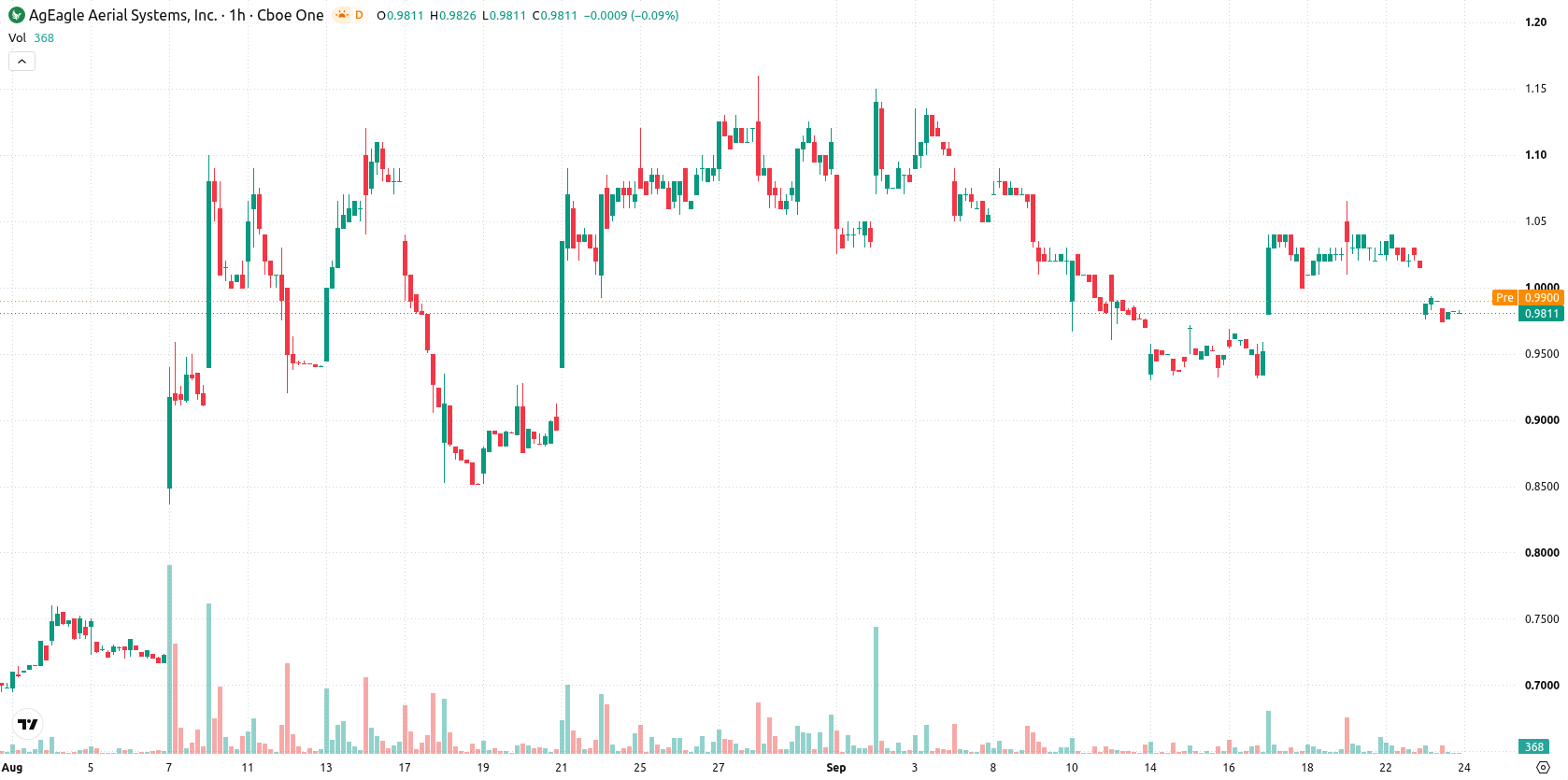
Downside favored as volatility and trading range limit upside
UAVS is expected to consolidate within a $0.94 to $1.03 trading range over the next several sessions. Probability favors continued downside, with a 78% likelihood of a bearish move versus a 22% chance of a bullish reversal. A break above $1.02 would signal upside potential, while a drop below $0.94 exposes the stock to further losses. Typical volatility is anticipated within this corridor over the short term.
Earlier, analysts noted that AgEagle Aerial Systems was experiencing persistent selling pressure with a bearish technical structure dominating its price action. The current analysis strengthens this outlook, highlighting a continued downside bias and suggesting that traders should monitor $1.02 as a key resistance and $0.94 as crucial support for potential breakout signals.









-
 Afghanistan
-
 Albania
-
 Algeria
-
 Angola
-
 Argentina
-
 Armenia
-
 Australia
-
 Austria
-
 Azerbaijan
-
 Bahamas
-
 Bahrain
-
 Bangladesh
-
 Belarus
-
 Belgium
-
 Bolivia
-
 Botswana
-
 Brazil
-
 Brunei
-
 Bulgaria
-
 Cambodia
-
 Cameroon
-
 Canada
-
 Chile
-
 China
-
 Colombia
-
 Congo
-
 Costa Rica
-
 Cote d'Ivoire
-
 Croatia
-
 Cuba
-
 Cyprus
-
 Czechia
-
 DR Congo
-
 Denmark
-
 Dominican Republic
-
 Ecuador
-
 Egypt
-
 El Salvador
-
 Estonia
-
 Eswatini
-
 Ethiopia
-
 Finland
-
 France
-
 Georgia
-
 Germany
-
 Ghana
-
 Greece
-
 Haiti
-
 Hong Kong
-
 Hungary
-
 India
-
 Indonesia
-
 Iran, Islamic republic
-
 Iraq
-
 Ireland
-
 Israel
-
 Italy
-
 Jamaica
-
 Japan
-
 Jordan
-
 Kazakhstan
-
 Kenya
-
 Korea
-
 Kuwait
-
 Kyrgyzstan
-
 Laos
-
 Latvia
-
 Lebanon
-
 Lesotho
-
 Libya
-
 Lithuania
-
 Luxembourg
-
 Madagascar
-
 Malaysia
-
 Malta
-
 Mauritius
-
 Mexico
-
 Moldova
-
 Mongolia
-
 Montenegro
-
 Morocco
-
 Mozambique
-
 Myanmar
-
 Namibia
-
 Nepal
-
 Netherlands
-
 New Zealand
-
 Nigeria
-
 North Macedonia
-
 Norway
-
 Oman
-
 Pakistan
-
 Palestine
-
 Panama
-
 Papua New Guinea
-
 Paraguay
-
 Peru
-
 Philippines
-
 Poland
-
 Portugal
-
 Puerto Rico
-
 Qatar
-
 Reunion
-
 Romania
-
 Rwanda
-
 Saudi Arabia
-
 Serbia
-
 Singapore
-
 Slovakia
-
 Slovenia
-
 Somalia
-
 South Africa
-
 Spain
-
 Sri Lanka
-
 Sweden
-
 Switzerland
-
 Syria
-
 Taiwan
-
 Tajikistan
-
 Tanzania
-
 Thailand
-
 Trinidad and Tobago
-
 Tunisia
-
 Turkey
-
 UAE
-
 Uganda
-
 Ukraine
-
 United Kingdom
-
United States
-
 Uruguay
-
 Uzbekistan
-
 Venezuela
-
 Vietnam
-
 Yemen
-
 Zambia
-
 Zimbabwe
- Forex
- Crypto












