

PG&E stock falls over 3% as technical indicators signal persistent selling pressure

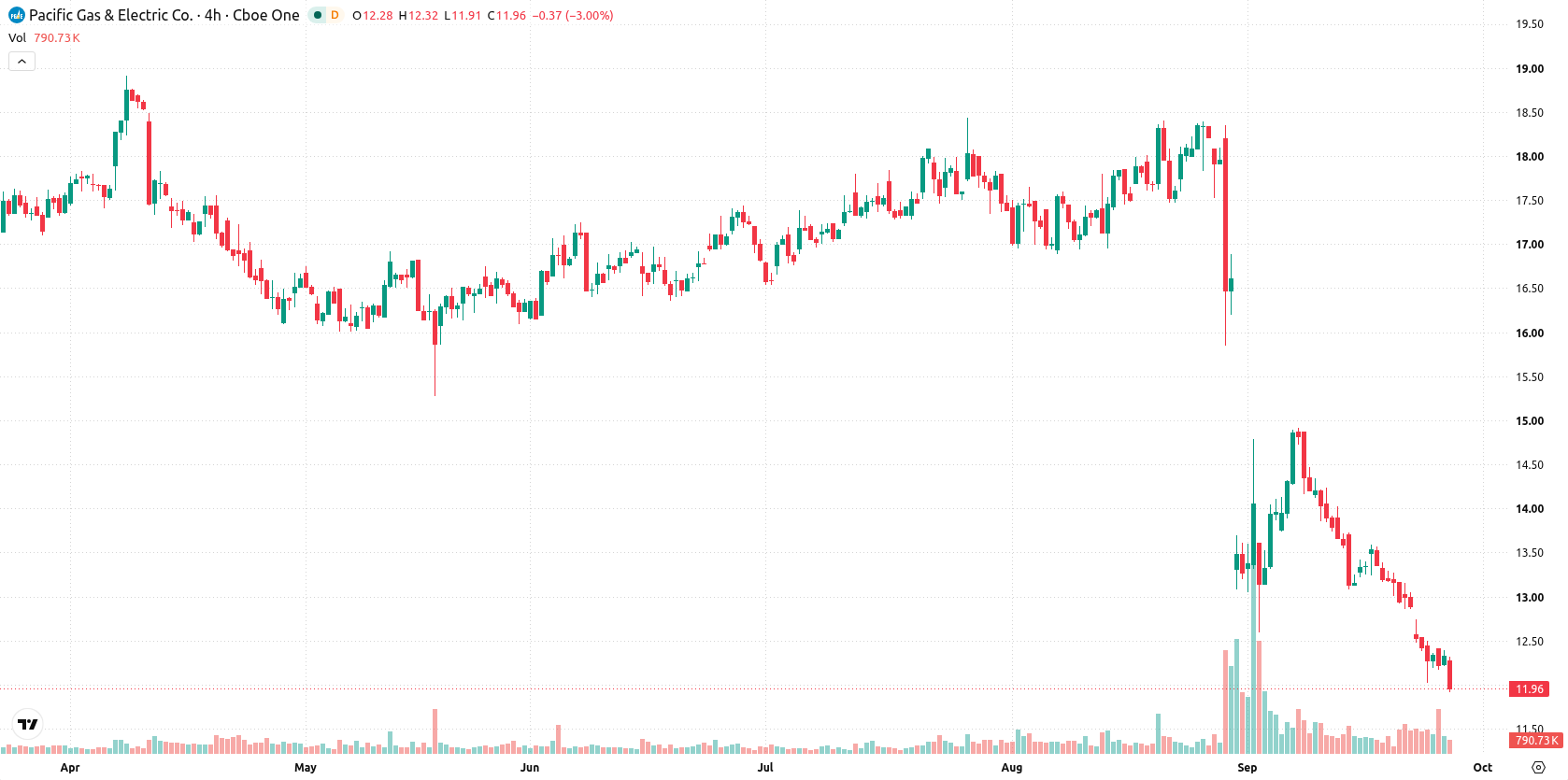
PG&E Corporation (PCG) dropped 3.16% as renewed selling pressure accelerated following its launch of a virtual power plant initiative in California. The move is supported by the fact that PCG remains below major moving averages, highlighting persistent bearish control in the short and medium term.
 13.31
13.40
Highlights
- PG&E is aggregating about 21,000 household devices in California as a virtual power plant to support grid stability and reduce peak demand.
- These devices, including thermostats and batteries, are managed as distributed energy resources under ongoing grid management efforts.
- Shares of PG&E trade at $11.94 after a 3.16% drop, with bearish momentum and a forecasted range of $11.39 to $12.49 over the next five days.
Grid reliability efforts expand as selling persists despite new initiative
PG&E initiated a program in California that uses approximately 21,000 household devices to form a virtual power plant aimed at supporting grid reliability and easing peak demand. These devices, likely including thermostats and batteries, are managed as a distributed energy resource under the company's ongoing grid management and energy sustainability efforts. This development was announced as price action has remained under broader selling pressure.
Bearish momentum deepens as key averages breached and volatility spikes
PG&E remains below the 20-day, 50-day, and 200-day moving averages ($13.6, $16.01, and $16.6), signaling sustained seller dominance across timeframes. The nearest support stands at $11.39, with resistance at $11.95. Momentum indicators are firmly bearish, with both the MACD and ADX suggesting continued downside. The RSI is deeply oversold at 28.01, as confirmed by extremely low Stochastic RSI, CCI, and BBP readings, and negative signals from the Awesome Oscillator. The stock is positioned near its session low with heightened intraday volatility, emphasizing the prevailing downward momentum.
Earlier, analysts noted that PG&E’s unresolved wildfire liabilities and persistent selling pressure kept its outlook bearish. The latest decline and failure to reclaim key moving averages reinforce this negative trend, with any decisive move below $11.39 likely to escalate downside risk in the near term.






Latest PG&E Corporation News



-
 Afghanistan
-
 Albania
-
 Algeria
-
 Angola
-
 Argentina
-
 Armenia
-
 Australia
-
 Austria
-
 Azerbaijan
-
 Bahamas
-
 Bahrain
-
 Bangladesh
-
 Belarus
-
 Belgium
-
 Bolivia
-
 Botswana
-
 Brazil
-
 Brunei
-
 Bulgaria
-
 Cambodia
-
 Cameroon
-
 Canada
-
 Chile
-
 China
-
 Colombia
-
 Congo
-
 Costa Rica
-
 Cote d'Ivoire
-
 Croatia
-
 Cuba
-
 Cyprus
-
 Czechia
-
 DR Congo
-
 Denmark
-
 Dominican Republic
-
 Ecuador
-
 Egypt
-
 El Salvador
-
 Estonia
-
 Eswatini
-
 Ethiopia
-
 Finland
-
 France
-
 Georgia
-
 Germany
-
 Ghana
-
 Greece
-
 Haiti
-
 Hong Kong
-
 Hungary
-
 India
-
 Indonesia
-
 Iran, Islamic republic
-
 Iraq
-
 Ireland
-
 Israel
-
 Italy
-
 Jamaica
-
 Japan
-
 Jordan
-
 Kazakhstan
-
 Kenya
-
 Korea
-
 Kuwait
-
 Kyrgyzstan
-
 Laos
-
 Latvia
-
 Lebanon
-
 Lesotho
-
 Libya
-
 Lithuania
-
 Luxembourg
-
 Madagascar
-
 Malaysia
-
 Malta
-
 Mauritius
-
 Mexico
-
 Moldova
-
 Mongolia
-
 Montenegro
-
 Morocco
-
 Mozambique
-
 Myanmar
-
 Namibia
-
 Nepal
-
 Netherlands
-
 New Zealand
-
 Nigeria
-
 North Macedonia
-
 Norway
-
 Oman
-
 Pakistan
-
 Palestine
-
 Panama
-
 Papua New Guinea
-
 Paraguay
-
 Peru
-
 Philippines
-
 Poland
-
 Portugal
-
 Puerto Rico
-
 Qatar
-
 Reunion
-
 Romania
-
 Rwanda
-
 Saudi Arabia
-
 Serbia
-
 Singapore
-
 Slovakia
-
 Slovenia
-
 Somalia
-
 South Africa
-
 Spain
-
 Sri Lanka
-
 Sweden
-
 Switzerland
-
 Syria
-
 Taiwan
-
 Tajikistan
-
 Tanzania
-
 Thailand
-
 Trinidad and Tobago
-
 Tunisia
-
 Turkey
-
 UAE
-
 Uganda
-
 Ukraine
-
 United Kingdom
-
United States
-
 Uruguay
-
 Uzbekistan
-
 Venezuela
-
 Vietnam
-
 Yemen
-
 Zambia
-
 Zimbabwe
- Forex
- Crypto












