

Barclays to report Q3 2026 earnings: Can BARC avoid deeper losses?

Barclays (BARC) stock is trading at GBX432.1, little changed on the day with a marginal decline. The price remains below its key moving averages, reflecting a persistently weak momentum profile in the near term.
 433.15
440.90
Highlights
- Barclays will announce Q3 2026 earnings before the market opens on October 22, introducing event-driven uncertainty for investors.
- Increased potential for short-term volatility is present as the scheduled earnings date approaches and positioning shifts.
- Shares of Barclays trade below key moving averages with technical signals indicating a bearish bias and a high probability of testing the GBX422.64 to GBX441.56 range.
Event-driven uncertainty heightens as earnings release approaches
Barclays is set to release its Q3 2026 earnings before the market opens on October 22, according to MarketBeat. The upcoming results introduce anticipatory positioning and event-driven uncertainty, as investors may adjust exposures ahead of the announcement. This scheduled earnings report increases the likelihood of short-term volatility as the date approaches.
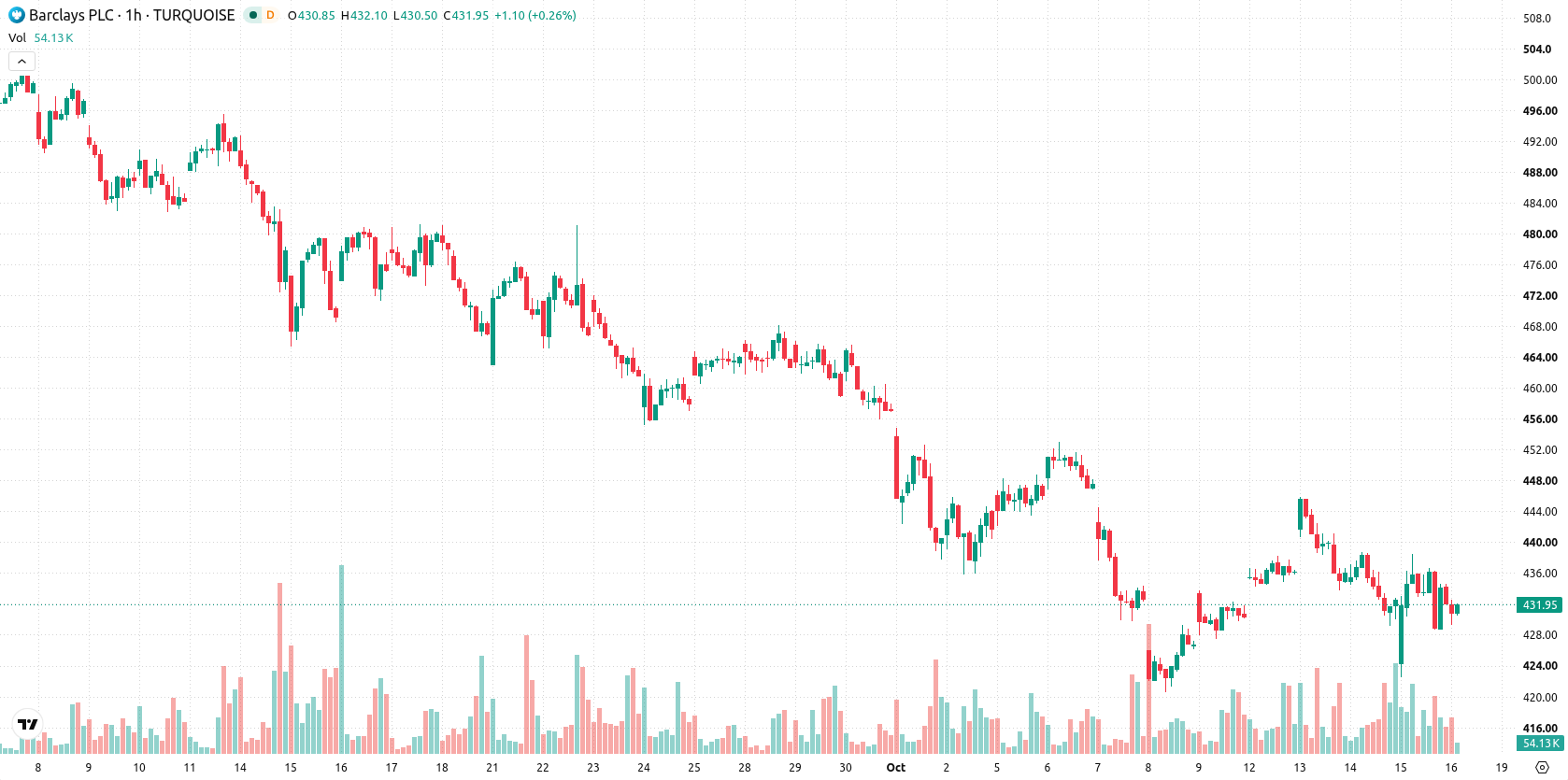
Sell bias confirmed as technical indicators highlight resistance pressure
On the hourly chart, BARC is trading below the MA-20 at GBX433.56 and MA-50 at GBX433.92. On the daily timeframe, price remains well below the MA-200 at GBX466.09, and the Ichimoku Kijun serves as immediate resistance at GBX433.44. Momentum readings are negative, with both the MACD and ADX confirming a sell bias. RSI is at 43.01, the CCI is in sell territory, and the Stoch RSI is neutral, collectively pointing to subdued intraday recovery prospects. Bull/Bear Power indicates sellers remain in control, and the Awesome Oscillator aligns with the current downward momentum.
Downside risks prevail as sideways range caps breakout potential
Over the coming days, BARC is expected to remain within the GBX422.64–GBX441.56 range, aligning with its typical volatility band. The probability of an upward breakout is very low, while downside risk dominates. BARC is likely to trade sideways unless a decisive move above the Kijun resistance occurs, whereas a breakdown below the lower end of the forecast range would signal renewed bearish momentum.
Previously it was reported that Barclays shares continued to face persistent downward pressure amid subdued technical signals. The current analysis reinforces this cautious outlook and highlights the importance of monitoring for any decisive move above the Kijun resistance or a breakdown below the lower end of the established trading range as catalysts for the next direction.











-
 Afghanistan
-
 Albania
-
 Algeria
-
 Angola
-
 Argentina
-
 Armenia
-
 Australia
-
 Austria
-
 Azerbaijan
-
 Bahamas
-
 Bahrain
-
 Bangladesh
-
 Belarus
-
 Belgium
-
 Bolivia
-
 Botswana
-
 Brazil
-
 Brunei
-
 Bulgaria
-
 Cambodia
-
 Cameroon
-
 Canada
-
 Chile
-
 China
-
 Colombia
-
 Congo
-
 Costa Rica
-
 Cote d'Ivoire
-
 Croatia
-
 Cuba
-
 Cyprus
-
 Czechia
-
 DR Congo
-
 Denmark
-
 Dominican Republic
-
 Ecuador
-
 Egypt
-
 El Salvador
-
 Estonia
-
 Eswatini
-
 Ethiopia
-
 Finland
-
 France
-
 Georgia
-
 Germany
-
 Ghana
-
 Greece
-
 Haiti
-
 Hong Kong
-
 Hungary
-
 India
-
 Indonesia
-
 Iran, Islamic republic
-
 Iraq
-
 Ireland
-
 Israel
-
 Italy
-
 Jamaica
-
 Japan
-
 Jordan
-
 Kazakhstan
-
 Kenya
-
 Korea
-
 Kuwait
-
 Kyrgyzstan
-
 Laos
-
 Latvia
-
 Lebanon
-
 Lesotho
-
 Libya
-
 Lithuania
-
 Luxembourg
-
 Madagascar
-
 Malaysia
-
 Malta
-
 Mauritius
-
 Mexico
-
 Moldova
-
 Mongolia
-
 Montenegro
-
 Morocco
-
 Mozambique
-
 Myanmar
-
 Namibia
-
 Nepal
-
 Netherlands
-
 New Zealand
-
 Nigeria
-
 North Macedonia
-
 Norway
-
 Oman
-
 Pakistan
-
 Palestine
-
 Panama
-
 Papua New Guinea
-
 Paraguay
-
 Peru
-
 Philippines
-
 Poland
-
 Portugal
-
 Puerto Rico
-
 Qatar
-
 Reunion
-
 Romania
-
 Rwanda
-
 Saudi Arabia
-
 Serbia
-
 Singapore
-
 Slovakia
-
 Slovenia
-
 Somalia
-
 South Africa
-
 Spain
-
 Sri Lanka
-
 Sweden
-
 Switzerland
-
 Syria
-
 Taiwan
-
 Tajikistan
-
 Tanzania
-
 Thailand
-
 Trinidad and Tobago
-
 Tunisia
-
 Turkey
-
 UAE
-
 Uganda
-
 Ukraine
-
 United Kingdom
-
United States
-
 Uruguay
-
 Uzbekistan
-
 Venezuela
-
 Vietnam
-
 Yemen
-
 Zambia
-
 Zimbabwe
- Forex
- Crypto












