

National Grid stock trades flat as consolidation continues near GBX1,189 support

National Grid (NG) stock is trading at GBX1,190 after a modest decline over the last session. The price currently sits just below its short-term moving averages but remains within range of medium-term levels.
 1216.50
Highlights
- National Grid confirmed its dividend stock designation and committed to a stable dividend policy in an updated regulatory disclosure.
- The company provided new information on network resilience and management communication standards, enhancing operational transparency.
- Shares of National Grid fell 0.29% to GBX1,190 with price expected to consolidate between GBX1,162 and GBX1,217 over the next two to three days.
Investor sentiment stabilizes as dividend policy and resilience outlined
National Grid has released a new regulatory disclosure that covers updates on distribution network resilience, management communication standards, and explicit confirmation of its dividend stock label, according to Kalkinemedia. This assured update increases operational transparency and clarifies the company's ongoing commitment to maintaining a stable dividend policy. Greater visibility on these core areas is likely to underpin general stability in institutional and retail investor sentiment during a period of muted price activity.
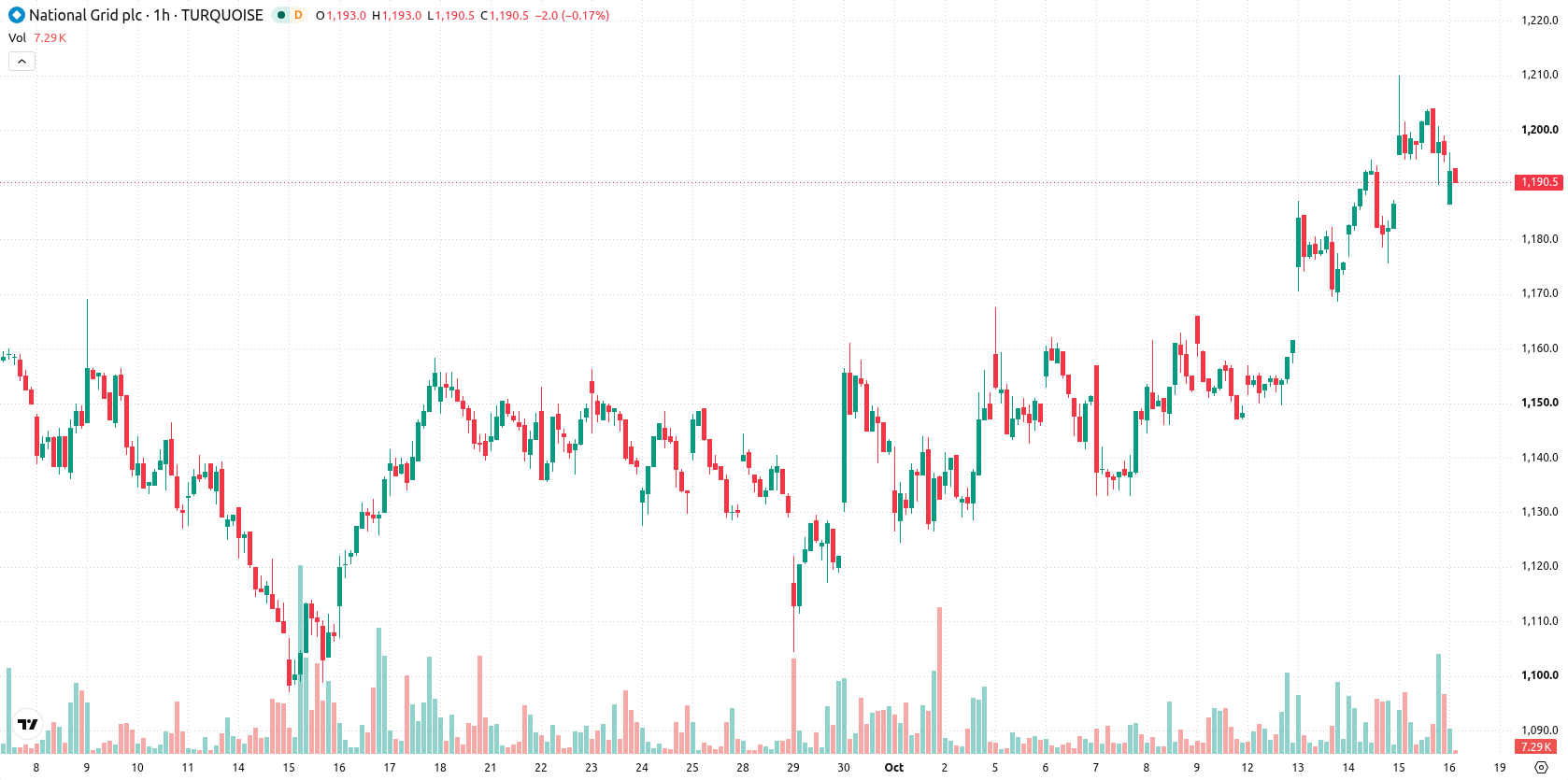
Key moving averages tested amid mixed momentum and diverging signals
Technical levels show NG is sitting just below the MA-20 at GBX1,192, with immediate support from the Ichimoku Kijun at GBX1,189. The stock remains above the MA-50 at GBX1,173 on the hourly chart, while longer-term structure is capped by the MA-200 at GBX1,235. Momentum indicators paint a mixed picture: MACD signals a strong buy and ADX points to continued buying interest, yet oscillators diverge as RSI shows buying but Stoch RSI and Bull/Bear Power register oversold reads, with CCI flat and the Awesome Oscillator neutral.
Consolidation favored as upside probability outweighs downside risk
In the near term, NG is expected to consolidate within a volatility band between GBX1,162 and GBX1,217. The probability of an upward move is 70%, while a downward breakout is less likely at 30%. Price action is most likely to range within this corridor unless there is a clear move above resistance or a slip beneath immediate support.
Earlier, analysts noted that National Grid’s regulatory disclosures and strong technical signals supported a positive outlook, despite mixed momentum indicators. The latest update on network resilience and dividend policy adds further transparency, making the GBX1,217 resistance level the key point to monitor for any breakout from the current consolidation range.





Latest National Grid News



-
 Afghanistan
-
 Albania
-
 Algeria
-
 Angola
-
 Argentina
-
 Armenia
-
 Australia
-
 Austria
-
 Azerbaijan
-
 Bahamas
-
 Bahrain
-
 Bangladesh
-
 Belarus
-
 Belgium
-
 Bolivia
-
 Botswana
-
 Brazil
-
 Brunei
-
 Bulgaria
-
 Cambodia
-
 Cameroon
-
 Canada
-
 Chile
-
 China
-
 Colombia
-
 Congo
-
 Costa Rica
-
 Cote d'Ivoire
-
 Croatia
-
 Cuba
-
 Cyprus
-
 Czechia
-
 DR Congo
-
 Denmark
-
 Dominican Republic
-
 Ecuador
-
 Egypt
-
 El Salvador
-
 Estonia
-
 Eswatini
-
 Ethiopia
-
 Finland
-
 France
-
 Georgia
-
 Germany
-
 Ghana
-
 Greece
-
 Haiti
-
 Hong Kong
-
 Hungary
-
 India
-
 Indonesia
-
 Iran, Islamic republic
-
 Iraq
-
 Ireland
-
 Israel
-
 Italy
-
 Jamaica
-
 Japan
-
 Jordan
-
 Kazakhstan
-
 Kenya
-
 Korea
-
 Kuwait
-
 Kyrgyzstan
-
 Laos
-
 Latvia
-
 Lebanon
-
 Lesotho
-
 Libya
-
 Lithuania
-
 Luxembourg
-
 Madagascar
-
 Malaysia
-
 Malta
-
 Mauritius
-
 Mexico
-
 Moldova
-
 Mongolia
-
 Montenegro
-
 Morocco
-
 Mozambique
-
 Myanmar
-
 Namibia
-
 Nepal
-
 Netherlands
-
 New Zealand
-
 Nigeria
-
 North Macedonia
-
 Norway
-
 Oman
-
 Pakistan
-
 Palestine
-
 Panama
-
 Papua New Guinea
-
 Paraguay
-
 Peru
-
 Philippines
-
 Poland
-
 Portugal
-
 Puerto Rico
-
 Qatar
-
 Reunion
-
 Romania
-
 Rwanda
-
 Saudi Arabia
-
 Serbia
-
 Singapore
-
 Slovakia
-
 Slovenia
-
 Somalia
-
 South Africa
-
 Spain
-
 Sri Lanka
-
 Sweden
-
 Switzerland
-
 Syria
-
 Taiwan
-
 Tajikistan
-
 Tanzania
-
 Thailand
-
 Trinidad and Tobago
-
 Tunisia
-
 Turkey
-
 UAE
-
 Uganda
-
 Ukraine
-
 United Kingdom
-
United States
-
 Uruguay
-
 Uzbekistan
-
 Venezuela
-
 Vietnam
-
 Yemen
-
 Zambia
-
 Zimbabwe
- Forex
- Crypto












