

Will AgEagle stock hold above $0.28 support amid continued seller pressure?

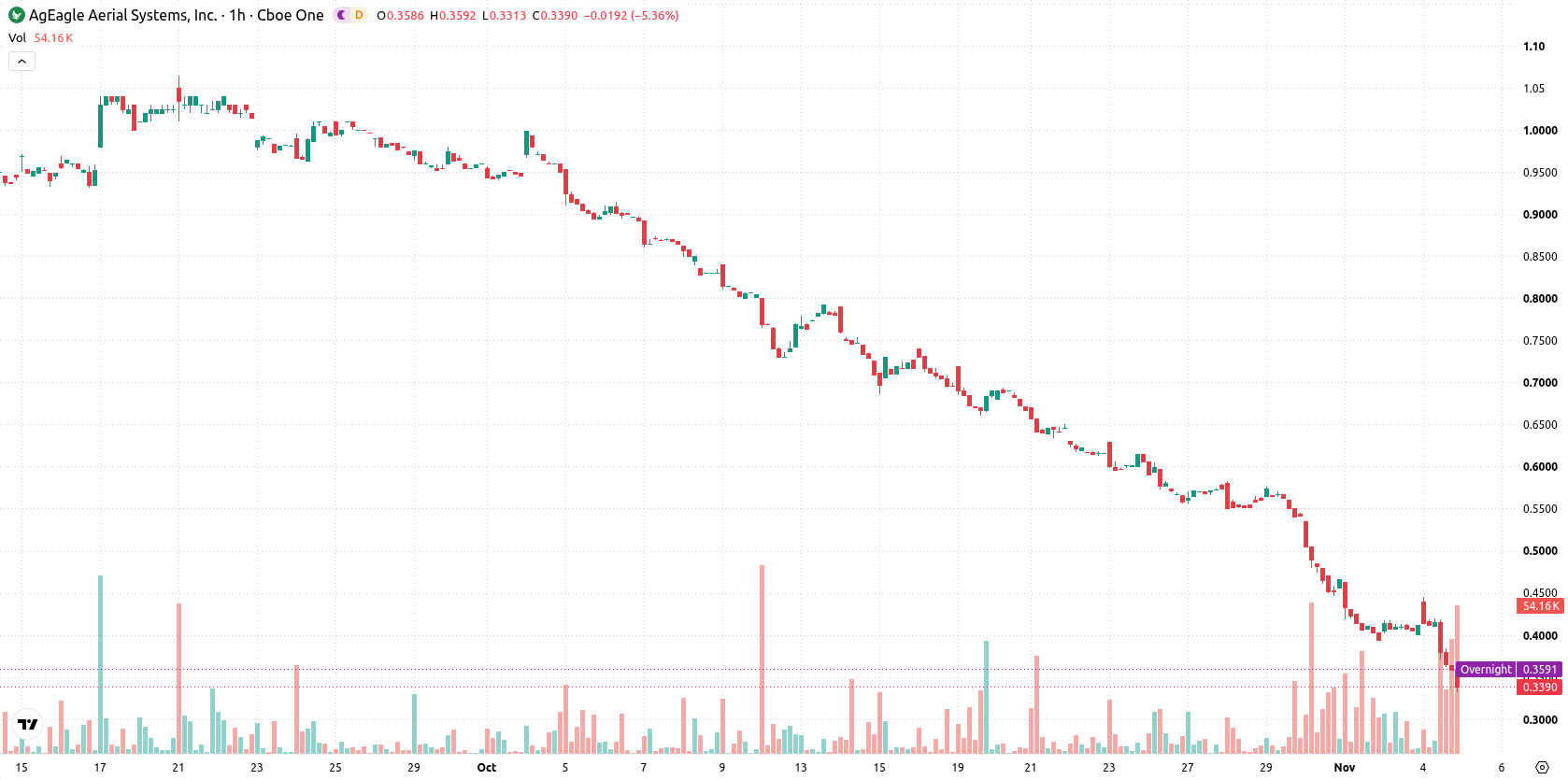
AgEagle (UAVS) stock is trading at $0.3461 after a sharp daily drop of 15.97%. The price remains below its key moving averages, indicating downward pressure from recent sessions.
 0.3698
0.4180
Highlights
- UAVS/USD trades below all key moving averages, showing sustained downside pressure across short and long timeframes.
- Momentum indicators are deeply oversold and consistently bearish, although persistent downside readings suggest a possible short-term rebound.
- For the next 2 to 3 trading days, price is expected to move in a $0.28 to $0.42 range, with further downside much more probable than upside.
Oversold momentum and resistance cap further downside risk
On the technical front, UAVS/USD is trading below the MA-20 at $0.40 and MA-50 at $0.48 on the hourly chart, with the long-term MA-200 at $0.95 overhead. The Ichimoku Kijun sits at $0.41, acting as immediate resistance. Momentum indicators remain broadly negative: MACD and ADX both confirm prevailing selling pressure, while RSI, Stochastic RSI, and CCI all register in oversold positions. Bull/Bear Power is negative at -0.03 on an intraday basis, and the Awesome Oscillator continues to signal a downtrend. Persistent oversold readings from the oscillators advise caution regarding further downside in the immediate term.
Neutral consolidation forecast as breakout levels approach
Looking ahead to the next two to three trading days, the projected price range for UAVS is $0.28 to $0.42, based on typical volatility. The baseline expectation is for the stock to consolidate within this band. A break above $0.41 could prompt a short-term rebound, while a decline below $0.28 would likely increase selling momentum and open the door for further losses.
Earlier, analysts noted that AgEagle was experiencing persistent bearish momentum with little indication of sustained recovery. The latest analysis reinforces this outlook, with new technical signals suggesting traders should closely monitor the $0.28 level as a potential trigger for increased downside risk in the near term.










-
 Afghanistan
-
 Albania
-
 Algeria
-
 Angola
-
 Argentina
-
 Armenia
-
 Australia
-
 Austria
-
 Azerbaijan
-
 Bahamas
-
 Bahrain
-
 Bangladesh
-
 Belarus
-
 Belgium
-
 Bolivia
-
 Botswana
-
 Brazil
-
 Brunei
-
 Bulgaria
-
 Cambodia
-
 Cameroon
-
 Canada
-
 Chile
-
 China
-
 Colombia
-
 Congo
-
 Costa Rica
-
 Cote d'Ivoire
-
 Croatia
-
 Cuba
-
 Cyprus
-
 Czechia
-
 DR Congo
-
 Denmark
-
 Dominican Republic
-
 Ecuador
-
 Egypt
-
 El Salvador
-
 Estonia
-
 Eswatini
-
 Ethiopia
-
 Finland
-
 France
-
 Georgia
-
 Germany
-
 Ghana
-
 Greece
-
 Haiti
-
 Hong Kong
-
 Hungary
-
 India
-
 Indonesia
-
 Iran, Islamic republic
-
 Iraq
-
 Ireland
-
 Israel
-
 Italy
-
 Jamaica
-
 Japan
-
 Jordan
-
 Kazakhstan
-
 Kenya
-
 Korea
-
 Kuwait
-
 Kyrgyzstan
-
 Laos
-
 Latvia
-
 Lebanon
-
 Lesotho
-
 Libya
-
 Lithuania
-
 Luxembourg
-
 Madagascar
-
 Malaysia
-
 Malta
-
 Mauritius
-
 Mexico
-
 Moldova
-
 Mongolia
-
 Montenegro
-
 Morocco
-
 Mozambique
-
 Myanmar
-
 Namibia
-
 Nepal
-
 Netherlands
-
 New Zealand
-
 Nigeria
-
 North Macedonia
-
 Norway
-
 Oman
-
 Pakistan
-
 Palestine
-
 Panama
-
 Papua New Guinea
-
 Paraguay
-
 Peru
-
 Philippines
-
 Poland
-
 Portugal
-
 Puerto Rico
-
 Qatar
-
 Reunion
-
 Romania
-
 Rwanda
-
 Saudi Arabia
-
 Serbia
-
 Singapore
-
 Slovakia
-
 Slovenia
-
 Somalia
-
 South Africa
-
 Spain
-
 Sri Lanka
-
 Sweden
-
 Switzerland
-
 Syria
-
 Taiwan
-
 Tajikistan
-
 Tanzania
-
 Thailand
-
 Trinidad and Tobago
-
 Tunisia
-
 Turkey
-
 UAE
-
 Uganda
-
 Ukraine
-
 United Kingdom
-
United States
-
 Uruguay
-
 Uzbekistan
-
 Venezuela
-
 Vietnam
-
 Yemen
-
 Zambia
-
 Zimbabwe
- Forex
- Crypto












