


Lockheed Martin Corporation (LMT) jumped 3.69% as traders positioned around potential shifts in defense spending, even as ongoing U.S. budget uncertainty weighs on the broader outlook. The up move looks limited, with the MA-50 remaining below the MA-200 and nearby resistance capping further gains.
Highlights
- Lockheed Martin faces risk to revenue growth as potential U.S. defense budget cuts could reduce allocations for key programs.
- The company depends heavily on government contracts but maintains some stability with multiyear agreements and a 24th consecutive annual dividend increase.
- Shares of Lockheed Martin trade in a bullish structure above key averages, with a near-term range of $545.71 to $630.2 and mixed momentum signals.
Revenue growth risks rise amid budget cuts and contract reliance
Lockheed Martin faces uncertainty due to possible reductions in the U.S. defense budget, as President Trump's proposed $1.5 trillion allocation faces resistance and may ultimately be reduced to $1 trillion. Revenue growth risk is heightened for Lockheed Martin as it relies heavily on government contracts, such as the F-35 Lightning II program. The company maintains a buffer with multiyear contract protections and has achieved a 24th consecutive annual dividend increase.
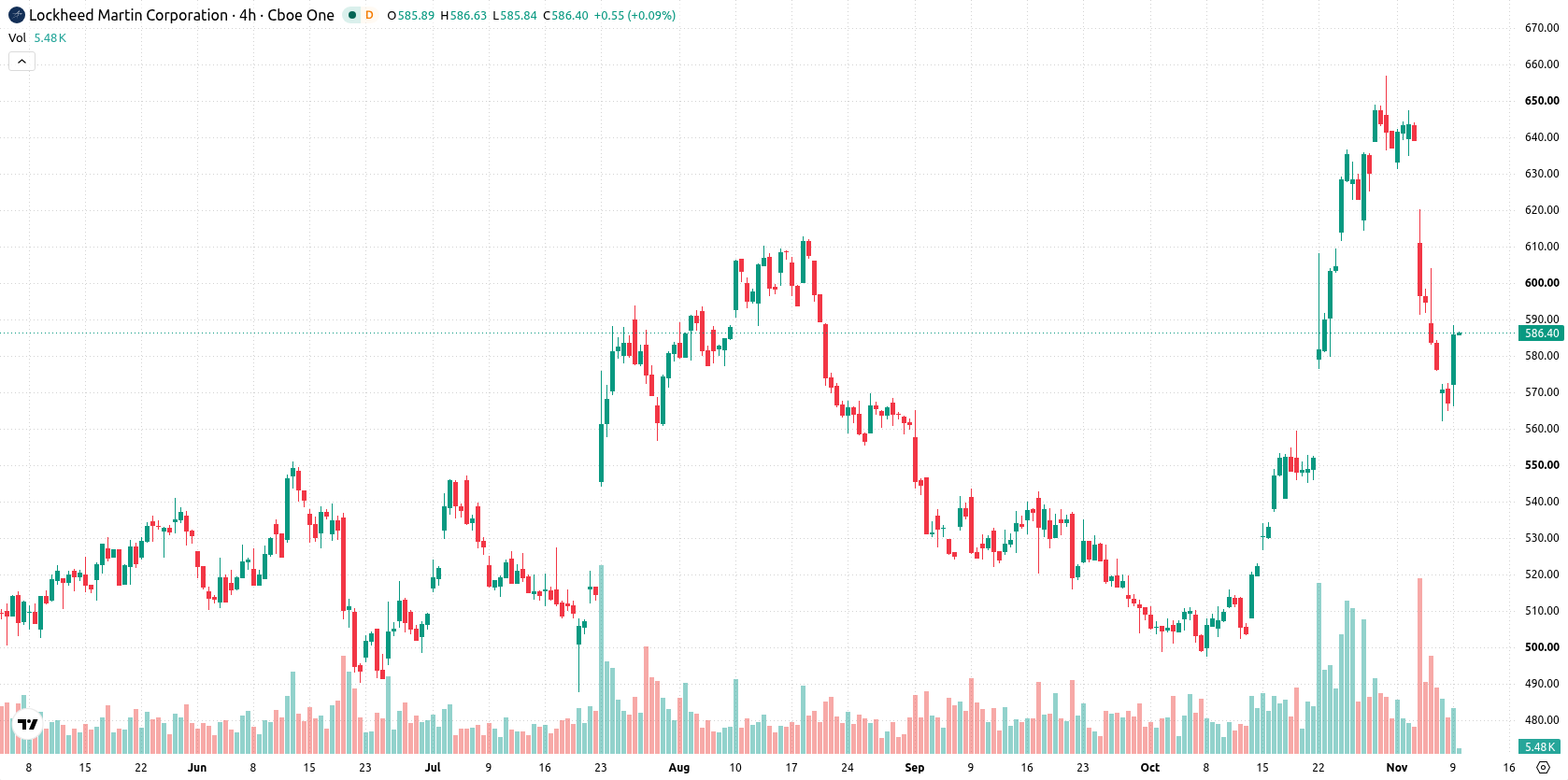
Bullish trading above averages as momentum and trend signals diverge
Lockheed Martin is trading above its 20-day, 50-day, and 200-day moving averages ($582.83, $548.21, $568.93), indicating bullish structure for short-, medium-, and longer-term trends. For the near term, the closest support is at $582.83, with resistance at $588.46. The MA-50 remains below the MA-200, highlighting some longer-term caution. Momentum signals are mixed: the MACD indicates strong upside momentum, but the Average Directional Index (ADX) reflects weak trend strength. Relative Strength Index (RSI) is neutral, as are the Commodity Channel Index (CCI) and Awesome Oscillator. The Stochastic RSI sits in the oversold zone. Bull/Bear Power (BBP) is negative, reflecting intraday seller dominance. The price is near the high of its intraday range, with volatility at 3.78%. Intraday action is strongly upward, yet overall momentum signals remain mixed.
Previously it was reported that Lockheed Martin’s technical outlook was mixed, with bullish potential hinging on the ability to overcome key resistance amid evolving defense sector developments. The current analysis adds that near-term market direction remains uncertain due to persistent budget risks and mixed momentum signals, making continued consolidation the prevailing scenario to monitor.






Latest Lockheed Martin News




-
 Afghanistan
-
 Albania
-
 Algeria
-
 Angola
-
 Argentina
-
 Armenia
-
 Australia
-
 Austria
-
 Azerbaijan
-
 Bahamas
-
 Bahrain
-
 Bangladesh
-
 Belarus
-
 Belgium
-
 Bolivia
-
 Botswana
-
 Brazil
-
 Brunei
-
 Bulgaria
-
 Cambodia
-
 Cameroon
-
 Canada
-
 Chile
-
 China
-
 Colombia
-
 Congo
-
 Costa Rica
-
 Cote d'Ivoire
-
 Croatia
-
 Cuba
-
 Cyprus
-
 Czechia
-
 DR Congo
-
 Denmark
-
 Dominican Republic
-
 Ecuador
-
 Egypt
-
 El Salvador
-
 Estonia
-
 Eswatini
-
 Ethiopia
-
 Finland
-
 France
-
 Georgia
-
 Germany
-
 Ghana
-
 Greece
-
 Haiti
-
 Hong Kong
-
 Hungary
-
 India
-
 Indonesia
-
 Iran, Islamic republic
-
 Iraq
-
 Ireland
-
 Israel
-
 Italy
-
 Jamaica
-
 Japan
-
 Jordan
-
 Kazakhstan
-
 Kenya
-
 Korea
-
 Kuwait
-
 Kyrgyzstan
-
 Laos
-
 Latvia
-
 Lebanon
-
 Lesotho
-
 Libya
-
 Lithuania
-
 Luxembourg
-
 Madagascar
-
 Malaysia
-
 Malta
-
 Mauritius
-
 Mexico
-
 Moldova
-
 Mongolia
-
 Montenegro
-
 Morocco
-
 Mozambique
-
 Myanmar
-
 Namibia
-
 Nepal
-
 Netherlands
-
 New Zealand
-
 Nigeria
-
 North Macedonia
-
 Norway
-
 Oman
-
 Pakistan
-
 Palestine
-
 Panama
-
 Papua New Guinea
-
 Paraguay
-
 Peru
-
 Philippines
-
 Poland
-
 Portugal
-
 Puerto Rico
-
 Qatar
-
 Reunion
-
 Romania
-
 Rwanda
-
 Saudi Arabia
-
 Serbia
-
 Singapore
-
 Slovakia
-
 Slovenia
-
 Somalia
-
 South Africa
-
 Spain
-
 Sri Lanka
-
 Sweden
-
 Switzerland
-
 Syria
-
 Taiwan
-
 Tajikistan
-
 Tanzania
-
 Thailand
-
 Trinidad and Tobago
-
 Tunisia
-
 Turkey
-
 UAE
-
 Uganda
-
 Ukraine
-
 United Kingdom
-
United States
-
 Uruguay
-
 Uzbekistan
-
 Venezuela
-
 Vietnam
-
 Yemen
-
 Zambia
-
 Zimbabwe
- Forex
- Crypto












