

Hotter consumer prices keep Apple under pressure through interest rate and funding cost risks

Apple (AAPL) stock is trading higher as of November 11, 2026, amid renewed concerns around interest rates following a hotter-than-expected inflation reading in the US. Elevated inflation and the increased likelihood of further Federal Reserve rate hikes have put funding costs and equity valuations, including for AAPL, in focus. Traders are watching upcoming US data and policy commentary for further direction.
 360.83
Highlights
- US consumer prices rose 0.4% in October 2026, surpassing forecasts and reinforcing ongoing inflation pressures before the Federal Reserve meeting.
- A higher-than-expected inflation reading increases the likelihood of a Fed rate hike, which can pressure interest-rate-sensitive stocks such as Apple.
- A bullish technical setup remains intact for Apple stock above $340 support, but persistent inflation or Fed tightening could trigger downside risk.
US inflation beats expectations, Fed hike risk rises
According to Investing.com, US consumer prices rose 0.4% in October 2026, exceeding economists' expectations and suggesting inflationary pressures remain elevated ahead of the Federal Reserve's next policy meeting.
A stronger-than-expected inflation outcome increases the odds of an imminent Fed rate hike, which typically raises funding costs and dampens valuations for interest-rate-sensitive equities such as Apple. The resultant risk channel centers on tighter financial conditions rather than company-specific news or operations.
While the current setup does not confirm immediate impact on AAPL, the prospect of higher rates acts as a macro headwind and warrants close monitoring should inflationary surprises persist.
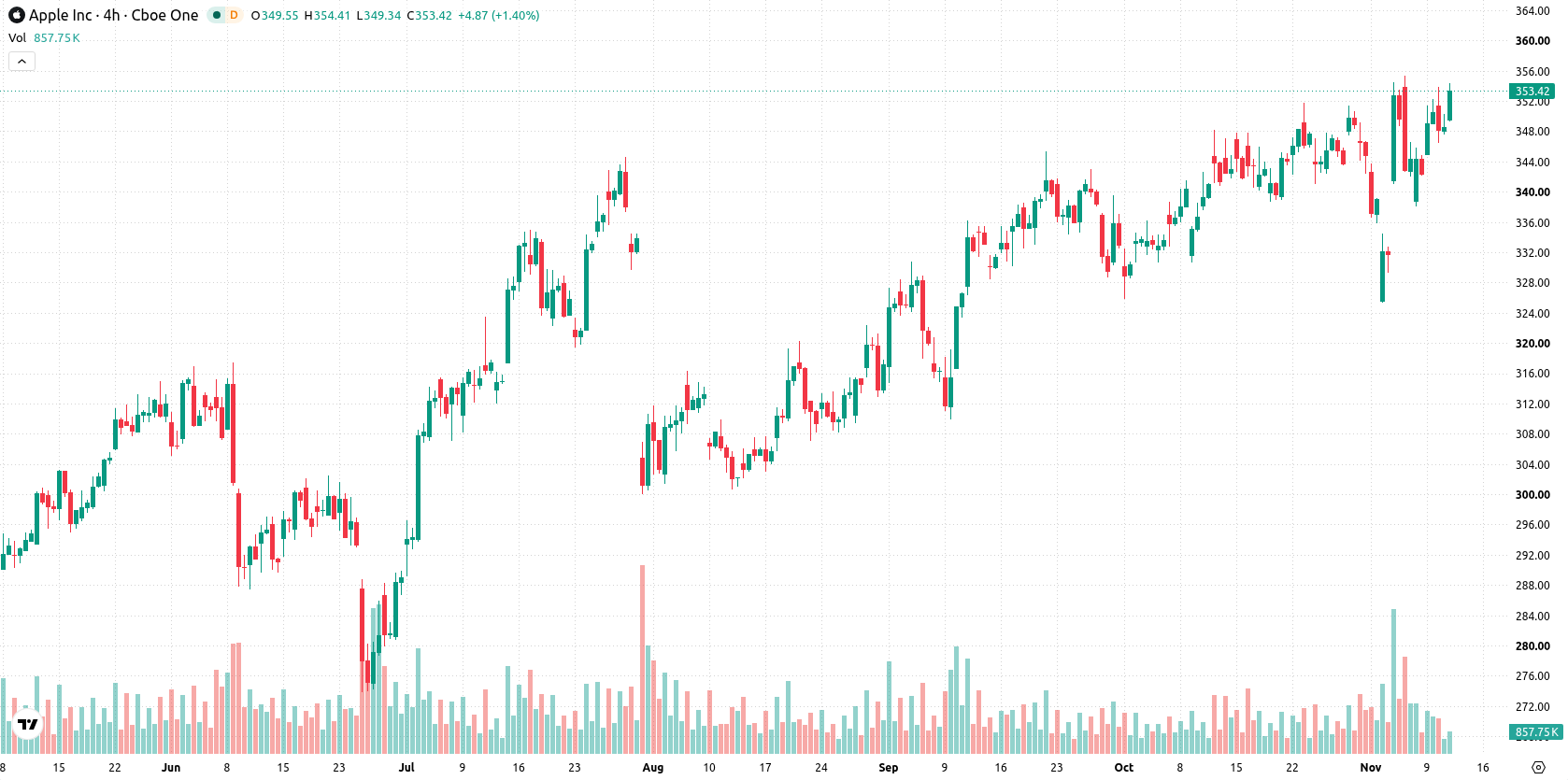
AAPL stays above 4H Kijun and daily SMAs despite policy risk
On the 4H chart, the price remains above major daily moving averages, reflecting recent bullish momentum despite the macro risk environment. Technical posture aligns with an optimistic undertone as AAPL continues to hold above longer-term support zones.
The MACD signals a buy bias on the 4H timeframe, while the Kijun (H4) at $340 provides near-term support. D1 SMAs underpin the trend as prices trade above both the 50- and 200-period averages.
US macro data and Fed policy to determine next directional shift
Further inflation surprises or confirmed Fed tightening would likely add downward pressure to growth equities, but stabilization around $340 could act as an initial support zone for AAPL. Monitoring US inflation data and Federal Reserve statements remains key. A sustained move below the H4 Kijun would challenge the current technical setup, while holding above this level increases prospects for continued bullish momentum.
Earlier, analysts noted that Apple maintained technical resilience despite supply chain scrutiny and macroeconomic headwinds. The current analysis adds a macro-driven angle, emphasizing that the outlook for AAPL now hinges on upcoming US inflation data and Federal Reserve policy signals.











-
 Afghanistan
-
 Albania
-
 Algeria
-
 Angola
-
 Argentina
-
 Armenia
-
 Australia
-
 Austria
-
 Azerbaijan
-
 Bahamas
-
 Bahrain
-
 Bangladesh
-
 Belarus
-
 Belgium
-
 Bolivia
-
 Botswana
-
 Brazil
-
 Brunei
-
 Bulgaria
-
 Cambodia
-
 Cameroon
-
 Canada
-
 Chile
-
 China
-
 Colombia
-
 Congo
-
 Costa Rica
-
 Cote d'Ivoire
-
 Croatia
-
 Cuba
-
 Cyprus
-
 Czechia
-
 DR Congo
-
 Denmark
-
 Dominican Republic
-
 Ecuador
-
 Egypt
-
 El Salvador
-
 Estonia
-
 Eswatini
-
 Ethiopia
-
 Finland
-
 France
-
 Georgia
-
 Germany
-
 Ghana
-
 Greece
-
 Haiti
-
 Hong Kong
-
 Hungary
-
 India
-
 Indonesia
-
 Iran, Islamic republic
-
 Iraq
-
 Ireland
-
 Israel
-
 Italy
-
 Jamaica
-
 Japan
-
 Jordan
-
 Kazakhstan
-
 Kenya
-
 Korea
-
 Kuwait
-
 Kyrgyzstan
-
 Laos
-
 Latvia
-
 Lebanon
-
 Lesotho
-
 Libya
-
 Lithuania
-
 Luxembourg
-
 Madagascar
-
 Malaysia
-
 Malta
-
 Mauritius
-
 Mexico
-
 Moldova
-
 Mongolia
-
 Montenegro
-
 Morocco
-
 Mozambique
-
 Myanmar
-
 Namibia
-
 Nepal
-
 Netherlands
-
 New Zealand
-
 Nigeria
-
 North Macedonia
-
 Norway
-
 Oman
-
 Pakistan
-
 Palestine
-
 Panama
-
 Papua New Guinea
-
 Paraguay
-
 Peru
-
 Philippines
-
 Poland
-
 Portugal
-
 Puerto Rico
-
 Qatar
-
 Reunion
-
 Romania
-
 Rwanda
-
 Saudi Arabia
-
 Serbia
-
 Singapore
-
 Slovakia
-
 Slovenia
-
 Somalia
-
 South Africa
-
 Spain
-
 Sri Lanka
-
 Sweden
-
 Switzerland
-
 Syria
-
 Taiwan
-
 Tajikistan
-
 Tanzania
-
 Thailand
-
 Trinidad and Tobago
-
 Tunisia
-
 Turkey
-
 UAE
-
 Uganda
-
 Ukraine
-
 United Kingdom
-
United States
-
 Uruguay
-
 Uzbekistan
-
 Venezuela
-
 Vietnam
-
 Yemen
-
 Zambia
-
 Zimbabwe
- Forex
- Crypto












