

Tougher U.S. export controls keep Nvidia exposed to global policy risks, with international chip revenue vulnerable

Nvidia (NVDA) stock is trading lower, with regulatory risks in focus after fresh U.S. government action. The main driver is the U.S. Commerce Department's announcement of tighter export controls on advanced computing goods, which directly impacts Nvidia's ability to supply chips to key international markets. Traders are watching for further U.S. policy moves and possible retaliation from China.
 161.38
177.53
Highlights
- The U.S. Commerce Department imposed stricter export controls on advanced semiconductor technology, restricting Nvidia's chip sales to China and other foreign actors.
- These regulatory barriers introduce revenue uncertainty for Nvidia and may prompt affected markets to pursue domestic semiconductor alternatives.
- Nvidia stock trades below key moving averages with oversold momentum indicators, and $183 serves as initial resistance amid ongoing external policy risks.
U.S. export controls restrict Nvidia’s global chip sales
According to CNBC, the U.S. Commerce Department on November 16, 2026, announced updated rules tightening export controls on advanced computing power, specifically aimed at restricting certain foreign actors—most notably China—from accessing high-performance U.S. semiconductor technology. These measures directly affect Nvidia's scope for advanced chip exports outside the U.S., targeting a major revenue stream.
The newly announced rules act as a regulatory barrier, limiting NVDA's access to some of the world's largest chip markets and reducing its ability to serve demand from clients in China. The change increases unpredictability in near- and mid-term global sales and may lead to shifts in supply chains as customers outside the U.S. seek alternatives.
While the specific impact will depend on the duration and enforcement of these rules, uncertainties remain around how China or other affected markets might respond, including possible countermeasures or acceleration of domestic semiconductor programs. These policy risks will remain relevant for NVDA's international growth outlook.
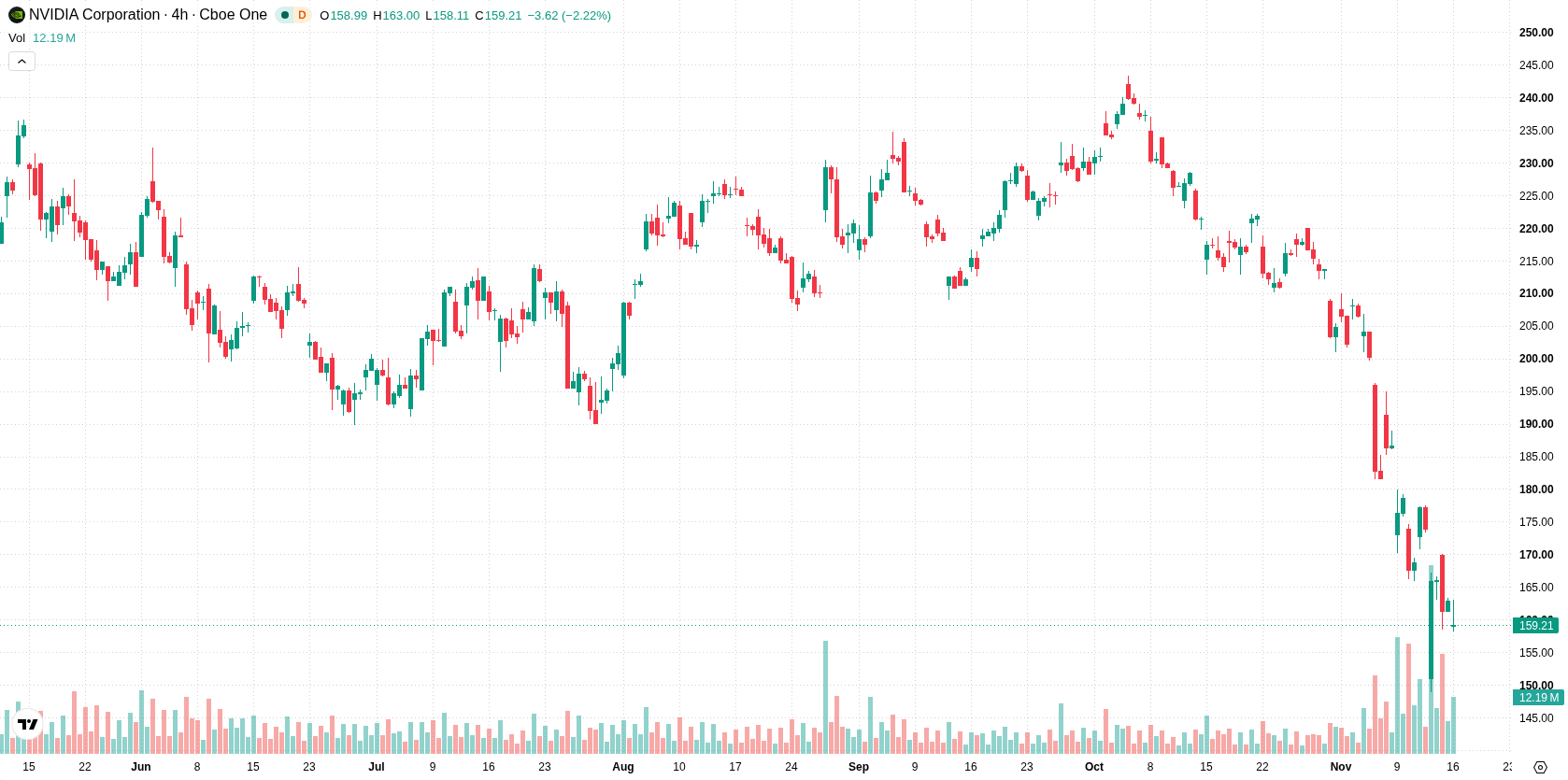
NVDA below key moving averages with oversold RSI
Technical analysis of the 4H chart shows NVDA trading below the D1 SMA-50 at $214.67 and the D1 SMA-200 at $204.19, signaling a bearish longer-term positioning. The price is also beneath the H4 SMA-20 at $180.79, indicating a loss of short-term momentum.
The RSI is deeply oversold at 26.04, while both MACD and ADX point to continued selling pressure, aligning with the broader downtrend. The H4 Kijun line at $183 stands as overhead resistance.
Further policy actions or easing to drive next move
The outlook for NVDA stock is highly sensitive to evolving U.S. export controls and any escalation in regulatory tension with China. A sustained move above the Kijun resistance around $183 could offer initial signs of stabilization. However, the external policy environment remains the key risk, and ongoing monitoring of both U.S. and Chinese responses is essential for direction.
Previously it was reported that retail traders had taken a notably bearish stance on Nvidia ahead of its earnings, with options activity signaling expectations of heightened volatility. The latest regulatory developments deepen the uncertainty around Nvidia, making future performance increasingly dependent on how U.S. export controls and potential responses from China unfold.






Latest NVIDIA News





-
 Afghanistan
-
 Albania
-
 Algeria
-
 Angola
-
 Argentina
-
 Armenia
-
 Australia
-
 Austria
-
 Azerbaijan
-
 Bahamas
-
 Bahrain
-
 Bangladesh
-
 Belarus
-
 Belgium
-
 Bolivia
-
 Botswana
-
 Brazil
-
 Brunei
-
 Bulgaria
-
 Cambodia
-
 Cameroon
-
 Canada
-
 Chile
-
 China
-
 Colombia
-
 Congo
-
 Costa Rica
-
 Cote d'Ivoire
-
 Croatia
-
 Cuba
-
 Cyprus
-
 Czechia
-
 DR Congo
-
 Denmark
-
 Dominican Republic
-
 Ecuador
-
 Egypt
-
 El Salvador
-
 Estonia
-
 Eswatini
-
 Ethiopia
-
 Finland
-
 France
-
 Georgia
-
 Germany
-
 Ghana
-
 Greece
-
 Haiti
-
 Hong Kong
-
 Hungary
-
 India
-
 Indonesia
-
 Iran, Islamic republic
-
 Iraq
-
 Ireland
-
 Israel
-
 Italy
-
 Jamaica
-
 Japan
-
 Jordan
-
 Kazakhstan
-
 Kenya
-
 Korea
-
 Kuwait
-
 Kyrgyzstan
-
 Laos
-
 Latvia
-
 Lebanon
-
 Lesotho
-
 Libya
-
 Lithuania
-
 Luxembourg
-
 Madagascar
-
 Malaysia
-
 Malta
-
 Mauritius
-
 Mexico
-
 Moldova
-
 Mongolia
-
 Montenegro
-
 Morocco
-
 Mozambique
-
 Myanmar
-
 Namibia
-
 Nepal
-
 Netherlands
-
 New Zealand
-
 Nigeria
-
 North Macedonia
-
 Norway
-
 Oman
-
 Pakistan
-
 Palestine
-
 Panama
-
 Papua New Guinea
-
 Paraguay
-
 Peru
-
 Philippines
-
 Poland
-
 Portugal
-
 Puerto Rico
-
 Qatar
-
 Reunion
-
 Romania
-
 Rwanda
-
 Saudi Arabia
-
 Serbia
-
 Singapore
-
 Slovakia
-
 Slovenia
-
 Somalia
-
 South Africa
-
 Spain
-
 Sri Lanka
-
 Sweden
-
 Switzerland
-
 Syria
-
 Taiwan
-
 Tajikistan
-
 Tanzania
-
 Thailand
-
 Trinidad and Tobago
-
 Tunisia
-
 Turkey
-
 UAE
-
 Uganda
-
 Ukraine
-
 United Kingdom
-
United States
-
 Uruguay
-
 Uzbekistan
-
 Venezuela
-
 Vietnam
-
 Yemen
-
 Zambia
-
 Zimbabwe
- Forex
- Crypto












