

Shell slips after US inflation tops forecasts, tightening financial conditions for equities

Shell (SHEL) stock is trading lower as of November 16, 2026, amid pressure from shifting macro policy risks. Higher-than-expected US inflation has prompted concerns around the cost of capital, making US central bank policy signals a key focus for market participants.
 3740.50
Highlights
- Short-term US Treasury yields saw their largest rise in 19 months after US consumer inflation surpassed forecasts, increasing the likelihood of more Federal Reserve interest rate hikes.
- The resulting surge in yields has pressured global equities and raised funding costs, with SHEL stock affected mainly through global cost of capital changes.
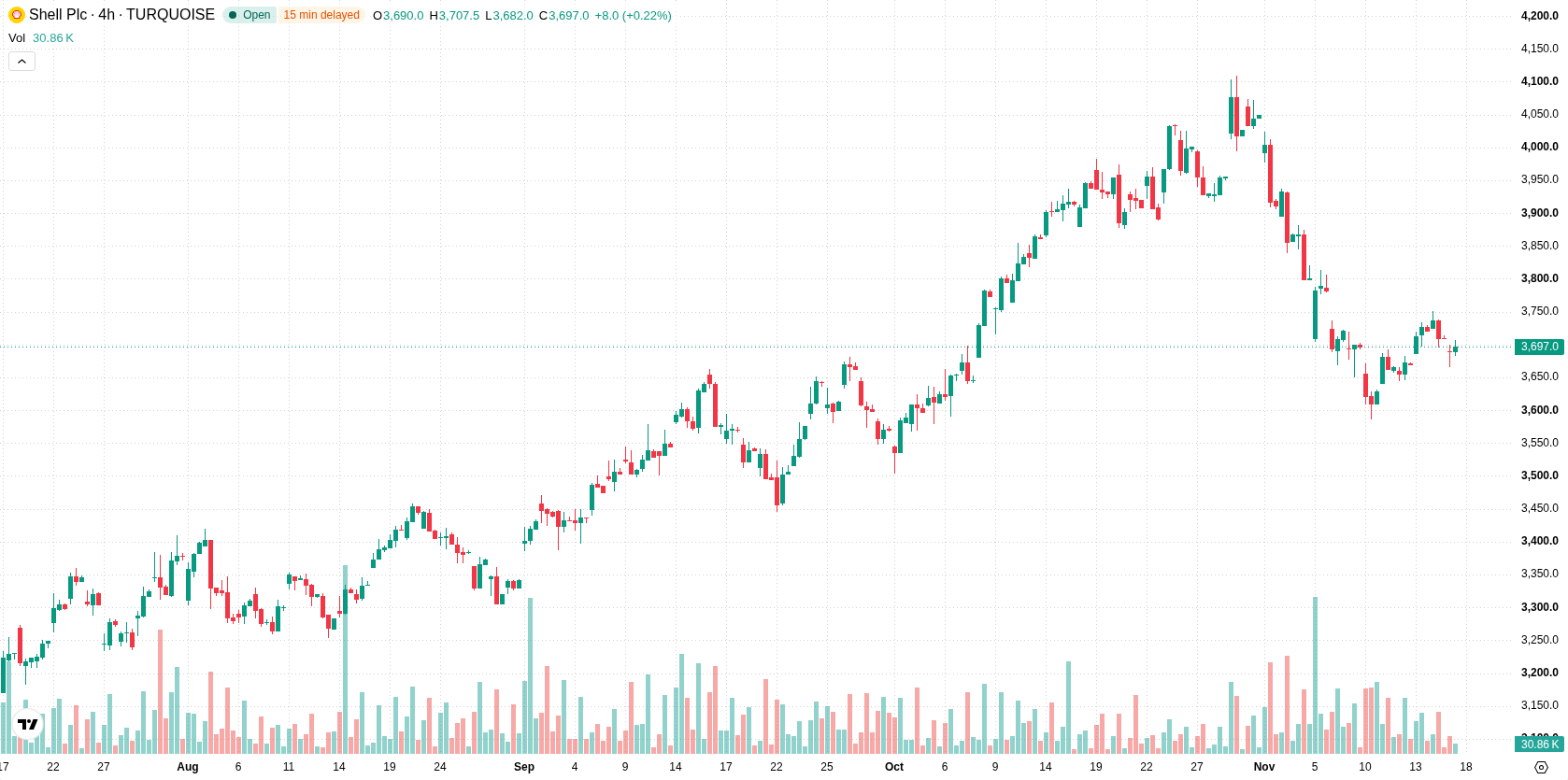
- SHEL stock remains in a corrective phase with downside momentum, trading below key resistance near GBX3,728 and support at GBX3,334.
US inflation surprise sparks Treasury yield surge and equity pressure
According to Bloomberg, on November 10, 2026, short-term US Treasury yields recorded their largest increase in 19 months after US consumer price inflation exceeded forecasts, fueling market expectations that the Federal Reserve may proceed with more aggressive interest rate hikes.
This surge in US yields has tightened global financial conditions, raising funding costs for corporations and pressuring global equities, including resource-linked stocks such as SHEL, through equity risk premia and capital flow effects.
While this policy shock increased uncertainty across international stock markets, its impact on SHEL is channeled primarily via global cost of capital dynamics, with investor attention now shifting to upcoming US inflation data and Federal Reserve statements that could further alter rate expectations.
SHEL trades below key medium-term averages as momentum weakens
In technical terms, the recent increase in US yields has coincided with SHEL remaining below its D1 SMA-50 at GBX3,727, suggesting the asset is trading in a corrective phase relative to medium-term trends. However, SHEL stays above the D1 SMA-200 at GBX3,334 and the H4 SMA-20 at GBX3,685, indicating underlying longer-term support levels have not been breached.
Momentum signals are weak, with both MACD and ADX on the 4H chart in sell territory, reflecting persistent downside pressure as global financial conditions tighten. Immediate resistance emerges at the Kijun level around GBX3,730, which would need to be reclaimed to suggest any stabilization.
US inflation releases and Fed policy signals to guide next move
SHEL remains exposed to external risks from further US policy tightening, keeping the next move dependent on signals from upcoming US inflation readings and Fed communications. Immediate resistance stands around GBX3,728, while support is located near GBX3,334. A sustained move back above the resistance area could indicate some stabilization, whereas a drop below support might confirm the bearish scenario.
Previously it was reported that Shell expanded its upstream portfolio by commencing production at the Mina West field in Egypt, broadening its geographic reach. The current environment adds a new dimension, as Shell's stock now faces heightened macroeconomic risk from rising US yields and policy uncertainty, with future direction hinging on upcoming US inflation data and Federal Reserve communications.











-
 Afghanistan
-
 Albania
-
 Algeria
-
 Angola
-
 Argentina
-
 Armenia
-
 Australia
-
 Austria
-
 Azerbaijan
-
 Bahamas
-
 Bahrain
-
 Bangladesh
-
 Belarus
-
 Belgium
-
 Bolivia
-
 Botswana
-
 Brazil
-
 Brunei
-
 Bulgaria
-
 Cambodia
-
 Cameroon
-
 Canada
-
 Chile
-
 China
-
 Colombia
-
 Congo
-
 Costa Rica
-
 Cote d'Ivoire
-
 Croatia
-
 Cuba
-
 Cyprus
-
 Czechia
-
 DR Congo
-
 Denmark
-
 Dominican Republic
-
 Ecuador
-
 Egypt
-
 El Salvador
-
 Estonia
-
 Eswatini
-
 Ethiopia
-
 Finland
-
 France
-
 Georgia
-
 Germany
-
 Ghana
-
 Greece
-
 Haiti
-
 Hong Kong
-
 Hungary
-
 India
-
 Indonesia
-
 Iran, Islamic republic
-
 Iraq
-
 Ireland
-
 Israel
-
 Italy
-
 Jamaica
-
 Japan
-
 Jordan
-
 Kazakhstan
-
 Kenya
-
 Korea
-
 Kuwait
-
 Kyrgyzstan
-
 Laos
-
 Latvia
-
 Lebanon
-
 Lesotho
-
 Libya
-
 Lithuania
-
 Luxembourg
-
 Madagascar
-
 Malaysia
-
 Malta
-
 Mauritius
-
 Mexico
-
 Moldova
-
 Mongolia
-
 Montenegro
-
 Morocco
-
 Mozambique
-
 Myanmar
-
 Namibia
-
 Nepal
-
 Netherlands
-
 New Zealand
-
 Nigeria
-
 North Macedonia
-
 Norway
-
 Oman
-
 Pakistan
-
 Palestine
-
 Panama
-
 Papua New Guinea
-
 Paraguay
-
 Peru
-
 Philippines
-
 Poland
-
 Portugal
-
 Puerto Rico
-
 Qatar
-
 Reunion
-
 Romania
-
 Rwanda
-
 Saudi Arabia
-
 Serbia
-
 Singapore
-
 Slovakia
-
 Slovenia
-
 Somalia
-
 South Africa
-
 Spain
-
 Sri Lanka
-
 Sweden
-
 Switzerland
-
 Syria
-
 Taiwan
-
 Tajikistan
-
 Tanzania
-
 Thailand
-
 Trinidad and Tobago
-
 Tunisia
-
 Turkey
-
 UAE
-
 Uganda
-
 Ukraine
-
 United Kingdom
-
United States
-
 Uruguay
-
 Uzbekistan
-
 Venezuela
-
 Vietnam
-
 Yemen
-
 Zambia
-
 Zimbabwe
- Forex
- Crypto












