

Bakkt shares technical analysis: Weak momentum highlights risk around $2.3 support

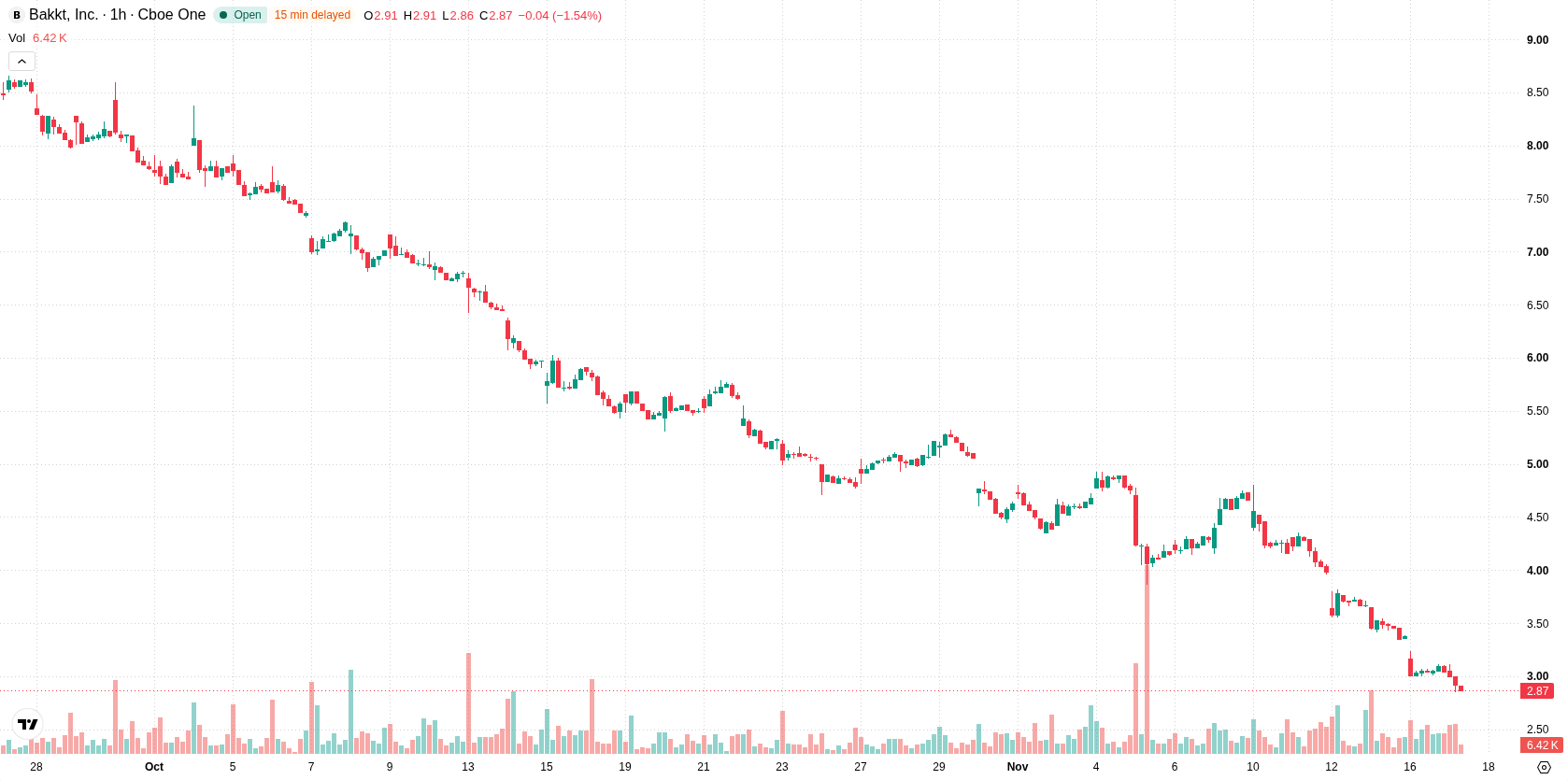
Bakkt Holdings, Inc. (BKKT) stock is trading at $2.88, down 5.57% for the day and near the session low. The price remains below its key short-, medium-, and long-term moving averages, reflecting ongoing bearish momentum amid heightened volatility.
 3.14
4.35
Highlights
- BKKT/USD trades below key short-, medium-, and long-term averages, establishing a strong bearish trend across timeframes.
- Sell signals from MACD and ADX, along with dominance from sellers, point to persistent downwards momentum.
- Price is down 5.57% at $2.88 with expected range at $2.3 to $3.46 over the next two to three days, with limited rebound likelihood.
Multiple resistance levels and oversold readings reinforce downside pressure
The H1 SMA-20 at $3.31, H1 SMA-50 at $3.89, and D1 SMA-200 at $8.21 serve as notable resistance levels above the current price. The Ichimoku Kijun is positioned at $3.53 as immediate resistance. MACD and ADX both display strong sell momentum, supported by a dominance of sellers as indicated by Bull/Bear Power, while the RSI and CCI have entered the oversold zone. The Awesome Oscillator and Stochastic RSI both indicate neutral sentiment, highlighting mixed short-term momentum signals.
Downside risk holds as narrow consolidation range curbs bullish potential
Over the coming two to three trading days, price action is expected to consolidate within a volatility band between $2.3 and $3.46. The likelihood of near-term upward movement remains low, with persistent downside risk dominating. In a bullish scenario, a break above immediate resistance at $3.53 could open the way for a stronger rebound, while a drop below support near $2.3 would point to a further extension of the recent decline.
Earlier, analysts noted that Bakkt faced ongoing downside risk due to sustained bearish signals and selling pressure. The latest price action reinforces this negative outlook, with traders advised to monitor the $2.3 support level closely as persistent volatility may drive further declines if this threshold is breached.









-
 Afghanistan
-
 Albania
-
 Algeria
-
 Angola
-
 Argentina
-
 Armenia
-
 Australia
-
 Austria
-
 Azerbaijan
-
 Bahamas
-
 Bahrain
-
 Bangladesh
-
 Belarus
-
 Belgium
-
 Bolivia
-
 Botswana
-
 Brazil
-
 Brunei
-
 Bulgaria
-
 Cambodia
-
 Cameroon
-
 Canada
-
 Chile
-
 China
-
 Colombia
-
 Congo
-
 Costa Rica
-
 Cote d'Ivoire
-
 Croatia
-
 Cuba
-
 Cyprus
-
 Czechia
-
 DR Congo
-
 Denmark
-
 Dominican Republic
-
 Ecuador
-
 Egypt
-
 El Salvador
-
 Estonia
-
 Eswatini
-
 Ethiopia
-
 Finland
-
 France
-
 Georgia
-
 Germany
-
 Ghana
-
 Greece
-
 Haiti
-
 Hong Kong
-
 Hungary
-
 India
-
 Indonesia
-
 Iran, Islamic republic
-
 Iraq
-
 Ireland
-
 Israel
-
 Italy
-
 Jamaica
-
 Japan
-
 Jordan
-
 Kazakhstan
-
 Kenya
-
 Korea
-
 Kuwait
-
 Kyrgyzstan
-
 Laos
-
 Latvia
-
 Lebanon
-
 Lesotho
-
 Libya
-
 Lithuania
-
 Luxembourg
-
 Madagascar
-
 Malaysia
-
 Malta
-
 Mauritius
-
 Mexico
-
 Moldova
-
 Mongolia
-
 Montenegro
-
 Morocco
-
 Mozambique
-
 Myanmar
-
 Namibia
-
 Nepal
-
 Netherlands
-
 New Zealand
-
 Nigeria
-
 North Macedonia
-
 Norway
-
 Oman
-
 Pakistan
-
 Palestine
-
 Panama
-
 Papua New Guinea
-
 Paraguay
-
 Peru
-
 Philippines
-
 Poland
-
 Portugal
-
 Puerto Rico
-
 Qatar
-
 Reunion
-
 Romania
-
 Rwanda
-
 Saudi Arabia
-
 Serbia
-
 Singapore
-
 Slovakia
-
 Slovenia
-
 Somalia
-
 South Africa
-
 Spain
-
 Sri Lanka
-
 Sweden
-
 Switzerland
-
 Syria
-
 Taiwan
-
 Tajikistan
-
 Tanzania
-
 Thailand
-
 Trinidad and Tobago
-
 Tunisia
-
 Turkey
-
 UAE
-
 Uganda
-
 Ukraine
-
 United Kingdom
-
United States
-
 Uruguay
-
 Uzbekistan
-
 Venezuela
-
 Vietnam
-
 Yemen
-
 Zambia
-
 Zimbabwe
- Forex
- Crypto












